Some Easy ways to keep you in shape |
|
Calories Burned in Daily Activity Per Hour
|
Some Easy ways to keep you in shape
Reply


Some Easy ways to keep you in shape |
|
Calories Burned in Daily Activity Per Hour
|
Copperhead snake |
|
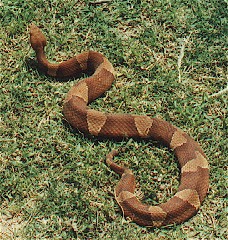
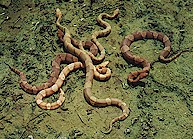
| It is characterized by the rich copper colour with wide alternating bands that extend completely around even the underside. They can be expected to be seen in gardens, flower beds, and around houses.
Venom is Haemotoxic Due to their usual small size, the copperhead’s bite is rarely fatal. Most adults of this type range in size from about 18 to 26 inches in length. It is a dangerous snake whose venom attacks the blood, but it is less aggressive, with shorter fangs and less potent venom. When approached, they will either move away quietly or lay motionless, relying on camouflage to protect them. Occasionally, they will vibrate their tails. Bites usually occur when people unknowingly step on or touch unseen snakes. It is found in hilly country from Massachusetts to northern Florida and westward to Illinois and Texas. Broad triangular head, vertically elliptical pupils and a heat sensitive pit between each eye and nostril. Mating takes place in spring and fall and females give birth to 4-8 young in August and September. Adult females usually give birth every two years. |
 |
 |
|
Moccasin |
|
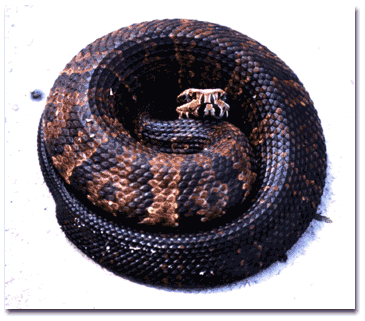
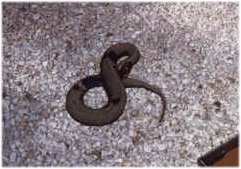
| Water moccasin or cottonmouth, common name for a poisonous aquatic snake, one of the pit vipers of the viper family. It is called cottonmouth because the lining of its mouth is white. It lives in swamps.
Venom – Vasculotoxic It is a slow-moving snake with hollow fangs that inject a toxin destructive to red blood cells. The bite, however, is rarely fatal, although it is painful and can cause local tissue damage. Brown or olive, with broad black bands across its body, the water moccasin averages 1.2 m (4 ft) in length. It feeds on fish and amphibians. |
 |
 |
|
Sea Snake |
|
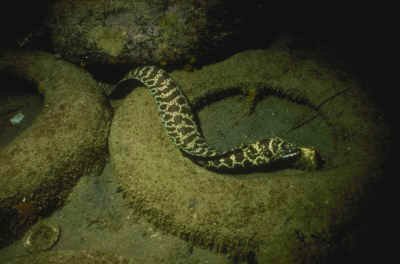
| SEA SNAKE, common name for members of a family of poisonous water snakes. Sea snakes inhabit tropical waters from the Persian Gulf to the southwest Pacific Ocean; they are particularly abundant in the Indian Ocean and the Bay of Bengal. Usually about 1.5 m (about 5 ft) long, some species may reach 2.7 m (9 ft). Sea snakes have no gills and must rise to the surface for air, but they can remain underwater for several hours, obtaining dissolved oxygen from water that they swallow and eject.They feed on fishes and seldom attack humans unless threatened. |
 |
What is good in Tomatoes ? |
|
|
Redness of the tomatoes is due to a pigment lycopene and the phytochemicals carotenoids. Lycopene is an antioxidant that has ability to fight cancer. During the ripening stage the chlorophyll of the green tomatoes is converted to limonene and thus the tomatoes are turned red.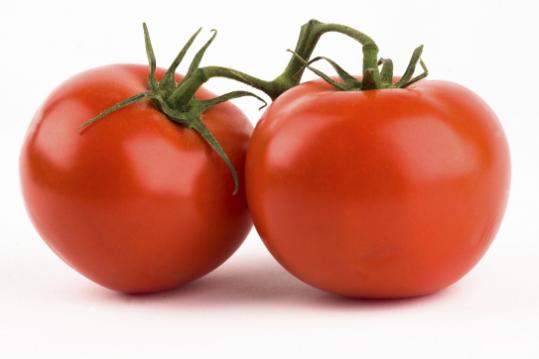 |
Many studies have suggested that people who eat a large amount of tomatoes have a reduced risk for a number of types of cancers. Tomatoes in many forms, including raw, ketchup, spaghetti sauce, tomato paste, soup and salsa have same benefit. Benefits were found from all those forms. Even cooking and processing tomatoes did not diminish the effect.
Tomatoes are rich in several phytochemicals believed to have anticancer properties. The most prominent of these phytochemicals is a compound that leads to the formation of carotenoids, chemicals that can protect cells from the effects of oxidants. Tomatoes are a particularly rich source of several carotenoids, including Lycopene.
|
 Manbir Online ~ for Health & Fitness