Unknown's avatar

About Manbir & Gurpreet

Gurpreet Kaur’s journey in this world .... Gurpreet Kaur was a Musician. She was a singer and a composer of music. Her interest was composing and singing Gurbani Shabads in Indian Classical style. She sang Shabads in All the Raags mentioned in Sri Guru Granth Sahib Ji. She also taught Gurmat Sangeet at Gurmat Gian Missionary College, Jawadi, Ludhiana. Elder child to Pushpinder Kaur and Dr. Brig. Harminder Singh, was born in Amritsar on 13th Jan 1962. She attended various convent schools as a child because her father would get frequent Army postings as a dental surgeon. She graduated with Music Honors from Govt. College for Women, Chandigarh. Music was her hobby and she composed and sang Raag based Gurbani Shabads. Doing Kirtan was part of growing up nurtured by her parents. She learned music from her father Dr. Brigadier Harminder Singh who was a dental surgeon in Indian Army and a very good singer himself. Gurpreet’s Bhua (father’s sister), Ajit Kaur retied as a Head of Department of Music from Govt. College for Women Ludhiana, and was a renounced Punjabi singer of her time. Gurpreet Kaur also learned nuances of Indian Classical Music from Pandita Sharma. She was a mother of three children, and a grandmother. Her daughter Keerat Kaur is a Computer Engineer. Her two sons Gurkeerat Singh and Jaskeerat Singh are doctors in USA. Her daughter Keerat Kaur too was part of her group ~ Gurmat Gian Group. Gurpreet Kaur left this world at the age of 54yrs on 12th Sept 2016 in Baltimore USA. She had recorded around 25 cds of Gurbani Keertan. 'Raag Ratan' Album (6 CDs) is a Compilation of Shabads in All the 31 Sudh Raags of Sri Guru Granth Sahib Ji. 'Gauri Sagar' Album (3 CDs) is a Compilation of All forms of Raag Gauri in Sri Guru Granth Sahib Ji. 'Nanak Ki Malhaar' ~ ((3 CDs) is an album of Raag Malhar Shabads in various forms of Malhar. 'Gur Parsaad Basant Bana' ~ (3 CDs) is an album of Shabads in Raag Basant sung in various forms of Raag Basant. Har Ki Vadeyai Sarni Aayea Sewa Priya Kee Preet Piyaree Mohan Ghar Aavho Karo Jodariya Mo Kao Taar Le Raama Taar Le Tere Kavan Kavan Gun Keh Keh Gawan Mera Baid Guru Govinda Saajanrraa Mera Saajanrraa

Coffee cuts breast cancer risk

Coffee cuts breast cancer risk

Ladies have new finding to note:
Drinking up to five cups of coffee a day may protect them from developing oestrogen receptor negative breast cancer which is one of the most aggressive forms of the disease.
Researchers at the Karolinska Institute in Sweden carried out the study in 6000 post menopausal women.
However, earlier studies had suggested that drinking coffee could increase the risk of breast cancer in women.

Breast Cancer ~ Some Facts

Genital Warts & HPV

Genital Warts & HPV

Genital warts are caused by Human Papilloma Virus (HPV). They were long considered inconvenient but benign conditions. Most genital warts are caused by HPV types 6 and 11, which are rarely if ever associated with invasive cancers. However, other strains of HPV (High Risk types) e.g., types 16, 18, 31, 33, 35, 39, 45, 52, 55, 56, and 58 are implicated in the development of moderate to severe squamous dysplasia and of overt cancer of the cervix, anus, vulva, vagina, and penis.

Human papillomaviruses (HPVs) selectively infect the epithelium of the skin and mucous membranes. These infections may be asymptomatic (without any problem), produce warts, or be associated with a variety of benign and malignant diseases.

The incubation period of HPV disease is usually 3 to 4 months, with a range of 1 month to 2 years.

  • There are many different types of genital HPV.
  • Only certain types of HPV are linked with cervical cancer. These are usually called “high-risk” types.
  • The types of HPV that cause raised external genital warts are not linked with cancer. These are called “low-risk” types.
  • These wart-types of HPV usually are not usually found on a female’s cervix, and therefore, are not going to carry any risk of cancer.
  • It is common for a person to be exposed and have more than one type of HPV, including several “high-risk” types. Yet, most women do not develop cervical cancer.
  • Cervical cancer usually takes years to develop.
  • Most of the time, men will not have any symptoms or health risks such as cancer with the “high-risk” types of HPV. It is the female’s cervix that needs to be monitored.

 Other types of warts

Common warts (verruca vulgaris) most prevalent among young children.

Plantar warts (verruca plantaris) are also widely prevalent; they occur most often among adolescents and young adults.

Condyloma acuminatum (which manifests as anogenital warts) is one of the most common sexually transmitted diseases.

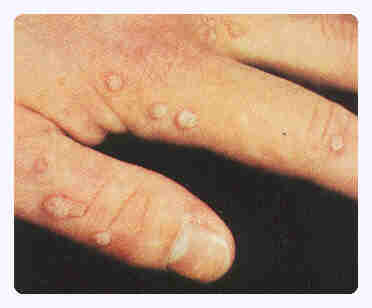
Common warts usually occur on the hands as flesh-colour  to brown, hyperkeratotic papules. Plantar warts may be quite painful. Flat warts ( verruca plana) are most common among children and occur on the face, neck, chest, and flexor surfaces of the forearms and legs.

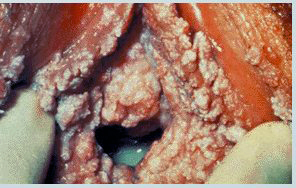
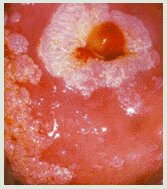
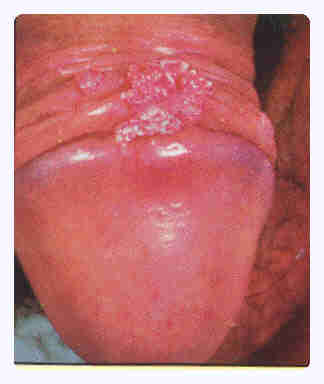
Anogenital warts develop on the skin and mucosal surfaces of the external genitalia and perianal areas. In men, warts are found most frequently at the frenum or coronal sulcus but may affect any part of the penis. They occur commonly at the urethral meatus and may extend proximally. Perianal warts are common among homosexual men but develop in heterosexual men as well. In women, warts appear first at the posterior introitus and adjacent labia. They then spread to other parts of the vulva and commonly involve the vagina and cervix. These lesions may be present without external warts.

The anogenital warts may be confused with many other types of diseases like condylomata lata of secondary syphilis, molluscum contagiosum and a variety of benign and malignant mucocutaneous cancers.

Infections involving the Respiratory system in young children may be life-threatening and presents as hoarseness, stridor, or respiratory distress. The disease in adults is usually mild.

The complications of warts include itching and occasionally bleeding. In rare cases warts become secondarily infected with bacteria or fungi. Large masses of warts may cause mechanical problems, such as obstruction of the birth canal. Dysplasias of the uterine cervix are generally asymptomatic until frank carcinoma develops.

Treatment

Currently available modes of treatment are not completely effective. Many lesions resolve spontaneously. Frequently used therapies include cryosurgery, application of caustic agents, electrodesiccation, surgical excision, and ablation with a laser. Topical antimetabolites such as 5-fluorouracil also have been used. Both failure and recurrence have been well documented with all of these methods of treatment. Cryosurgery is the initial treatment of choice for condyloma acuminatum. Topically applied podophyllum preparations as well as podofilox may also be used. Various interferon preparations have been employed with modest success in the treatment of respiratory papillomatosis and condyloma acuminatum.

Genital Warts

   Typical papilliferous warts (condyloma acuminata) affecting the vulva and vagina.
   Typical papilliferous warts (condyloma acuminata) affecting the cervix.
   Veneral Warts of Penis
   Common Warts

HPV And Oral Cancer

Genetically Modified Foods

Genetically Modified Foods

Genetic engineering is a process that involves transferring DNA from one organism into the DNA of another. By making changes in genetic information across species, scientists can give plants special characteristics such as that increases vitamin content and increased resistance to pests.
In US, the genetically engineered crops comprised 25 percent of the nation’s cropland, including 35 percent of all corn, 55 percent of all soybeans and 50 percent of all cotton. Many of these crops were exported.
Genetically engineered crops are being prefered by farmers as they create higher yields and lower production costs. They also decrease the need for pesticides.
Not everyone believes that this new technology is a good thing. Critics say weeds and pests could eventually adapt to the altered crops, requiring deadlier pesticides to eradicate them. Another worry is that native crop strains could be wiped out. Europe has not reacted as favorably to the use of the modified crops, requiring food labels to state whether a product contains genetically modified ingredients. United States does not require labeling of genetically modified foods.
Progress already has been made toward creating a strain of rice that has been genetically altered to contain vitamin A. Childhood blindness related to vitamin A deficiency, a serious global problem, could be dramatically reduced with the use of this new “golden rice”. Similarly high Iron containing rice variety has been created which could prove highly beneficial in combating Iron deficient Anaemia in developing countries.

Human Genome

Human Genome

On Monday 26 June 2000, after more than a decade of effort, a working draft of the human genome was presented to the humanity. This day would be remembered as the day when humankind learned about the set of genetic instructions which governs the assembly and fuction of human beings.

The scale of this triumph of biological science is awesome.

  • The 24 different human chromosomes may be too small for the eye to see, but each set contains 3.1 billion base pairs: a code written in 3.1 billion “letters”. This amount of data is equivalent to the contents of 200 telephone directories, each 500 pages long. It has been estimated that it would take over nine years to read aloud this data.
  • If all the DNA in the human body were put end to end, it would reach to the sun and back more than 600 times.
  • There are 20 different building blocks (amino acids ) used in an array of combinations to produce proteins as different as keratin in the hair and haemoglobin in the blood.
  • The vast majority of the DNA (97 % ) in human genome has no known function.
  • Between humans the DNA differs by only 0.2 %.
  • Human DNA is 98 % identical to chimpanzee.
  • Scientists estimate that there are 300,000 spots in the human genetic code where individual differences can exist.

Reading Human genome code took the combined efforts of thousands of researchers, and countless hours of work by hundreds of state-of-the-art robotic sequencing machines humming quietly around the clock in pristine laboratories. Each machine prepares DNA samples, runs them through electrophoresis gels, and reads off the results into a database, only requiring the help of a human once every 24 hours.

The public Human Genome Project took blood and sperm samples from a dozen anonymous donors and combined them. The project’s commercial rival, Celera Genomics, put an ad in The Washington Post, selected 30 men and women from a variety of ethnic backgrounds and used six of them.

Estimated number of genes:
Humans & mice – 60,000 to 100,000
Roundworm – 19,000
Yeast – 6,000

October 16, 2002
Researchers have come up with some new findings. That the genome has revealed  that the human chromosome carries only about 30,000 genes, twice the number of a fruit fly, 10,000 more than a roundworm, and only a few hundred more than a mouse. Originally scientists expected as many as 140,000, which means the question of how genes actually work is now an even bigger mystery. The genome also reveals that many human genes originate from microbes. This raises questions about human evolution.

In future:

  • Doctors may treat you for conditions such as cancer and heart disease even before they appear. There may be fundamental shift towards preventive medicine.
  • A routine check-up in future will perhaps involve giving a sample of blood from which your DNA will be extracted and screened to determine your risk of developing various diseases.
  • We already know the genes that cause many rare, single-gene disorders, but in future you could be screened for common diseases that appear in adulthood, such as type II diabetes, heart disease and cancer, and perhaps even complex mental disorders such as schizophrenia and depression. Because these diseases have many contributory factors, both genetic and environmental, the test results will give a percentage risk rather than a definite yes or no.
  • Doctors may also use gene screening to discover which drugs best suit you. Our genes determine whether different drugs will work well or cause side effects. For example, Alzheimer’s patients with a gene variant called ApoE 4 are much less likely to benefit from a drug called tacrine than other patients.
  • The insurance agencies making use of genetic information is a possibility.
A single gene may play a role in the development of cancer and a number of age-related diseases, including arthritis, hardening of the arteries and Alzheimer’s disease, according to new study findings.
Gene Therapy
Genetic disorders
Genome Sequencing helps diagnosing rare disorder

Gene Therapy

Gene Therapy

Gene therapy is a newer approach to treating diseases based on modifying a person’s genes toward a therapeutic goal. Gene therapy has been targeted towards treating lethal and disabling diseases. It also has potential of preventing diseases. This method of treatment is still in its infancy.
It can be said that the gene that we inherit from our parents influence practically every disease. A composite of approximately 150,000 individual genes constitutes a human being. Several years ago, an international effort was launched to identify every single human gene. This effort, called the Human Genome Project. Variation in the structure of a person’s genes collectively helps define us as individuals such as how tall we are to what color our eyes are supposed to have. Some of this genetic ‘miscalculations’ unfortunately leads to the development of disease. The genetics of many diseases are passed from one generation to the next by inheriting a single gene. An example is Huntingdon’s disease. Many other diseases and traits are influenced by a collection of genes.
The premise of gene therapy is to treat the disease at its root. There are two types of Gene Theapy. Somatic Gene Therapy and  Germline Gene Therapy.
Somatic gene therapy involves the manipulation of gene expression in cells that will be corrective to the patient but not inherited to the next generation.
Germline gene therapy, this involves the genetic modification of germ cells that will pass the change on to the next generation.
It is the Somatic Gene therapy that is being mainly investigated throughout the world. The work on Germline gene therapy is restricted due to technical and ethical reasons.
To deliver genetic material to the appropriate cells of the patient in a way that is specific, efficient and safe, gene delivery vehicles called vectors have been created. The vectors being used are modified and attenuated viruses. The virus is modified in such a way that its disease causing component is removed and in its place gene are inserted. Synthetic vectors are also being used formed of complexes of DNA, Protein and Lipids.
The first human trials of Gene therapy began in 1990. Many types of diseases are currently being investigated as candidates for gene therapy including cardiovascular diseases, cholesterol lowering therapy, infectious diseases such as AIDS, and cancer.
Gene therapy can be used not only in treating genetic diseases but also to deliver specific proteins. By placing genes in laboratory-cultured organisms that produce the proteins coded by those genes. Examples of such manufactured proteins include insulin, growth hormone, and erythropoietin, all of which must be injected frequently into the patient.
In hemophilia treatments, a gene-carrying vector could be injected into a muscle, prompting the muscle cells to produce Factor IX and thus prevent bleeding. This method would end the need for injections of Factor IX — a derivative of pooled blood products and a potential source of HIV and hepatitis infection. In gene therapies such as these, the introduced gene is always “on” so the protein is always being produced, possibly even in instances when it isn’t needed.

First human chromosome mapped

For the first time, scientists have mapped virtually an entire human chromosome, one of the chains of molecules that bear the genetic recipe for human life. The achievement was announced on Wednesday 1st Dec ’99. It was an important step for the $3 billion Human Genome Project, which is attempting to detail the tens of thousands of genes that carry instructions for everything in a human from brain function to hair color to foot size.
This is probably the most important scientific effort that mankind has ever mounted. That includes splitting the atom and going to the moon. In laying out the chemical instructions for life, scientists believe they are in the early stages of revolutionizing the study of human development and medicine. Already, researchers have begun testing several biological therapies that replace faulty genes or correct their misfirings to make cells work correctly. Such therapies, if they can be made reliable, would bring a more precise way to treat diseases without the sometimes debilitating side effects of conventional drugs.
The defects in the genes along the chromosome contribute to heart defects, immune system disorders, cancers, schizophrenia and mental retardation.

The human genetic pattern, or genome, is a biological map laying out the sequence of 3 billion pairs of chemicals that make up the DNA in each cell. All human DNA is contained within 23 pairs of chromosomes.

Genes are arrayed along chromosomes, the rod-shaped bodies inside the nucleus of a cell. Proteins and other compounds carry out the instructions of genes. Inside the chromosomes, genetic material is linked along tightly coiled strands of the master molecule DNA, which twists like a spiral ladder. Each rung is built with pairs of four chemical bases ordered in different numbers and combinations to form genes.

Mapping a gene is only an early step in understanding the gene’s function and how it might contribute to a particular disease.

Human Genome 
Genome Sequencing helps diagnosing rare disorder
Genome Editing