Hognose Snake Family Colubridae |
|
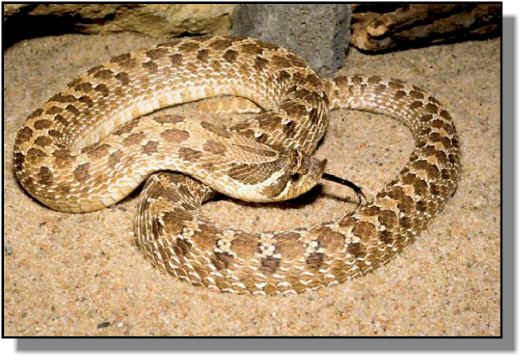
| It is a harmless snake found in North American. It is named for their upturned snouts used for digging. Also known as the puff adder, the hissing adder, and the spreading adder.There are two species commonly found – eastern hognose and western hognose. |
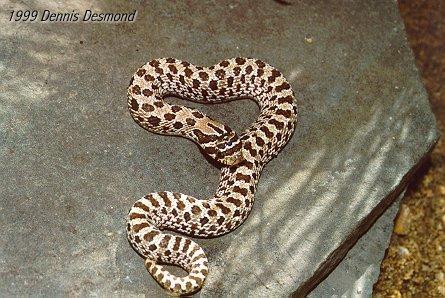
Western Hognose Snake |
| The hognose is widely feared because, when disturbed, it assumes a menacing position, flattens its head, expands its neck, opens its mouth, and hisses wildly. If these aggressive tactics fail to frighten the intruder, however, the snake falls to the ground and plays dead. Hognose snakes have short, thick, usually black bodies, occasionally with white circular markings down either side of their backs. Their size is on average 2 ft. in length. |
Hognose |
|
Hognose |
|
|
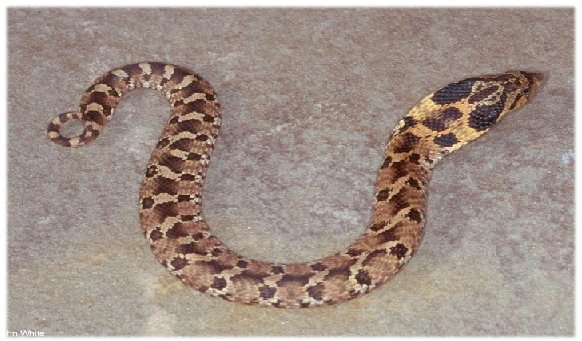
Eastern Hognose |
|
Author Archives: Manbir & Gurpreet
Addar Snakes
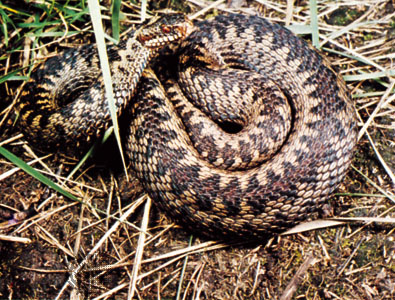
Addar Snakes Family ColubridaeAdder is a common name for a snake of the viper family. There are many types of snakes also reffered as adders. The range of this snake extends east to the Pacific Ocean and North to the Arctic Circle, the farthest north of any venomous snake. Its less than 2 ft. in length. Its color varies from gray, green, or brown to velvety black. A regular series of zigzag black marks may be seen on the back. |
|
| The common addar or common European viper, is a poisonous snake like all other vipers. Its bite is rarely fatal and this snake is less aggressive. It is the only poisonous snake found in Great Britain. |
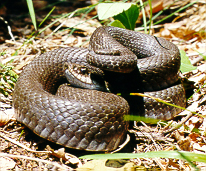
Common Adder or European viper |
| Puff addar – Is a large snake in Africa and belongs to the viper family. |
Puff Addar |
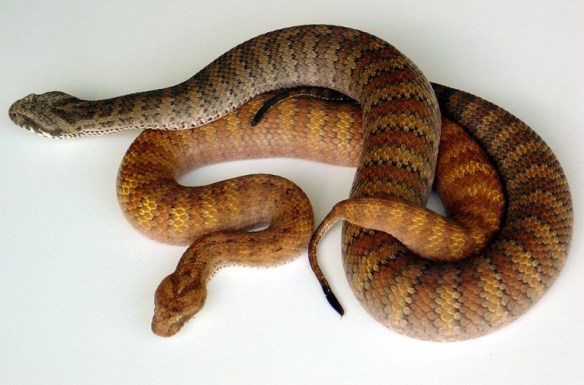
| Death adder – is actually a member of the cobra family. It is found in Australia, New Guinea, and nearby islands. It has the most dangerous bite of any snake of this region. Its long fangs inject a large dose of a powerful poison a neurotoxic poison. |
Northern Death Adder |
| Hognose snakes, also called puff adders, spreading adders, or hissing adders, rarely even bite; these snakes puff up and hiss wildly when disturbed. | Western Hognose Snake![]() |
Pancreas Cell Transplants
| New achievement in Pancreas Cell Transplants |
| In this procedure doctors injected an average of 350,000 islet cells directly into liver, a procedure that does not require major surgery. After this the liver started producing Insulin. This can have a far reaching effect on the treatment of the diabetics especially the Type I diabetes. Its too early for insulin injecting diabetics to be happy. The real problem is to find source for the islet cells of pancreas.Eight patients with severe diabetes were able to throw away their insulin for as long as 15 months – after a new cell-transplant procedure.
Islet cell transplants require whole pancreases, from which the insulin-producing cells are extracted. Each patient requires organs from at least two cadaver donors, meaning, a very small number of patients can benefit from this procedure. But researchers are hopeful they can find other sources of the precious cells, perhaps growing them from “stem” cells that are capable of forming various tissues. Because of the risks of side-effects posed by anti-rejection drugs, the researchers at University of Alberta in Edmonton did the procedure only in patients with Type I diabetes, that was so severe that patients’ blood sugar couldn’t be controlled even with regular insulin shots. One woman, a junior high school teacher, regularly fell into a diabetic coma. That woman and seven others “quickly attained insulin independence” after doctors injected an average of 350,000 islet cells directly into their livers, a procedure that does not require major surgery. To achieve good control of blood sugar, seven patients so far have required a second transplant, while an eighth has required a third. Once researchers solve the problem of where to get human islet cells in large quantities, the real benefit of this islets cells transplant can be given to the patients. |

Stem Cell
Stem Cell |
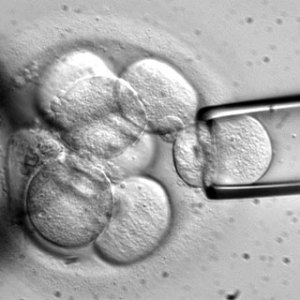
| Stem cells are unique in a sense they are capable of developing and can give rise to almost all of the cells types of the body, such as muscle, nerve, heart, blood. Thus they hold great promise for both research and health care.
While every cell has genetic information, the egg cell derived from a female after fertilization with a sperm is capable of developing into an entire human being. When the fertilized egg cell divides the first few cells are capable of growing into any part of the body.
There are 220 different cell types found in the body of human beings. It is the biochemical signals that decide whether the stem cells are destined to become heart, brain or kidney. These ‘specialized’ cells with This research was conducted on early-stage embryos donated voluntarily by couples undergoing fertility treatment in an in vitro fertilization (IVF) clinic or from non-living fetuses obtained from terminated first trimester pregnancies. |
Stem Cell – Future prospects
Scientists at Advanced Cell Technology in Worcester, Massachusetts, took a skin from Cow A, cloned it (by injecting the nucleus into a cow egg whose nucleus had been removed), then implanted the embryo in the uterus of Cow B. That embryo clone grew into a fetus, which, had it been born, would have been Cow C. But it was not born. The fetus was removed from the uterus and harvested for its tissues. These tissues from the clone were then put back into the original Cow A. It worked !!. These cells from the clone were not rejected by Cow A ! These cells organized themselves into functioning tissue such as kidney.
Its an amazing success. By this technology the advocates of cloning research are promising great possibilities for incurable diseases like Alzheimer’s disease, Parkinson’s disease, Spinal-cord injuries and innumerable conditions which stand incurable today. All this is causing a big concern among those who consider this as “Manipulating Humanity”. We do not know where all this would lead us to. That day may not be far when humans too would be treated the same way as the Cows and Dogs. |
| Stem Cells turned into Blood Cells
Scientists for the first time have been able to form blood cells from human embryonic stem cells. This advancement eventually may offer safe and inexhaustible source of blood for transfusion and also new treatment for many blood diseases. This was done by researchers at University of Wisconsin in Madison. They could manage to direct the immature cells to form every type of regular blood cells – red blood cells, white blood cells and platelets. Because embryonic cells can be expanded without apparent limit the cell derived blood products could be created in virtually unlimited amounts. There is growing excitement in the field of stem cells research. The stem cells have the potential of transforming into any kind of tissue in the body. This may eventually lead to new ways of treatment for host of diseases. In the case of blood cells they could be used to treat illnesses such as leukemia and anemia. The benefit of this research is not going to be available in a very near future, but certainly a big step has be taken towards something which we could not think about in recent past. Theoretically the new technology may eventually eliminate the shortage of blood transfusion. |
| Stem Cells as biological pacemakersJohns Hopkins University researchers have found the first evidence that genetically engineered heart cells derived from human embryonic stem cells might one day turn out to be a promising biological alternative to electronic pacemakers used by hundreds of thousands of people worldwide.
Human embryonic stem cells were genetically engineered by the researchers to make a green protein, grown in the lab and then encouraged to become heart cells. They then selected clusters of the cells that beat on their own accord, indicating the presence of pacemaking cells. These clusters when implanted into hearts of guinea pigs, triggered regular beating of the heart itself. These implanted cells also responded appropriately to drugs used to slow or speed the heart rate, which electronic pacemakers can’t do. But many challenges remain before this technique could be used for patients. |
Chronic Granulomatous Disease Pancreas Cell Transplants Teeth created from Stem Cells
Chronic Granulomatous Disease
Chronic Granulomatous Disease |
| Chronic Granulomatous Disease is a rare disease. It is estimated to occur once in 250,000 individuals. Most often CGD is inherited as an X-linked recessive pattern, although in about 40 percent of patients the disease is inherited with an autosomal recessive pattern.
Patients with CGD characteristically have increased infection. When patients with CGD become infected, they often have extensive inflammatory reactions despite the administration of appropriate antibiotics. Aphthous ulcers and chronic inflammation of the nares are usually present. Granulomas are frequent and can obstruct the gastrointestinal or genitourinary tracts. |
| Blood in the placenta contains bone marrow stem cells. This fact was made use by the doctors to treat a rare disease known as Chronic Granulomatous Disease in a child. Dr. Andrew Cant, director of the children’s bone marrow transplant unit claim it is the first time the treatment has been used.July 04, 2002A 3-year-old north Wales boy, Tom Stretch with a life-threatening condition has been cured after a pioneering treatment involving his mother’s placenta. This child was suffering from CGD and needed a bone marrow transplant to combat a blood defect which had left him unable to fight off germs. The boy had a series of serious pneumonias and an inflamed bowel.
He needed bone marrow transplant and there was no immediately suitable bone marrow donor. After his mother Joanne gave birth to his sister Hannah at Ysbyty Glan Clwyd in north Wales in November last year doctors preserved the placenta. The blood was kept in a bank at Newcastle General Hospital’s specialist children’s bone marrow transplant unit. Doctors decided to try an infusion of the placenta blood containing the stem cells as an alternative to bone marrow transplant. The treatment to infuse the cord blood into the vein took place 16 weeks ago and experts claim that Tom’s condition has now been cured and he is free of infection and his bowel inflammation is settling rapidly. Its first time anywhere in the world that this technique has been used to treat CGD. |


age and further multiplication loose this ability. Thus if captured at an early stage they can be manipulated in various ways to grow and form different types of tissues. A medical revolution can be created by manipulating the genes at