1
Rat Snake |
|
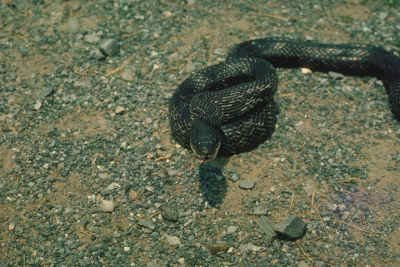
Harmless snakes, that feed chiefly on small mammals and birds. Also called Chicken Snake |
 |

1
Rat Snake |
|
Harmless snakes, that feed chiefly on small mammals and birds. Also called Chicken Snake |
|
CORAL Snake |
|
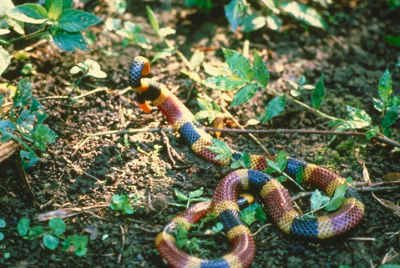
| Venom – NeurotoxicBrightly colored venomous snakes of the cobra family. Coral snakes do not strike, but when touched they bite repeatedly, injecting a deadly poison that acts on the nervous system.The snakes are marked with a pattern of brightly colored rings or bands that are black, yellow, and red.
About 40 species of coral snakes are known, most of them native to Central and South America. |
 |
| Iodine Deficiency |
|
IODINE is an essential micronutrient for humans. Even animals and plants need it. Iodine deficiency constitutes the world’s major cause of preventable mental retardation ranging from mild intellectual blunting to overt cretinism.Thyroid gland produces two hormones – thyroxine (T4) and tri-iodo-thyronine (T3). Iodine is used for the production of these hormones. Iodine also helps in the growth of new cells in the foetal life.Effects of iodine deficiency:
When the availability of iodine is low, the thyroid gland grows bigger and bigger. Iodine deficiency is the major cause of endemic goitre. While iodine deficiency early in pregnancy accounts for neurological cretin that occurring later in foetal life and continuing through out infancy leads to a profound decrease in thyroid functions, resulting in Unlike other nutrients such as iron, calcium, zinc or the vitaniins, iodine does not occur in sufficient concentration in natural foods. Small quantities of iodine are present in vegetables and drinking water. Deforestation and soil erosion increase the loss of iodine from the soil. Desalinated sea water and seafoods (prawns, fish crabs, snails, etc.) have higher quantities of iodine. Dietary iodine supplementation has, therefore, become essential. Potassium iodate is used for the iodinsation of refined salt. The level of iodisation at the production level is 30 mg per kg salt, aiming at providing an individual 30O ug of iodine in 10g of salt consumed. Iodine being a volatile substance is rapidly lost from the iodised salt when it is kept open, near a fire place and or is added while cooking. A fresh packet of iodised salt should be obtained every month, stored away from the fireplace and added to food items after cooking. The fear of harmful effects of iodine is totally unjustified. The use of iodised salt by people with iodine-sufficient status produces no hann. Iodised salt should be avoided by patients with thyrotoxicosis. |
|
 |
|
 |
 |
 |
 |
| Hydrogen Cyanide |
HYDROGEN CYANIDE, also called hydrocyanic acid and prussic acid, extremely poisonous, colorless liquid with a bitter-almond odor. The compound’s chemical formula is HCN. HCN melts at –14° C (6.8° F) and boils at 25.7° C (78.2° F).
It is reported that this substance was used by Iraq in the war against Iran and against the Kurds in the northern Iraq in the 1980s.A few milligrams of the substance and of related cyanides can be rapidly fatal to humans, acting by blocking the ability of cells to use oxygen. The compound mixes with water, alcohol, and ether in all proportions. When impurities are present, HCN molecules can combine to form a black solid; the reaction may be explosive unless inhibited. HCN is flammable and can form explosive mixtures with air. It was once produced from the pigment Prussian blue, hence its secondary name. Now it is prepared commercially by the reaction of methane with ammonia in the presence of a platinum catalyst. One major use of HCN is in the production of acrylonitrile, a starting compound for various products. HCN has many other industrial uses, including the making of plastics and several important cyanide compounds. The latter include sodium cyanide (NaCN) and potassium cyanide (KCN), both of them important in metallurgy. They are used in recovering gold and silver from ores, for example, and NaCN is used in the hardening of steel. Several cyanide compounds are employed in the electroplating of metals such as silver, gold, copper, and platinum. |
Cyanide Poisoning
Chemical Weapons
| Viper Snake |
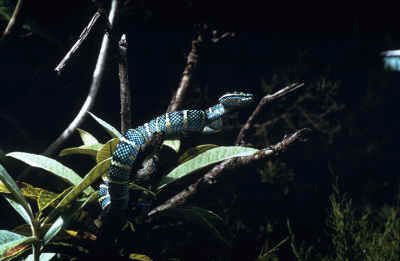 |
VIPER: Characterized by a pair of long, hollow fangs, usually with reserve fangs beside them, in the front of the upper jaw. The fangs fold back against the palate when not in use and quickly swing forward to strike, injecting a deadly venom that attacks blood and tissues. The viper’s broad, triangular head is generally covered with scales, and the eye has a vertical pupil. They are distributed worldwide, with most found in Africa. Pit vipers : have deep pits containing heat receptors on each side of the head between the eye and the nostril that enable the snakes to detect warm-blooded prey in the dark.There are more than 120 species. Important ones are rattlesnake, moccasin, copperhead, fer-de-lance, and bushmaster. Most inhabit the western hemisphere; a few are native to Asia. |
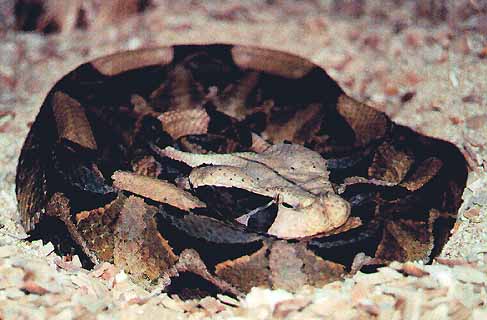 |
East African Gaboon Viper: Natural habitat of the Gibbon Viper is spread along the equatorial belt of Africa. Because of their colour patern they are difficult to spot. They give a sluggish appearance but are capable of attaching their prey with speed and swiftness which one may not expect from their placid nature. |
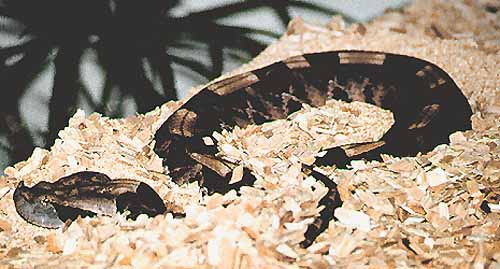 |
West African Gaboon Viper |
| Snake Bite |

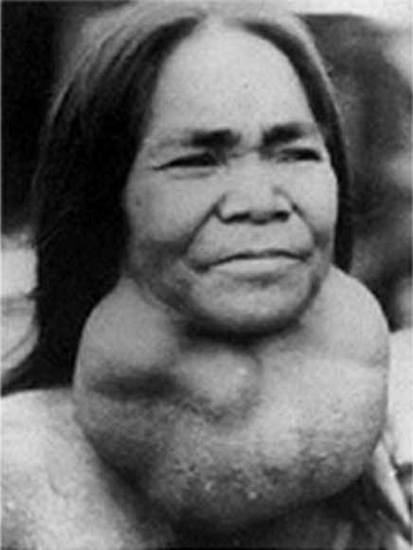
 a myxodematous cretin.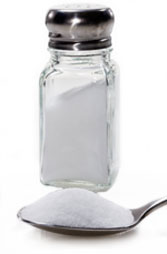
 Manbir Online ~ for Health & Fitness