Short Stature ~ Cause

Causes of Short Stature
Short Stature is a comparative evaluation of an individual’s height with his genetic background and in relation to that of a large population of a similar genetic background. Growth Failure and Short Stature may not be the same thing. Often these two are confused as the same thing. Short stature is often a normal variant. On the other hand Short Stature may be a sign of a wide variety of pathologic conditions or inherited disorders.
Majority of patients with Short Stature come under following groups:

  • Constitutional Growth Delay – 98 %
  • Growth Hormone deficiency – 0.1 %
  • Hypothyroidism – 0.2 %
  • Systemic diseases – 0.3 %
  • Chromosomal disorders – 0.1 %
  • Bone Cartilage Dysplasia – 0.3 %
  • Psycho social disorders – 1 %
Important Causes of Short Stature

  • Isolated GH deficiency
  • Panhypopituitarism
  • Primary hypothyroidism
  • Cushing’s syndrome
  • Achondroplasia- short limbs for spine
  • Mucopolysaccharidoses- short limbs and very short spine.
  • Turner’s syndrome
  • Malabsorption syndromes- Crohn’s disease,Coeliac disease, Colitis
  • Congenital heart diseases, Intrauterine growth retardation,Systemic illnesses like asthma, renal disease, malnutrition, psychosocial deprivation, Constitutional short stature with normal bone age.
Clinically, syndromes of Short Stature present with specific physical findings which may aid in diagnosing the illness, like –Growth Hormone deficiency – Frontal bossing, Central Obesity, High pitched voice.
Hypothyroidism – Dry skin, coarse hairs, immature facies
Cushing syndrome – Striae, central obesity, hypertension
Gonadal dysgenesis – Delayed sexual development, webbed neck, multiple pigmented navi, shield chest
Pseudohypoparathyroidism – Mental retardation, moon facies, obesity, short metacarpals.
Bone Cartilage dysplasia – Abnormal proportions, macrocephaly
Russell Silver Dwarfism – Small at birth, pointed facies, asymmetry
To reach the final diagnosis regarding the cause of the short stature in an individual detailed history and clinical examination is important followed by some screening tests which may pin point the actual cause of short stature.

Some of these test are –
Serum thyroxine – hypothyroidism
Serum GH levels – Growth hormone deficiency
Serum calcium – Pheusohypoparathyroidism
Serum phosphate – Vitamine D resistant Rickets
Serum bicabonate – Renal tubular acidosis
Blood urea nitrogen – Renal failure
Complete Blood count – Anaemia, nutritional disorders, inflammatory diseases
Bone age – Hypothyroidism, GH deficiency, Constitutional delay
Chromosomal karyotype – Gonadal dysgenesis and other abnormalities


Sun Burns

Sun Burns
When our skin is exposed to the ultraviolet (UV) rays of the sun, it produces a substance called melanin, which protects the skin and gives it color. UV rays stimulate production of melanin. So, the more skin is exposed to these rays, the more tanned it becomes. When our body can’t produce enough melanin to counter-act the UV rays absorbed by the skin, a sunburn results.
Fair-skinned people with light-colored hair are at greatest risk of sunburn because their bodies produce lower amounts of melanin.  Environmental and genetic factors also play roles. People with fair skin, eyes and hair, the blue-eyed blondes and redheads — are particularly prone to burn easily. Because of their genetics, they are more susceptible to skin cancer than people with more natural pigment.
Sunburn destroys cells on the skin’s outer layer. In most cases, these burns are minor, causing red, tender, sometimes blistered skin that sheds after several days. Regular overexposure to the sun can age your skin prematurely, causing sagging, wrinkling, wart-like growths, and a leathery appearance. It also can lead to skin cancer.
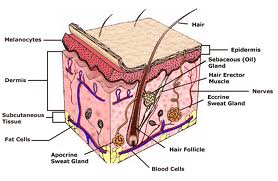
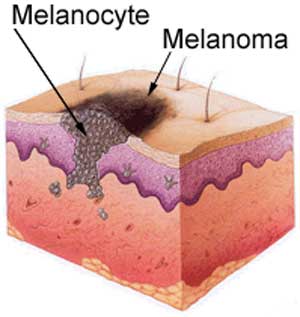
The appearance of the skin is partly due to the reddish pigment in the blood of the superficial vessels. However, it is mainly determined by melanin, a pigment manufactured by dendritic cells called melanocytes, found among the basal cells of the epidermis. Their numbers in any one region of the body, range from about 1,000- 2,000 per square millimetre. It is roughly the same within and between races. The blondest whites have as many as the darkest blacks. Colour differences are due solely to the amount of melanin produced and the nature of the pigment granules. When the skin becomes tanned on exposure to sunlight, the melanocytes do not increase in number, only in activity. Not only do melanocytes produce a tan, they are also responsible for the form of cancer called melanoma. Melanoma is caused by UV radiation damage to melanocytes.
Treatment

  • Acetaminophen and ibuprofen can help relieve sunburn pain. Its better to avoid aspirin.
  • Anesthetic Creams and Sprays containing  benzocaine or lidocaine can be used. It gives cooling affect and also relieves pain.
  • Antibacterial and antimicrobial soaps and antiseptics to prevent infection can be used.
  • Moisturizers help to prevent the skin from drying out and tightening. Oil-based products and ointments should be avoided.

Prevention

Sunscreens protect your skin from harmful UV rays. Sunscreens are rated for their protection ability. SPF – sun protection factor. The higher the number, the greater the protection. One should choose the SPF number based on ones skin type and the length of time expect to be in the sun. Broad-spectrum sunscreens with a protection factor of 15 or higher should be preferred.

Individuals can help prevent skin cancer by using sunscreens, limiting exposure, and wearing hats and protective clothing. Most of the lifelong skin damage caused by the sun is done before age 18.

Apply sunscreen liberally and frequently. Re-apply sunscreen after swimming and after profuse sweating.

It should be remembered that radiation is at the greatest intensity between 10 a.m. and 4 p.m.

Skin Burns & Cancer:  Skin cancer is the most common form of cancer. There are three major types of skin cancer: basal cell, squamous cell carcinoma and melanoma. The vast majority of skin cancers are basal and squamous cell.
A lesion that won’t heal, bleeds easily and is traumatized easily could be cancer.Long-term sun exposure not only increases the risk of skin cancer but also leads to  wrinkles and sun spots.Environmental and genetic factors also play roles. People with fair skin, eyes and hair — the blue-eyed blondes and redheads — are particularly prone to burn easily. Because of their genetics, they are more susceptible to skin cancer than people with more natural pigment.
Melanoma 
Skin Diseases

Ricin

Ricin
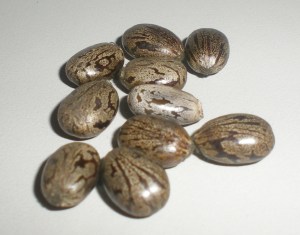
Ricin is one of the most toxic naturally occurring substances.It is derived from seeds of the castor bean plants. These seeds are also used to make castor oil. Accidental exposure to ricin is highly unlikely, except through the ingestion of castor beans.Castor beans are processed throughout the world to make castor oil. Ricin is part of the waste “mash” produced when castor oil is made.It can be in the form of a powder, a mist, or a pellet, or it can be dissolved in water. It is a stable substance under normal conditions, but can be inactivated by heat above 80 degrees Centigrade.
Symptoms of ricin poisoning by inhalation may occur within 8 hours of exposure. It would cause pulmonary edema and respiratory distress.If someone swallows a significant amount of ricin, he or she would develop vomiting and diarrhea that may become bloody.Ricin is unlikely to be absorbed through normal skin. Contact with ricin powders or products may cause redness and pain of the skin and the eyes.
In 1978, Bulgaruian dissident Georgi Markow  was killed in London using this poison. The poison was injected into him from the tip of an umbrella as Markow was waiting for a bus.

In the 1940s the U.S. military experimented with using ricin as a possible warfare agent. In some reports ricin has possibly been used as a warfare agent in the 1980s in Iraq and more recently by terrorist organizations.


Pemphigus Vulgaris

Pemphigus Vulgaris
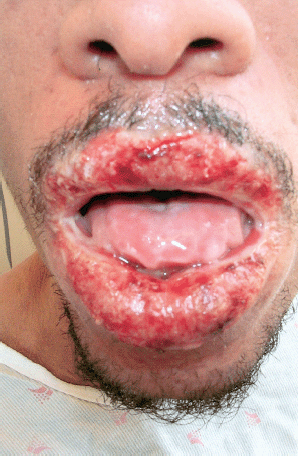
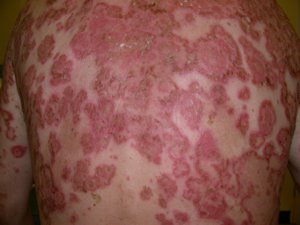
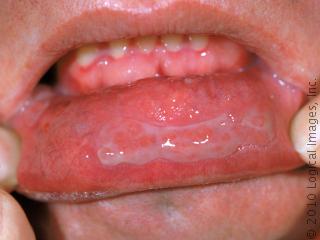
Pemphigus is a group of rare autoimmune blistering disorders of the skin in which blisters and sores occur in skin and mucous membrane. It is a disease of immune system. The immune system produces antibodies which normally attack hostile viruses and bacteria in the blood in an effort to keep us healthy. In an affected individual however, the antibodies erroneously perceive the skin and/or mucous membrane tissue as foreign and attacks them. This produces burn-like lesions that will not heal. In some cases, these sores can cover a significant area of the skin. The disease can give a horrifying image and if not managed properly may lead to death. There is no cure for this disease. Steroids are only hope and give dramatic relief.
There are three main categories of Pemphigus.Paraneoplastic Pemphigus, Pemphigus vulgaris and Pemphigus foliaceusPemphigus vulgarisIt is most frequently diagnosed form of pemphigus. Sores and blisters almost always start in the mouth. Large bullae occur on skin. Those in the oral cavity soon rupture leaving a ragged slough over a shallow ulcer. It has a high rate of mortality.

There is a research which shows that there is a genetic predisposition to Pemphigus Vulgaris, based primarily on the observation that this disease appears to occur more frequently than normal in Askenazi Jews.

Microscopic Features: Characteristic features under microscope are “Intraepithelial clefting” and “tombstoning”.


 Pemphigus Vulgaris
Pemphigus foliaceusWith pemphigus foliaceus, blisters and sores do not occur in the mouth. Crusted sores or fragile blisters usually first appear on the face and scalp and later involve the chest and back.The blisters are superficial and often itchy, but are not usually as painful as in pemphigus vulgaris. In PF disfiguring skin lesions can occur but the mortality rate from the disease is much lower than in PV  Pemphigus Vulgaris
Paraneoplastic pemphigusThis is the most serious form of pemphigus, which occurs most often in someone who has already been diagnosed with a Cancer.

 Paraneoplastic Pemphigus

 Treatment

Prednisone is the most important medication for these patients and those not put on steroids may rapidly deteriorate and die. Dose of prednisone has to be according to the need of individual patient. Other drugs used include Azathioprine, CyclophosphamideMethotrexate, Dapsone, GoldTetracyclineMinocycline.

Diet high in protein, low in carbohydrates, low in salt, low in fat is beneficial. In extensive lesions fluid loss may have to be managed. Mouth lesions may hamper nutrition of the patient which also has to be taken care of. Blood calcium and potassium levels may be disturbed. Fungal infections have also to be managed in such patients.

 Skin Diseases

History of Plague

History of Plague
Plague’s deadly epidemic potential is notorious and well documented. The Justinian pandemic (542 to 767 A.D.) spread from central Africa to the Mediterranean littoral and thence to Asia Minor, causing an estimated 40 million deaths. The second pandemic began in central Asia, was carried to Sicily by ship from Constantinople in 1347, and swept through Europe and the British Isles in successive waves over the next four centuries. At its height, it killed as many as a quarter of the affected population and became known as the Black Death.In the third (modern) pandemic, plague appeared in Yunnan, China, in the latter half of the nineteenth century; established itself in Hong Kong in 1894; and spread by ship to Bombay in 1896 and subsequently to major port cities throughout the world, including San Francisco and several other West Coast and Gulf Coast ports in the United States. The plague bacillus was first cultured by Alexandre Yersin in Hong Kong in 1894. In 1898, Paul-Louis Simond, a French scientist sent to investigate epidemic bubonic plague in Bombay, identified the bacillus in the tissues of dead rats and proposed transmission by rat fleas. Waldemar Haffkine, also in Bombay at that time, developed a crude vaccine.

By 1910, plague had circled the globe and established itself in rodent populations on all inhabited continents other than Australia. After 1920, however, the spread of plague was largely halted by international regulations that mandated control of rats in harbours and inspection and rat-proofing of ships. Before the third pandemic subsided, it resulted in an estimated 26 million plague cases and more than 12 million deaths, the vast majority in India. By 1950, plague outbreaks around the world had become isolated, sporadic, and manageable with modern techniques of surveillance, flea and rat control, and antimicrobial treatment of patients. From 1969 through 1993, a median of 1356 human plague cases were reported annually to the World Health Organization, with around 10 to 15 countries reporting cases each year. Plague has practically disappeared from cities and now occurs mostly in rural and semirural areas, where it is maintained in wild rodents. In the United States, the last outbreak of urban plague occurred in Los Angeles in 1924 and 1925, and human cases since then have resulted from zoonotic exposures in rural areas of western states.

Plague, because of its pandemic history, remains one of three quarantinable diseases subject to international health regulations (the other two being cholera and yellow fever). The alarm that plague is still able to evoke was highlighted by the public panic over and exaggerated international response to reports of outbreaks of bubonic and pneumonic plague in India in 1994.

Except for large outbreaks of pneumonic plague in Manchuria in the early part of the twentieth century, person-to-person respiratory transmission of plague during and since the third pandemic has occurred only sporadically and has been limited to clusters of close contacts of pneumonic plague patients, such as household members and caregivers. The 1994 outbreak of pneumonic plague in the city of Surat, India, although reported to be extensive, most likely involved fewer than 100 cases and 50 deaths.

From 1979 through 1993, 16,312 human plague cases and 1668 deaths (mortality, 10 percent) were reported by 20 countries to the World Health Organization. In the same 15-year period, the United States reported 227 plague cases (mean, 15 cases per year) and 32 deaths (mortality, 14 percent).

 Plague