Back Pain
Back pain is one of the most common health problems.Back pain can occur at any age in both men and women. However, it may occur slightly more often in women beginning at middle age, probably due to osteoporosis.
Everyone’s back pain is different. For some people, back pain involves mild pain (pain that is bothersome, aching, sore). For other people, back pain involves severe pain (pain that hurts all the time, even when resting).


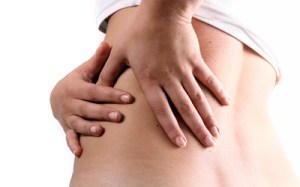
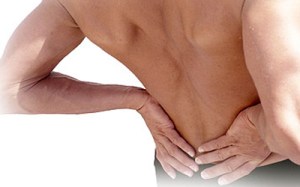
Causes of Back Pain
Ruptured Intervertebral Disc
This may be the most painful condition. A ruptured or herniated disc is one that bulges into the spinal canal, pressing on the nerve roots. This causes the nerve roots to become irritated. A ruptured disc may cause back pain and muscle spasms. More commonly it presents as sciatic pain. This is severe pain spreading down one leg and often into the foot.
Spinal Stenosis
In spinal stenosis, the spinal canal becomes narrowed. This squeezes the back nerves and puts pressure on them. It is this pressure that causes the back pain. Numbness, pain and weakness in the legs also can occur. The most common symptom of spinal stenosis is pain that worsens when walking and subsides when sitting down.
Osteoarthritis
Osteoarthritis can cause back pain. It breaks down the cartilage (soft, elastic material) that cushions the spinal joints. Lower back pain can become more intense when osteoarthritis affects the hips or the knees. Osteoarthritis also can directly affect the spine, causing muscles, tendons, or ligaments to become strained, which can lead to back and/or neck pain.
Ankylosing Spondylitis
This form of arthritis causes the joints in the spine to become stiff and swollen. In time, stiff joints can fuse. The most common symptoms are pain and stiffness in the buttocks and lower back (particularly in the morning).
Injury or Accident
Many back injuries are caused by an unexpected twist or sudden motion. This usually results in muscle strain. With either an injury or accident, severe muscle spasms usually last 48 to 72 hours. They generally are followed by days or weeks of less-severe pain. It usually takes two to four weeks to heal completely from a mild back injury. It could take from six to 12 weeks if there are strained ligaments or if the strain is more severe.
Osteoporosis
This is a type of bone disorder that causes bones to become thin and weak due to calcium loss. Fragile bones, especially those bones in the spinal column, can break more easily, and there is an increased tendency for this to happen in older women. Osteoporosis also contributes to compression fractures, or spinal fractures in which the vertebrae become flattened. Falls, lifting heavy objects or moving the wrong way can result in a compression fracture.
Polymyalgia Rheumatica (PMR)
This rheumatic disorder causes muscle pain, aching and stiffness in the neck and shoulders, lower back, thighs and hips. It can last a few months or many years. Most people experience severe stiffness in the morning.
Fibromyalgia
People with fibromyalgia feel pain and stiffness in muscles and tendons, especially in the neck and upper back. The pain can last for weeks, months or years. The symptoms may disappear by themselves. This condition often is related to sleep problems, poor conditioning or an old injury.
Paget’s Disease
This is a type of disorder in which the calcium in the bone spreads unevenly. The bones most commonly affected are in the lower back, pelvis, tailbone, skull and long bones of the legs. Back pain may be a symptom, but most often there are no obvious symptoms. Paget’s disease usually is discovered on an X-ray or bone scan done for reasons other than pain.
Other conditions causing Back Pain
Prostate trouble in men; problems with reproductive organs in women; kidney diseases, such as an infection or kidney stone; diseases of the intestines or pancreas, cancer that has spread to the spine; multiple myeloma, a form of cancer of the bone and bone marrow; curvature of the spine; or rarely, a tumor on the spinal cord.
Factors That Can Make Back Pain Worse
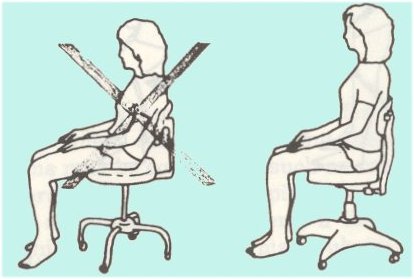
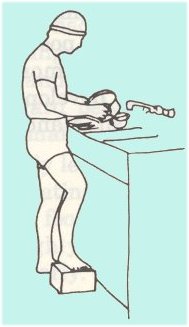
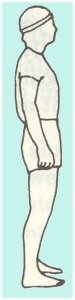
Stress, poor posture, lack of exercise and being overweight all can contribute to the problem. Extra pounds people carry every day due to their being overweight puts added pressure and strain on the back and stomach muscles, causing those muscles to stretch and weaken. Weak back and stomach muscles cannot support the back properly. Poor posture can shift your body out of balance. This forces only a few muscles and joints to do all the work. Without proper exercise, muscles become weak and tire easily. Exercise is necessary to keep the back strong.
Special Tests that may be needed to diagnose the cause of back pain.
X-ray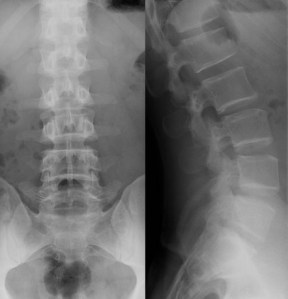
CT Scan
Only a few people with lower back pain need a CT (computerized axial tomography) scan. A special machine takes an X-ray scan of the area. A computer turns this scan into a three-dimensional view of the back. This helps the doctor see if there is a ruptured disc that can’t be seen on regular X-rays. Other conditions that a CT scan can help detect are spinal stenosis,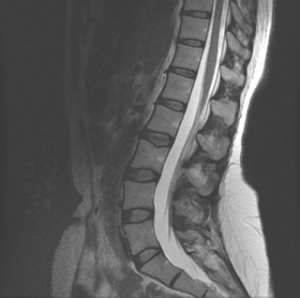 tumors and infections of the spinal cord.
MRI
MRI (magnetic resonance imaging) is another way to make very clear pictures of parts of the spine. The MRI does not use X-rays or radioactive dyes. It can provide clearer pictures of soft tissues such as muscles, cartilage, ligaments, tendons and blood vessels, in addition to bone structure.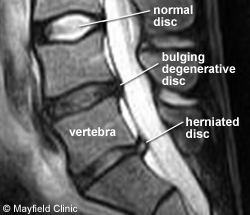
Myleogram
During a myelogram, a special liquid dye called contrast medium is injected into the spinal canal. X-rays are then taken of the area. The contrast medium can make problem areas show up more clearly on the X-ray such as spinal stenosis or spinal cord tumors.
Bone Scan
During a bone scan, a very small amount of radioactive liquid is injected into a vein and concentrates in the bones for a short time. A special radioactive detecting machine then will scan the area of concern to produce a picture. Occasionally bone scans are done to look for damage or tumors in the bones themselves.
Electrodiagnostic studies are used to help confirm the presence of nerve compression in the spine. An electrodiagnostic study consists of two tests. One is an electrical test, which is designed to study nerve conduction. In this test the nerve is given an electrical stimulation, and the speed of the impulse is measured. The other test is a needle test called an electromyogram, or EMG. The purpose of this test is to study the muscles for primary disease or for the effect of nerve compression on the muscle. The compression is especially seen in herniated discs or spinal stenosis.
Tips for Back care
Managing Back Pain
Exercise
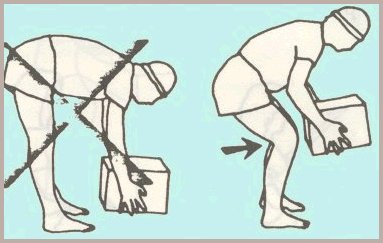
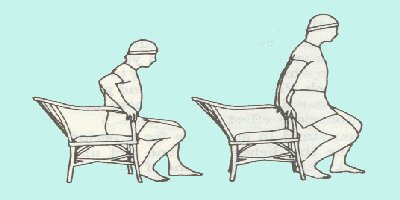
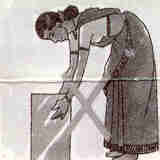
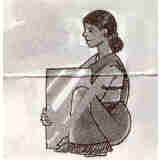
Handling Everyday Tasks


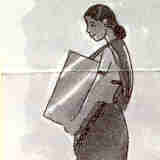
 Weight training conditions muscles and possibly prevents back trouble or the falls that plague so many older people.
 Moderate activity like walking around the block or cleaning the house can lower blood pressure.
 Jogging, swimming, tennis, and other more vigorous activities make the heart and lungs work more efficiently.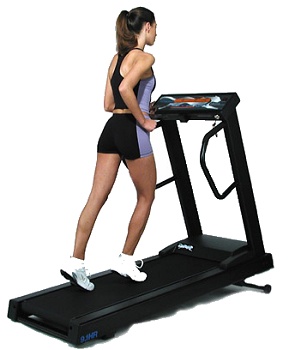
 Manbir Online ~ for Health & Fitness