Gurpreet Kaur’s journey in this world ....
Gurpreet Kaur was a Musician. She was a singer and a composer of music. Her interest was composing and singing Gurbani Shabads in Indian Classical style. She sang Shabads in All the Raags mentioned in Sri Guru Granth Sahib Ji. She also taught Gurmat Sangeet at Gurmat Gian Missionary College, Jawadi, Ludhiana.
Elder child to Pushpinder Kaur and Dr. Brig. Harminder Singh, was born in Amritsar on 13th Jan 1962. She attended various convent schools as a child because her father would get frequent Army postings as a dental surgeon. She graduated with Music Honors from Govt. College for Women, Chandigarh.
Music was her hobby and she composed and sang Raag based Gurbani Shabads. Doing Kirtan was part of growing up nurtured by her parents. She learned music from her father Dr. Brigadier Harminder Singh who was a dental surgeon in Indian Army and a very good singer himself. Gurpreet’s Bhua (father’s sister), Ajit Kaur retied as a Head of Department of Music from Govt. College for Women Ludhiana, and was a renounced Punjabi singer of her time. Gurpreet Kaur also learned nuances of Indian Classical Music from Pandita Sharma.
She was a mother of three children, and a grandmother. Her daughter Keerat Kaur is a Computer Engineer. Her two sons Gurkeerat Singh and Jaskeerat Singh are doctors in USA. Her daughter Keerat Kaur too was part of her group ~ Gurmat Gian Group.
Gurpreet Kaur left this world at the age of 54yrs on 12th Sept 2016 in Baltimore USA.
She had recorded around 25 cds of Gurbani Keertan.
'Raag Ratan' Album (6 CDs) is a Compilation of Shabads in All the 31 Sudh Raags of Sri Guru Granth Sahib Ji.
'Gauri Sagar' Album (3 CDs) is a Compilation of All forms of Raag Gauri in Sri Guru Granth Sahib Ji.
'Nanak Ki Malhaar' ~ ((3 CDs) is an album of Raag Malhar Shabads in various forms of Malhar.
'Gur Parsaad Basant Bana' ~ (3 CDs) is an album of Shabads in Raag Basant sung in various forms of Raag Basant.
Har Ki Vadeyai
Sarni Aayea
Sewa
Priya Kee Preet Piyaree
Mohan Ghar Aavho Karo Jodariya
Mo Kao Taar Le Raama Taar Le
Tere Kavan Kavan Gun Keh Keh Gawan
Mera Baid Guru Govinda
Saajanrraa Mera Saajanrraa
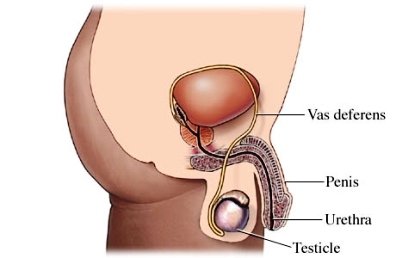
Vasectomy is a contraceptive procedure for men. It is a permanent surgical method to make a man incapable to reproduction. It is not castration procedure, and does not affect the testes, and it does not affect sexual ability of the man. He continues to remains a sexually capable and active person after the procedure. It does not in any way affect his sexual function except that he would not be capable to make another female pregnant. A man who decides that he no longer need to have another child may go in for this procedure. It is a small surgical procedure and can be done in an outpatient setup with proper infection prevention taken.The doctor makes a small opening in the man’s scrotum, that holds his testicles and closes off both tubes Vas deferens that carry sperm from his testicles. This keeps the sperm out of his semen. The man can have erections and ejaculate semen, while his sperm no longer makes a woman pregnant. His ejaculate does not contain his sperms.It is a permanent procedure. It is advisable that the man should take some additional precaution while having intercourse during the first month after the procedure or say, for 20 ejaculations he should take additional measure of contraception.
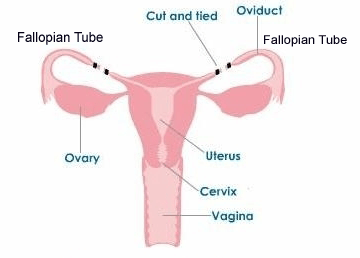
Tubectomy is a permanent contraceptive method for females. It is a surgical procedure by which both the fallopian tubes are ligated so that the egg released by the ovaries does not reach the uterus. The fallopian tubes are two tubes that carry the egg released by the ovaries to the uterus.One end of the fallopian tubes open into the abdomen and the other end are connected to the uterus. Each tube is about 10cmm in length. When the ovum or egg is released from the ovary, it is picked up by Fallopian tube through which it moves into the uterus. If sperms are present in the Fallopian tubes, the ovum is fertilized and the resulting embryo is transmitted to the uterus where it is embedded to continue the process of pregnancy.
Gynaecologists, general surgeons and laparoscopic surgeons perform tubectomy.
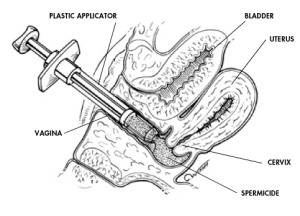
This type of contraceptive contains chemicals that kill the sperms. Whenever the spermicide isintroducedinto vagina, it kills and immobilizes the sperms. Example of spermicide is Delfen Cream. It is a white cream with 5% nonoxynol 9 as spermicide. A plastic applicator with piston is used which is screwed to the mouth of the cream tube. The cream tube is pressed to fill up to the mark of 2.5 ml. The women lies on her back with knees pulled up, separates her labia minora by left thumb and index finger and pushes the cream filled applicator inside vagina as high up as possible. The cream is delivered by pressing on the piston. The cream is introduced 3 minutes before coitus.
Pregnancy failure per 100 women year is 15
Side effects: A few can have vaginal and penile allergy.
Vaginal Contraceptive Pessary
This is about 1 inch long flat tablet containing nonoxynol 9 as spermicide. Within 5 minutes of its introduction it dissolves and micro foam is produced to cover cervix and upper vagina.
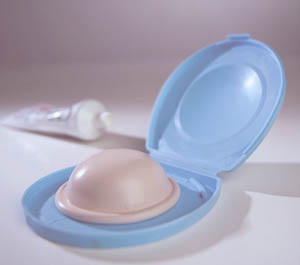
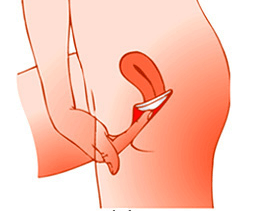
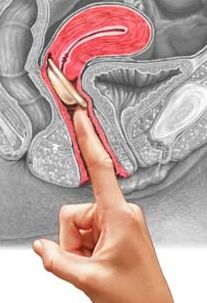
This is a female contraceptive cap worn by women in her vagina during coitus.
It acts as a mechanical barrier. It was first introduced by Hasse from Germany in 1882.This is made of rubber dome with a base made of either flat or coiled steel spring. They are available invarious sizes from 50-100 mm diameters. Females who have not given birth to a baby need smaller size as compared to those who have produced children by vaginal route.
When fitted inside it covers the cervix lying above the diaphragm while the ring comes in contact with the vaginal wall all round.The diaphragm is introduced before intercourse and is taken out at least 8 hours after the last intercourse. It is washed with cold water and soap and dried and left in the container for reuse. One diaphragm can be used for approx. 6 months.
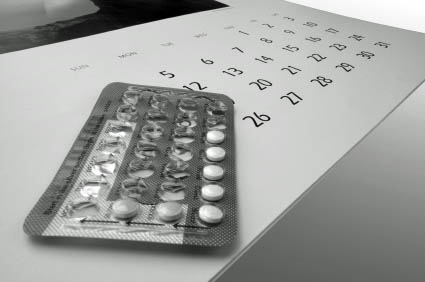
Oral contraceptive is a hormonal pill. It is a combination of oestrogen and progesterone. When taken orally and regularly it acts as the most effective method to prevent pregnancy.Rock, Garcia, Pincus from USA first pioneered in the clinical use of the pill as contraceptive in 1957.
The OC is started from the 5th day of a menses. One pill is taken at bed time daily for 21 days. Within a week the next menses comes. The next course is started from the 5th day of the menses. If one pill is missed at any night the missed pill is taken at the next morning.
There are some Absolute contraindications when the oral contraceptive is not to be taken –
History of liver disease or jaundice with one year.
Thromboembolic disorders.
Carcinoma of breast, cervix or uterus.
Undiagnosed genital bleeding.
There are some Relative contraindications where it may or may not be used after proper consideration.
Migraine
Severer allergy
Hypertension
Diabetes
Women aged beyond 35 years who smoke.
Mechanism of action of Oral contraceptiveOral contraceptives containing the oestrogen and progesterone act by their action on the anterior pituitary and hypothalamus. Its action is also at the uterus and the cervix. It causes the abolition of midcycle FSH-LH surge by suppressing GNRH and FSH. These hormones are required for the development of follicles in the ovary. Thus as no follicular development takes place no ovulation occurs. At the Cervix the cervical mucus becomes less penetrable to sperm by the action of progesterone. Endometrial lining of the uterus also becomes unresponsive to lodging of the fertilized egg.All women must have preliminary medical checkups before starting on the pill.
Following delivery ovulation is delayed beyond 6 weeks, although it can happen at 4th week when the women are not breast feeding. Thus if the mother is not breastfeeding it is started at 4 weeks and if she is breastfeeding it is started after 6 months because oestrogen inhibits prolactin action on breasts causing poor milk yield.


 introducedinto vagina, it kills and immobilizes the sperms. Example of spermicide is Delfen Cream. It is a white cream with 5% nonoxynol 9 as spermicide. A plastic applicator with piston is used which is screwed to the mouth of the cream tube. The cream tube is pressed to fill up to the mark of 2.5 ml. The women lies on her back with knees pulled up, separates her labia minora by left thumb and index finger and pushes the cream filled applicator inside vagina as high up as possible. The cream is delivered by pressing on the piston. The cream is introduced 3 minutes before coitus.
 Manbir Online ~ for Health & Fitness