Unknown's avatar

About Manbir & Gurpreet

Gurpreet Kaur’s journey in this world .... Gurpreet Kaur was a Musician. She was a singer and a composer of music. Her interest was composing and singing Gurbani Shabads in Indian Classical style. She sang Shabads in All the Raags mentioned in Sri Guru Granth Sahib Ji. She also taught Gurmat Sangeet at Gurmat Gian Missionary College, Jawadi, Ludhiana. Elder child to Pushpinder Kaur and Dr. Brig. Harminder Singh, was born in Amritsar on 13th Jan 1962. She attended various convent schools as a child because her father would get frequent Army postings as a dental surgeon. She graduated with Music Honors from Govt. College for Women, Chandigarh. Music was her hobby and she composed and sang Raag based Gurbani Shabads. Doing Kirtan was part of growing up nurtured by her parents. She learned music from her father Dr. Brigadier Harminder Singh who was a dental surgeon in Indian Army and a very good singer himself. Gurpreet’s Bhua (father’s sister), Ajit Kaur retied as a Head of Department of Music from Govt. College for Women Ludhiana, and was a renounced Punjabi singer of her time. Gurpreet Kaur also learned nuances of Indian Classical Music from Pandita Sharma. She was a mother of three children, and a grandmother. Her daughter Keerat Kaur is a Computer Engineer. Her two sons Gurkeerat Singh and Jaskeerat Singh are doctors in USA. Her daughter Keerat Kaur too was part of her group ~ Gurmat Gian Group. Gurpreet Kaur left this world at the age of 54yrs on 12th Sept 2016 in Baltimore USA. She had recorded around 25 cds of Gurbani Keertan. 'Raag Ratan' Album (6 CDs) is a Compilation of Shabads in All the 31 Sudh Raags of Sri Guru Granth Sahib Ji. 'Gauri Sagar' Album (3 CDs) is a Compilation of All forms of Raag Gauri in Sri Guru Granth Sahib Ji. 'Nanak Ki Malhaar' ~ ((3 CDs) is an album of Raag Malhar Shabads in various forms of Malhar. 'Gur Parsaad Basant Bana' ~ (3 CDs) is an album of Shabads in Raag Basant sung in various forms of Raag Basant. Har Ki Vadeyai Sarni Aayea Sewa Priya Kee Preet Piyaree Mohan Ghar Aavho Karo Jodariya Mo Kao Taar Le Raama Taar Le Tere Kavan Kavan Gun Keh Keh Gawan Mera Baid Guru Govinda Saajanrraa Mera Saajanrraa

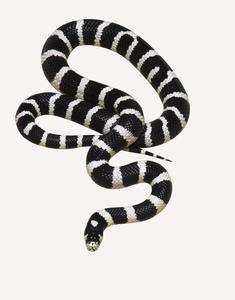
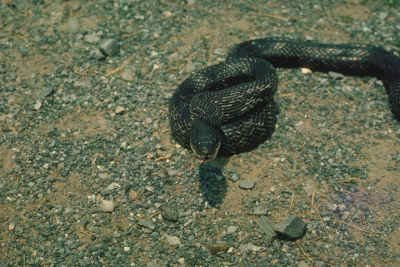
King Snake

King Snake – Constricting snake 

King Snake – Constricting snakeThese snakes squeeze their prey to death by coiling around it. They eat rodents, birds, and other snakes, including poisonous ones. Curiously, they are not affected by the venom of vipers. A common king snake is the chain snake, named for its chainlike yellow or white markings.
King snakes have Vertical contrasting stripes, rounded head, gentle disposition, eats other snakes. The most famous characteristic of the King Snake is its habit of eating rattlesnakes.
 

Snake Bite

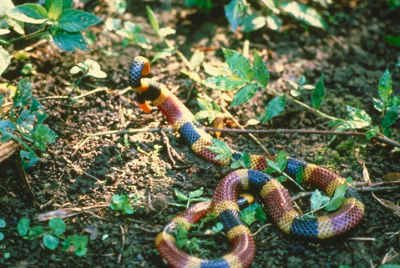
CORAL Snake

CORAL Snake
Venom – NeurotoxicBrightly colored venomous snakes of the cobra family. Coral snakes do not strike, but when touched they bite repeatedly, injecting a deadly poison that acts on the nervous system.The snakes are marked with a pattern of brightly colored rings or bands that are black, yellow, and red.

About 40 species of coral snakes are known, most of them native to Central and South America.


Snake Bite

Iodine Deficiency

Iodine Deficiency

Over a quarter of the world’s population faces problems of iodine deficiency.

Of them, 655 million persons have endemic goitre, 5.7 million cretinism and 26 million brain damage. Every year 60,000 still births, abortions and infant deaths occur within days of delivery owing to iodine deficiency.

Iodine deficiency constitutes the world’s major cause of preventable mental retardation ranging from mild intellectual blunting to overt cretinism.

IODINE is an essential micronutrient for humans. Even animals and plants need it. Iodine deficiency constitutes the world’s major cause of preventable mental retardation ranging from mild intellectual blunting to overt cretinism.Thyroid gland produces two hormones – thyroxine (T4) and tri-iodo-thyronine (T3). Iodine is used for the production of these hormones. Iodine also helps in the growth of new cells in the foetal life.Effects of iodine deficiency:

  • Enlargement of the thyroid – goitre
  • Cretinism
  • Mental retardation.
  • Subtle iodine deficiency affects the woman’s ability to have a pregnancy, increases foetal loss.
  • Leads to a lack of concentration, poor memory and sluggishness.

When the availability of iodine is low, the thyroid gland grows bigger and bigger. Iodine deficiency is the major cause of endemic goitre.

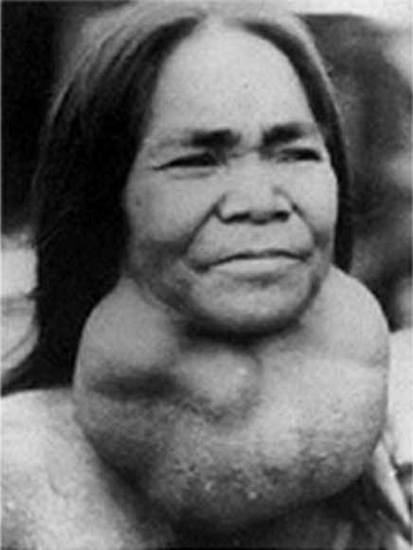
Neck irradiation for lymphnode malignancies, radiation exposure following nuclear accidents and even repeated X-Rays of the neck increase the risk of thyroid cancer in subjects with iodine-deficient goitres. Follow-up studies of the Chemobyl nuclear plants disaster have confirmed the risk of thyroid cancer from a nuclear accident.
Iodine deficiency during reproductive age may cause inability to conceive. Higher rates of pregnancy loss and, most importantly, mental retardation and various neurological manifestations in the newborn are well-known sequelae of iodine deficiency.

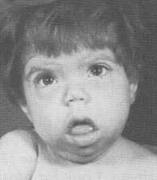
While iodine deficiency early in pregnancy accounts for neurological cretin that occurring later in foetal life and continuing through out infancy leads to a profound decrease in thyroid functions, resulting inmyxodematous cretin.
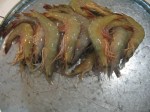
Unlike other nutrients such as iron, calcium, zinc or the vitaniins, iodine does not occur in sufficient concentration in natural foods. Small quantities of iodine are present in vegetables and drinking water. Deforestation and soil erosion increase the loss of iodine from the soil. Desalinated sea water and seafoods (prawns, fish crabs, snails, etc.) have higher quantities of iodine.
Soils from mountain ranges such as the Himalayas, the Alps and the Andes are areas devastated with frequent floods; these are iodine deficient. Hence, ground or surface water in these areas are iodine deficient.
The contamination of sea water by industrial and other organic wastes have significantly reduced iodine availability in our sea foods.

Dietary iodine supplementation has, therefore, become essential.

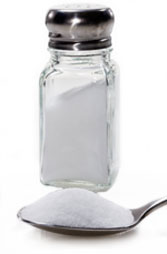
Potassium iodate is used for the iodinsation of refined salt. The level of iodisation at the production level is 30 mg per kg salt, aiming at providing an individual 30O ug of iodine in 10g of salt consumed.

Iodine being a volatile substance is rapidly lost from the iodised salt when it is kept open, near a fire place and or is added while cooking. A fresh packet of iodised salt should be obtained every month, stored away from the fireplace and added to food items after cooking.

The fear of harmful effects of iodine is totally unjustified. The use of iodised salt by people with iodine-sufficient status produces no hann. Iodised salt should be avoided by patients with thyrotoxicosis.

A practical way to include iodine rich foods in your body is to use iodized salt.
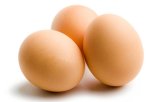
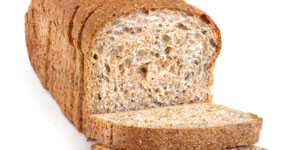
Prawns, Fish crabs, Snails, Shellfish are another sure way to consume iodine in your diet. Other food items with iodine content are Kelp (sea vegetable), Yogurt (low-fat), Egg (whole, boiled), Strawberries. Eating iodine rich breads such as various Rye breads will also provide high amounts of iodine.

  • Kelp (sea vegetable) – ¼ ounce, 415.00 mcg
  • Yogurt (low-fat) – 1 cup, 87.22 mcg
  • Cow’s milk (2%) – 1 cup, 58.56 mcg
  • Egg (whole, boiled) – 1 each, 23.76 mcg
  • Strawberries – 1 cup, 12.96 mcg
Other Natural food sources of Iodine include: garlic, asparagus, lima beans, mushrooms, sesame seeds, spinach, turnip greens, and soybeans.


Hydrogen Cyanide

 Hydrogen Cyanide
HYDROGEN CYANIDE, also called hydrocyanic acid and prussic acid, extremely poisonous, colorless liquid with a bitter-almond odor. The compound’s chemical formula is HCN.  HCN melts at –14° C (6.8° F) and boils at 25.7° C (78.2° F).

It is reported that this substance was used by Iraq in the war against Iran and against the Kurds in the northern Iraq in the 1980s.

A few milligrams of the substance and of related cyanides can be rapidly fatal to humans, acting by blocking the ability of cells to use oxygen. The compound mixes with water, alcohol, and ether in all proportions. When impurities are present, HCN molecules can combine to form a black solid; the reaction may be explosive unless inhibited. HCN is flammable and can form explosive mixtures with air. It was once produced from the pigment Prussian blue, hence its secondary name. Now it is prepared commercially by the reaction of methane with ammonia in the presence of a platinum catalyst.

One major use of HCN is in the production of acrylonitrile,  a starting compound for various products. HCN has many other industrial uses, including the making of plastics and several important cyanide compounds. The latter include sodium cyanide (NaCN) and potassium cyanide (KCN), both of them important in metallurgy. They are used in recovering gold and silver from ores, for example, and NaCN is used in the hardening of steel. Several cyanide compounds are employed in the electroplating of metals such as silver, gold, copper, and platinum.

Cyanide Poisoning 
Chemical Weapons