Unknown's avatar

About Manbir & Gurpreet

Gurpreet Kaur’s journey in this world .... Gurpreet Kaur was a Musician. She was a singer and a composer of music. Her interest was composing and singing Gurbani Shabads in Indian Classical style. She sang Shabads in All the Raags mentioned in Sri Guru Granth Sahib Ji. She also taught Gurmat Sangeet at Gurmat Gian Missionary College, Jawadi, Ludhiana. Elder child to Pushpinder Kaur and Dr. Brig. Harminder Singh, was born in Amritsar on 13th Jan 1962. She attended various convent schools as a child because her father would get frequent Army postings as a dental surgeon. She graduated with Music Honors from Govt. College for Women, Chandigarh. Music was her hobby and she composed and sang Raag based Gurbani Shabads. Doing Kirtan was part of growing up nurtured by her parents. She learned music from her father Dr. Brigadier Harminder Singh who was a dental surgeon in Indian Army and a very good singer himself. Gurpreet’s Bhua (father’s sister), Ajit Kaur retied as a Head of Department of Music from Govt. College for Women Ludhiana, and was a renounced Punjabi singer of her time. Gurpreet Kaur also learned nuances of Indian Classical Music from Pandita Sharma. She was a mother of three children, and a grandmother. Her daughter Keerat Kaur is a Computer Engineer. Her two sons Gurkeerat Singh and Jaskeerat Singh are doctors in USA. Her daughter Keerat Kaur too was part of her group ~ Gurmat Gian Group. Gurpreet Kaur left this world at the age of 54yrs on 12th Sept 2016 in Baltimore USA. She had recorded around 25 cds of Gurbani Keertan. 'Raag Ratan' Album (6 CDs) is a Compilation of Shabads in All the 31 Sudh Raags of Sri Guru Granth Sahib Ji. 'Gauri Sagar' Album (3 CDs) is a Compilation of All forms of Raag Gauri in Sri Guru Granth Sahib Ji. 'Nanak Ki Malhaar' ~ ((3 CDs) is an album of Raag Malhar Shabads in various forms of Malhar. 'Gur Parsaad Basant Bana' ~ (3 CDs) is an album of Shabads in Raag Basant sung in various forms of Raag Basant. Har Ki Vadeyai Sarni Aayea Sewa Priya Kee Preet Piyaree Mohan Ghar Aavho Karo Jodariya Mo Kao Taar Le Raama Taar Le Tere Kavan Kavan Gun Keh Keh Gawan Mera Baid Guru Govinda Saajanrraa Mera Saajanrraa

Microcephaly

Microcephaly

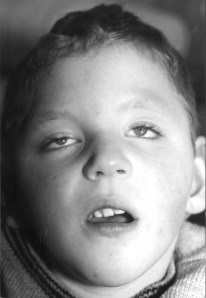
Microcephaly is a rare, neurological disorder in which the circumference of the head is smaller than the average for the age and gender of the infant. Microcephaly may be congenital or it may develop in the first few years of life.

This disorder may be caused by a wide variety of conditions that effect the growth of brain. It is often associated with chromosomal abnormality.

Infants with microcephaly may be born with a normal or reduced head size. The head fails to grow while the face continues to develop at a normal rate, producing a child with a small head, a large face, and a loose, often wrinkled scalp. As the child grows the smallness of the head becomes more obvious. Whole body is also underdeveloped. Motor functions and speech are delayed. Motor ability may vary, and it may be clumsy movements or even quadriplegia (paralysis of both upper and lower limbs).Hyperactivity and mental retardation are common. Convulsions may also occur.

The is no specific treatment in such cases. Treatment is symptomatic and supportive. Life expectancy is low and the prognosis for normal brain function is poor.


The Causes of Microcephaly can be Genetic and Non genetic

Genetic

  1. Autosomal Recessive (Familial)
  2.  Autosomal Dominant
  3.  Syndromes

Syndromes

  • Aicardi Syndrome
  • Beckwith-Wiedemann Syndrome
  • Bloom Syndrome
  • Cohen Syndrome
  • Cornelia de Lange
  • Cri-du-chat (5p-)
  • Dubowitz Syndrome
  • Rubinstein-Taybi Syndrome
  • Smith-Lemli-Opitz Syndrome
  • Trisomy 21
  • Trisomy 18
  • Trisomy 13
  • Xeroderma Pigmentosum

Non Genetic

1. Congenital CNS Anomalies

      • Agenesis of the Cerebellar Vermis
      • Agenesis of the Corpus Callosum
      • Craniosynostosis
      • Encephalocele
      • Holoprosencephaly
      • Lissencephaly
      • Macrogyria
      • Porencephaly
      • Schizencephaly

2. Congenital Infections

      • CMV
      • Rubella
      • Toxoplasmosis
      • Varicella

3. Drugs

      • Alcohol
      • Aminopterin
      • Dilantin
      • Methyl Mercury

4. Hypoxic-Ischemic Encephalopathy

5. Infections

      • Encephalitis
      • Meningitis

6. Metabolic

      • Maternal Diabetes Mellitus
      • Maternal PKU
      • Inborn Errors of Metabolism
      • Neuronal Ceroid Lipofuscinoses

7. Others

      • Radiation
      • Hyperthermia

Melanoma

Melanoma
 Skin cancer is the most common of all cancers.  Melanoma, the most serious form, accounts for 4 percent of skin cancer cases but causes 79 percent of skin-cancer deaths.


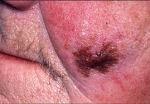
 Melanoma originates from melanocytes, pigment cells present normally in the skin. The tumor can affect adults of all ages, even young individuals (starting in the mid-teens). The incidence has increased dramatically -a 300 percent increase in the past 40 years or so.  
The individuals most susceptible to development of melanoma are those with fair complexions, red or blond hair, blue eyes, and freckles and who tan poorly and sunburn easily. Increased risk include a family history of Melanoma. Dark-skinned populations (such as those of India and Puerto Rico), blacks, and East Asians have rates 10 to 20 times lower than lighter-skinned whites.Typically they start as a mole. Sometimes a mole of many years changes in size, shape, color or elevation, or starts to bleed.  
                 How to suspect a Mole:

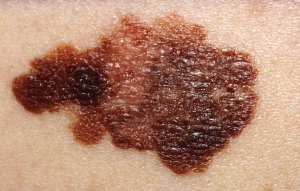
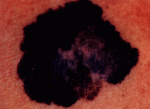
  • You should be able to draw a line through the middle of a mole or lesion and have it look the same on both halves.
  • You should have a nice, clean regular border around your mole.
  • Change in color is a major indicator of a potential problem.
  • More than about six millimeters in diameter can be suspicious.
 Early detection of melanoma may be facilitated by applying the “ABCD rules”:A– asymmetry, benign lesions are usually symmetricB– border irregularity, most nevi have clear-cut borders

C– color variegation, benign lesions usually have uniform light or dark pigment

D – diameter > 6 mm (the size of a pencil eraser).

   
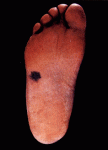
Acral lentiginous melanoma is more common in blacks, Asians, and Hispanics and occurs as an enlarging hyperpigmented macule or plaque on the palms and soles.

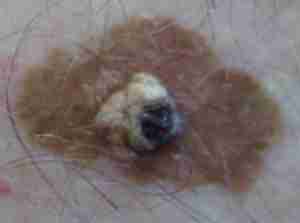
Nodular melanoma most commonly manifests itself as a rapidly growing, often ulcerated or crusted black nodule.

Irradiation of food

Irradiation of food
Irradiation of food has been approved in 37 countries for more than 40 products. The radiation of interest in food preservation is ionizing radiation, also known as irradiation. These shorter wavelengths are capable of damaging microorganisms such as those that contaminate food or cause food spoilage and deterioration. Irradiation is known as a cold process. It does not significantly increase the temperature or change the physical or sensory characteristics of most foods.Food is irradiated to provide the same benefits as when it is processed by heat, refrigeration, freezing or treated with chemicals to destroy insects, fungi or bacteria that cause food to spoil or cause human disease and to make it possible to keep food longer and in better condition in warehouses and homes.Because irradiation destroys disease causing bacteria and reduces the incidence of food borne illness, hospitals sometimes use irradiation to sterilize food for immuno-compromised patients.
Irradiated foods are wholesome and nutritious. All known methods of food processing and even storing food at room temperature for a few hours after harvesting can lower the content of some nutrients, such as vitamins. At low doses of radiation, nutrient losses are either not measurable or are not significant. At the higher doses used to extend shelf-life or control harmful bacteria, nutritional losses are less than or about the same as cooking and freezing.
As in the heat pasteurization of milk, the irradiation process greatly reduces but does not eliminate all bacteria. Irradiated poultry, for example, still requires refrigeration, but would be safe longer than untreated poultry. Strawberries that have been irradiated will last two to three weeks in the refrigerator compared to only a few days for untreated berries.Irradiation does not make food radioactive.Eating irradiated food does not present long-term health risks.

In the United States, the Food and Drug Administration (FDA) has approved irradiation for eliminating insects from wheat, potatoes, flour, spices, tea, fruits, and vegetables. Irradiation also can be used to control sprouting and ripening. Approval was given in 1985 to use irradiation on pork to control trichinosis. Using irradiation to control Salmonella and other harmful bacteria in chicken, turkey, and other fresh and frozen uncooked poultry was approved in May 1990.

Potential food irradiation uses
Type of food Effect of Irradiation
Meat, poultry Destroys pathogenic fish organisms, such as Salmonella, Clostridium botulinum, and Trichinae
Perishable foods Delays spoilage; retards mold growth; reduces number of microorganisms
Grain, fruit Controls insect vegetables, infestation dehydrated fruit, spices and seasonings
Onions, carrots, potatoes, garlic, ginger Inhibits sprouting
Bananas, mangos,papayas, guavas, other non-citrus fruits Delays ripening avocados, natural juices.
Grain, fruit Reduces rehydration time

Other uses of Irradiation – In addition to cancer treatment, irradiation is used for many purposes, including: performing security checks on hand luggage at airports, making tires more durable, sterilizing manure for gardens, making non-stick cookware coatings, purifying wool, sterilizing medical products like surgical gloves, and destroying bacteria in cosmetics.

Since 1986, all irradiated products must carry the international symbol called a radura, which resembles a stylized flower.

Impetigo

Impetigo
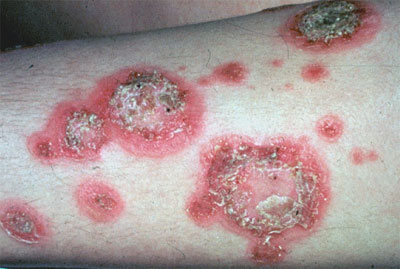
Impetigo (Pyoderma) is a superficial infection of the skin caused primarily by group A streptococci and occasionally by other streptococci or by Staphylococcus aureus.This condition is seen most often in young children, tends to occur during the warmer months, and is more common in semitropical or tropical climates than in cooler regions. The infection occurs especially often among children living under conditions of poor hygiene. Minor trauma, such as a scratch or an insect bite, may then serve to lodge bacteria into the skin and cause this infection. While the bacteria causing impetigo may have been caught from someone else with impetigo or boils, impetigo usually begins out of the blue without any apparent source of infection. Impetigo is best prevented, therefore, by attention to adequate hygiene.


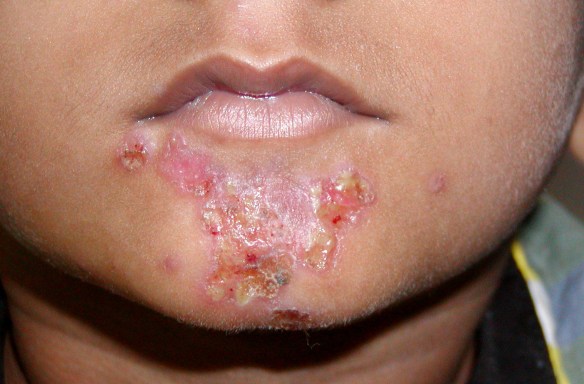
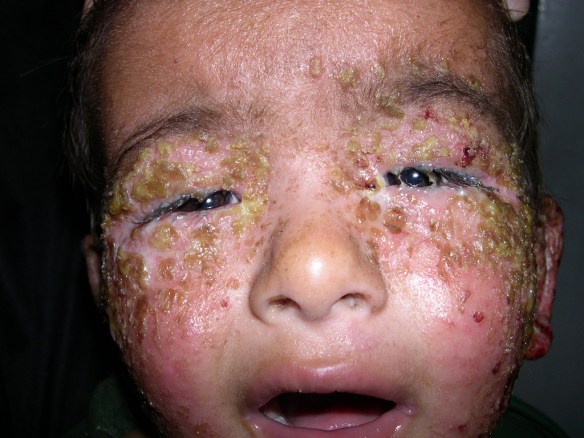
The usual sites of involvement are the face (particularly around the nose and mouth) and the legs, although lesions may occur at other locations.
Individual lesions begin as red papules, which turn quickly to vesicular and then pustular lesions that break down and coalesce to form characteristic honeycomb-like crusts. Lesions generally are not painful, and patients do not appear ill. Fever is not a feature of impetigo.


Bullous impetigo is a distinctive form of impetigo characterized by the presence of more extensive, bullous lesions that break down and leave thin paper like crusts instead of the thick amber crusts of impetigo.  
Treatment Consists of cleaning the lesions with soap and water and topical and systemic antiboiotics.

  • Antibiotics usually clear up impetigo in four or five days. It’s important for the antibiotic to be taken faithfully until the prescribed supply is completely used up.
  • An antibiotic ointment, such as Polysporin, should be applied thinly four times daily. Polysporin can be purchased without a prescription.
  • Crusts should be removed before the ointment is applied. Soak a soft, clean cloth in a mixture of one-half cup of white vinegar and a quart of lukewarm water. Press this cloth on the crusts for 10-15 minutes three or four times daily. Then gently wipe off the crusts and apply a little antibiotic ointment. You can stop soaking the impetigo when crusts no longer form. When the skin is healed, stop the antibiotic ointment.

Among the antibiotics useful are dicloxacillin, cephalexin, or topical mupirocin ointment provide the most reliable treatment for impetigo, although penicillin or erythromycin are cheaper alternatives and equally effective.

A possible complication of Impetigo is glomerulonephritis, a type of kidney disease.

Precautions:Impetigo is contagious when there is crusting or oozing. While it’s contagious, take the following precautions:

  • Patients should avoid close contact with other people.
  • Children should be kept home from school until the lesions crust over.
  • Use separate towels for the patient. The patient’s towels, pillowcases, and sheets should be changed after the first day of treatment. His or her clothing should be changed and laundered daily for the first two days.
  • Usually the contagious period ends within two days after treatment starts.
Skin Diseases
Ecthyma

Boa Snake

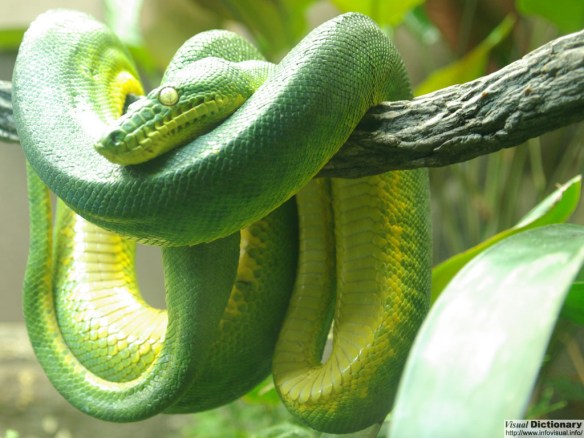
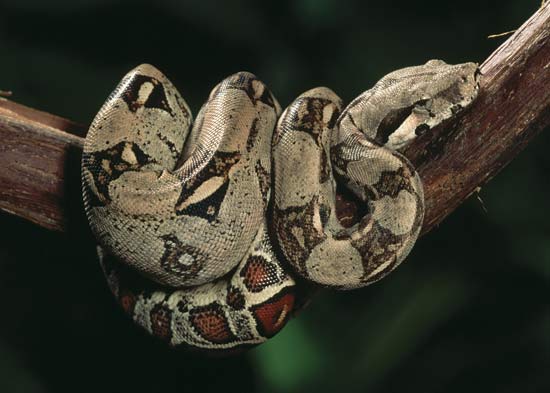
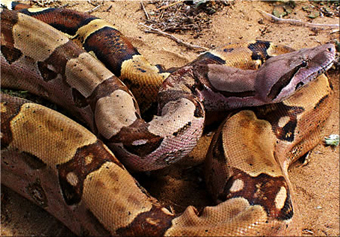
Boa Snake Boa is a common name for non poisonous snake of boa and python family. Boa and python family contains some 70 species. Like pythons boa too kill their prey by constricting them to death and then swallowing it whole. They can stretch their jaws wide appart more than the size of their head to swallow a large animal. While a large boa might easily kill an average-size person, it would have difficulty swallowing the body, and is generally not considered a threat to humans.
Tree boas are brightly colored tree boa, live in trees. With their triangular heads, elliptical eye pupils, and long, curved front teeth, they resemble the venomous vipers.
Boas give birth to their young, while pythons lay eggs; pythons are confined mostly to the Old World, whereas boas are found worldwide.

In the jungles of Central and South America boa constrictor is a reddish-gray, with a ladder of broad, dark stripes.

 Constrictor Boa Snake

Rubber boa, found throughout the southwestern U.S. The rubber boa, whose shiny brown skin actually resembles rubber, is a burrowing animal. With its blunt head and tail, it is sometimes called a two-headed snake.

 Constrictor Boa Snake

Snake Bite