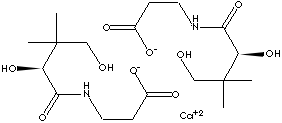
| Calcium pantothenate, Calcium pantothenate, VitaminB5 | ||
Calcium pantothenate also known as Calcium pantothenate is a water soluble vitamin. It is produced in the intestines by bacteria. Vitamin B5 is lost in cooking water and is destroyed by heat or freezing. Acids and alkalis such as vinegar and baking soda also destroy this vitamin.Vitamin B5 is necessary has a role in various fuctions in our body:
Vitamin B5 should be taken along with other B vitamins. It should also be combined with co- nutrients like manganese, sulphur, zinc and vitamin C. Natural sources are: Egg yolks, Milk, Yoghurt, Cheese, Wheat germ, Nuts and Whole grains. |
||
![]() |
![]() |
![]() |
![]() |
![]() |
![]() |
Author Archives: Manbir & Gurpreet
Nausea & Vomiting
| Nausea & Vomiting |
| NAUSEA is the sensation that precedes vomiting.VOMITING is the involuntary forced expulsion of stomach contents through the mouth. In most cases, the explanation is simple like irritation of the stomach by food or overindulgence in food and alcohol. Both are common complaints and are usually self-limiting. However, attention has to be paid to fluid balance and referral to hospital should be considered in case of dehydration and weight loss. If symptoms persist, a full examination of the patient is mandatory to look for serious underlying pathologies.Stimulation of the vomiting centre causes hypo-motility and reverse- motility of the digestive tract. The diaphragm presses down on the stomach and the abdominal walls move inwards, forcing the stomach contents out through the oesophagus. As this happens, the epiglottis clamps down upon the voice-box, thus preventing vomit from entering the wind-pipe.
What causes Nausea and Vomiting? Both nausea and vomiting result from stimulation of the vomiting centre located in the brain stem. This centre can be activated in two ways – chemically and neutrally. Chemical activation is mediated via Stimulation of the vomiting centre causes hypo-motility and reverse- motility of the digestive tract. The diaphragm presses down on the stomach and the abdominal walls move inwards, forcing the stomach contents out through the oesophagus. As this happens, the epiglottis clamps down upon the voice-box, thus preventing vomit from entering the wind-pipe. Identification of Cause The seriousness of vomiting depends upon its cause. It may be caused by overeating or drinking too much or by a viral infection. Alternatively, it may follow head injury or poisoning. Careful attention has to be paid in the following situations:
Situation & Conditions to be suspected
Drugs that commonly cause nausea and vomiting
Management The patient must be asked not to eat any solid food until nausea and vomiting subsides. He must be encouraged to take small sips of water to prevent dehydration. When the stomach settles, he should be advised to eat dry food like biscuits and toast before resuming normal diet. Attention has to be paid to fluid and electrolyte balance. Signs of dehydration include severe thirst, dry lips and tongue, sunken eyes, loss of skin elasticity, increased heart and respiratory rate, muscle cramps, lethargy, confusion and headache. If patient cannot take anything by mouth, intravenous fluids should be considered and the water salt balance should be carefully monitored by blood tests. Medication Drugs to manage nausea and vomiting are of two types: those that act directly on the digestive tract and those that act centrally. Drugs that act on the digestive tract increase intestinal contraction and accelerate transit. Centrally acting agents act at the vomiting centre or chemoreceptor trigger zone (CTZ) located in the brainstem and block impulses that induce nausea and Vomiting. DOPAMINE ANTAGONISTS (prochlorperazine, metoclopramide, domperidone) act against D2 receptors in the brain stem (CTZ). Prochlorperazine is a phenothazine possessing powerful antiernetic activity. In addition to CTZ, it also acts at the vomiting centre. It is used for nausea and vomiting due to various causes including migraine. Metoclopramide has a peripheral action on the gut and enhances gastric hurrying in addition to its effect on CTZ. Domperidone, unlike metoclopramide, does not cross the blood-brain barrier and may cause fewer extrapyramidal side-effects at high doses, eg. dystonia in children and parkinsonism in elderly. ANTIHISTAMINES (promethazine, diphenhydramine, cyclizine, cinnarizine) act on the vestibular apparatus of the inner ear and are useful in motion sickness and vomiting due to vestibular disease. ANTISEROTONIN agents like ondansetron act on peripheral and central serotonin Acceptors and are valuable in the management of nausea and vomiting not relieved by conventional, less expensive agents. ANTICHOLINERGICS act on the vomiting centre and digestive tract and reduce gastrointestinal hyperactivity. They help in the management of motion sickness but can cause dry mouth, drowsiness and blurred vision. All motion sickness drugs are effective if given before the journey. Once the sickness has started, the symptoms are more difficult to control. |
Mustard agents
| Mustard agents | |
| Mustard agent was produced for the first time in 1822 but its harmful effects were not discovered until 1860.Mustard agents are usually classified as “blistering agents”. They also cause severe damage to the eyes, respiratory system and internal organs.
The effect of mustard agent is delayed and the first symptoms do not occur until 2-24 hours after exposure. A typical result of warfare with mustard agent is that the medical system is overloaded with numerous victims who require long and demanding care. |
|
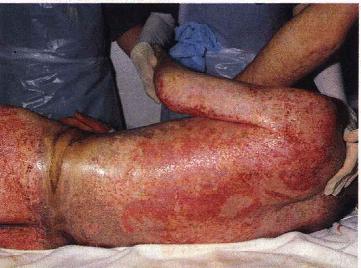
| Mustard agent attacks the skin, eyes, lungs and gastro-intestinal tract. Internal organs may also be injured, mainly blood-generating organs, as a result of mustard agent being taken up through the skin or lungs and transported into the body. Mustard agent gives no immediate symptoms upon contact and consequently a delay of between two and twenty-four hours may occur before pain is felt and the victim becomes aware of what has happened. By then cell damage has already been caused.Mustard Agents as chemical weapons were first used towards the end of World War I. It was most commonly used chemical weapon, used to cause severe eye and lung damage. |
Mustard Agent-blistering of skin from exposure to mustard |
| United States, Russia, Germany and Iraq are all said to have produced mustard agents during the 20th century. Iraq used it against Iran and the Kurdish civilians in the Iran-Iraq war. They are easy to make. They have rotten mustard or onion odour. | |
| Chemical Weapons | |
Migraine
| Migraine | ||||||||||||||||||||
| Migraine is an episodic unilateral headache accompanied by visual disturbances and vomiting. The episodic nature of the headache is most characteristic. Initially during aura, there is a decrease in cerebral blood flow, particularly in the occipital and parietal lobes. Later, during the phase of headache there is a dilatation of the extracranial arteries related to the variations in 5-HT blood levels.Types of Migraine1. Classical migraine: The headache is preceded by visual or sensory aura.2. Common migraine: This is without aura. Headache, nausea, vomiting and photophobia are the classical symptoms.3. Hemiplegic migraine: In this type, hemiplegia lasting for a few days follows the headache.
4. Basilar migraine: Vertigo, diplopia, dysarthria with or without visual symptoms precede occipital headache. 5. Cluster headache: Bouts of severe pain around one eye with associated epiphora and nasal congestion is the hallmark and this type, mostly affects males. Treatment Treatment of migraine involves managing acute attacks with analgesics and prevention of further attacks. Precipitating causes have to be taken care of and family and work related stress should be managed by various methods of coping with stress and relaxation and keeping regular hours of sleep and meals habits. Simple analgesics like asprin, acetoaminophen and also ibuprofen and diclofenac are used to alleviate pain. Ergotamine is used when analgesics give less relief. It acts by causing vasoconstriction of extracranial vessels and reduction of platelets aggregation. Sumatriptan is a highly selective 5-HT1 receptor agonist which are mainly located in cerebral arteries. It constricts cerebral blood vessels. Dopamine antagonists, metoclopramide, chlorpromazine, prochlorperazine have been used for severe attacks. Narcotics and short course of corticosteroids and antipsychotics can be used when severe migraine does not respond to conventional measures. Precipitating Factors Although investigation have not conclusively proved that any factor causes migraine headache, some patients do recognize certain factors that precipitate an attach. Certain dietary factors like Tyramine, monosodium glutamate, excessive alcohol, excessive analgesics, ergotamine, and oral contraceptives act as trigger to cause migraine. Diagnosis: Careful history is important. Diagnostic criteria Migraine without aura A. At least 5 attacks fulfilling criteria B-D B. Headache attacks lasting 4-72 hours (untreated or unsuccessfully treated) C. Headache has at least 2 of the following characteristics:
D. During headache at least 1 of the following:
E. Not attributed to another disorder Migraine with aura A. At least 2 attacks fulfilling criterion B B. Migraine aura fulfilling criteria B-C for one of the subforms (typical aura with migraine headache, typical aura with non-migraine headache, typical aura without headache, familial hemiplegic migraine, sporadic hemiplegic migraine, or basilar-type migraine) C. Not attributed to another disorder Typical aura with migraine headache A. At least 2 attacks fulfilling criteria B-D B. Aura consisting of at least 1 of the following, but no motor weakness:
C. At least two of the following:
D. Headache fulfilling criteria B-D for “Migraine without aura” begins during the aura or follows aura within 60 minutes E. Not attributed to another disorder Typical aura without headache As “Typical aura with migraine headache” except: B. Aura consisting of at least 1 of the following, with or without speech disturbance but no motor weakness:
D. Headache does not occur during aura nor follow aura within 60 minutes Prevention of Migraine Preventive measures are to be considered when migraine attacks occur more than two or three times a month and disturb normal activity. Preventive medication is continued for 6 months and gradually withdrawn. Drugs used include 5-HT influencing drugs like Amitriptyline, Methysergide, Propranolol, Metoprolol, Nadolol, Nefedipine, Nimodipine,Verapamil, Pizotefen. |
||||||||||||||||||||
Drugs used in Migraine
|
Melatonin
| Melatonin |
| Melatonin is a hormone secreted by the pineal gland. The pineal gland is a pea like structure located in the centre of the brain. What is now known is that it is part of the body clock, an internal timer that regulates the production of various hormones which in turn control human activities like – sleeping, eating, sexual development, immune systems and maternal instincts.Plasma Melatonin levels increase steadily between 9 p.m. and 11 p.m. and reaches its peel value between 2 a.m. and 4 a.m. The level of this hormone then declines and reaches its low level in the afternoon.
Melatonin is synthesized by the pineal gland from the neurotransmitter, serotonin. Serotonin is involved in several central physiological processes, including body temperature and blood-pressure regulation, as well as a variety of neuro-psychological functions such as appetite, memory, and mood. Melatonin and serotonin are inextricably linked: When melatonin levels drop or rise for any reason, so do serotonin levels, and vice versa. Actions of Melatonin
Taking Melatonin Why take Melatonin ? There is lot to be learned about Melatonin. Research is underway to determine melatonin’s effects on human body and its more precise role and actions. Recommended dose: It varies between 100 mcg to 200 mg. Start with lower dose and increase gradually. It is one of the least toxic substances. Those taking Prozac should not take melatonin. Melatonin should not be combined with Vitamin B6. It should also not be combined with oestrogen or any other hormone. When should melatonin be taken: Melatonin should only be taken at night-time, usually about thirty minutes prior to going to bed. If you are travelling on a long trip you may want to take a low dosage 300mcg tablet prior to getting on your flight. |
Vitamin B5 is lost in cooking water and is destroyed by heat or freezing. Acids and alkalis such as vinegar and baking soda also destroy this vitamin.Vitamin B5 is necessary has a role in various fuctions in our body:




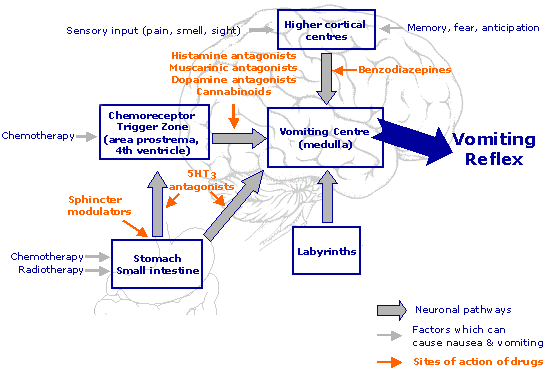
the chemoreceptor trigger zone (CTZ) that is sensitive to the presence of toxins and poisons in the blood stream. Neural activation occurs as a result of information coming directly from the frontal lobes of the brain, the digestive tract and balancing mechanism of the inner ear.