Gurpreet Kaur’s journey in this world ....
Gurpreet Kaur was a Musician. She was a singer and a composer of music. Her interest was composing and singing Gurbani Shabads in Indian Classical style. She sang Shabads in All the Raags mentioned in Sri Guru Granth Sahib Ji. She also taught Gurmat Sangeet at Gurmat Gian Missionary College, Jawadi, Ludhiana.
Elder child to Pushpinder Kaur and Dr. Brig. Harminder Singh, was born in Amritsar on 13th Jan 1962. She attended various convent schools as a child because her father would get frequent Army postings as a dental surgeon. She graduated with Music Honors from Govt. College for Women, Chandigarh.
Music was her hobby and she composed and sang Raag based Gurbani Shabads. Doing Kirtan was part of growing up nurtured by her parents. She learned music from her father Dr. Brigadier Harminder Singh who was a dental surgeon in Indian Army and a very good singer himself. Gurpreet’s Bhua (father’s sister), Ajit Kaur retied as a Head of Department of Music from Govt. College for Women Ludhiana, and was a renounced Punjabi singer of her time. Gurpreet Kaur also learned nuances of Indian Classical Music from Pandita Sharma.
She was a mother of three children, and a grandmother. Her daughter Keerat Kaur is a Computer Engineer. Her two sons Gurkeerat Singh and Jaskeerat Singh are doctors in USA. Her daughter Keerat Kaur too was part of her group ~ Gurmat Gian Group.
Gurpreet Kaur left this world at the age of 54yrs on 12th Sept 2016 in Baltimore USA.
She had recorded around 25 cds of Gurbani Keertan.
'Raag Ratan' Album (6 CDs) is a Compilation of Shabads in All the 31 Sudh Raags of Sri Guru Granth Sahib Ji.
'Gauri Sagar' Album (3 CDs) is a Compilation of All forms of Raag Gauri in Sri Guru Granth Sahib Ji.
'Nanak Ki Malhaar' ~ ((3 CDs) is an album of Raag Malhar Shabads in various forms of Malhar.
'Gur Parsaad Basant Bana' ~ (3 CDs) is an album of Shabads in Raag Basant sung in various forms of Raag Basant.
Har Ki Vadeyai
Sarni Aayea
Sewa
Priya Kee Preet Piyaree
Mohan Ghar Aavho Karo Jodariya
Mo Kao Taar Le Raama Taar Le
Tere Kavan Kavan Gun Keh Keh Gawan
Mera Baid Guru Govinda
Saajanrraa Mera Saajanrraa
The Role of Hormone Therapy (HRT) in the Prevention and Treatment of OsteoporosisWhat is Hormone Therapy?
Hormone therapy in cases of osteoporosis is treatment which supplements of the hormones that ovaries have stopped making at menopause. It consists of either Oestrogen alone or in combination with Progesterone.
Possible guidelines for the use of Hormone therapy
As a preventive measure for women entering menopause with multiple risk factors. Post menopausal osteoporosis is best prevented by starting hormonal therapy at the time of menopause and continued for a minimum of 10 years.
Women who undergo early menopause or surgical menopause should start hormone therapy immediately and continue until at least up to the average age of menopause.
Women with osteoporosis even if she is many years past menopause.
Women in early 40, with signs of low bone density, especially with multiple risk factors and her bone density tests revealing low bone mass.
Types of Hormone therapy
Hormone therapy can be given in a number of ways. Oestrogen can be given alone or in combination with progesterone. When oestrogen is given alone chances of uterine cancer increases. To eliminate this risk progesterone can be added to oestrogen. Women who have had a hysterectomy may be treated with estrogen alone.Common Hormone Regimens
Estrogen and progesterone are both taken every day.
Estrogen is taken every day for 31 days and progesterone is taken for the first 14 days.
Women without a uterus can take estrogen alone every day of the month or for 25 days followed by a five-day break, which can help control sore breasts.
Recently claims have been made that natural progesterone creams will prevent osteoporosis.
A dosage of 0.625 mg of oral estrogen per day (or its equivalent) is the minimum dose required to protect against osteoporotic fractures. Lower doses of estrogen (0.3 mg per day) combined with calcium supplements (1,500 mg per day) may also protect bones.
Side effects of Hormone therapy: depression, headaches, breast tenderness, skin irritation and weight gain.
Conditions when Hormone therapy is to be Avoided
history of unexplained vaginal bleeding
active liver disease or Chronic Liver disease
breast cancer
active vascular thrombosis
migraines
history of thromboembolism (blood clots which break up, travel and form other blockages)
history of hypertriglyceridemia in your family (elevated blood lipids)
uterine fibroids
endometriosis
past history of uterine cancer — effectively treated
gall bladder disease
strong family history of breast cancer
To be on Guard when on Hormone therapy
To report any Irregular Vaginal Bleeding
Regular checkup for Breast Health. Fequent self examination of Breasts.
Regular Mamograms advisible.
Other benefits of Hormone TherapyResearchers believe it helps to prevent heart disease; and it may provide protection against Colon cancer, Alzheimer’s disease and stroke.
Risks of Hormone therapyMost researchers believe that hormone therapy is safe for short term – 10 years. Even for longer use the risks are minimal and the benefits outweigh the risks.
Results of various studies suggest that over a lifetime approximately 10 in 100 women on hormone therapy will develop breast cancer.
The Role of Hormone Therapy in the Prevention and Treatment of OsteoporosisWhile one in four women over the age of 50 has osteoporosis, only one in eight men have the disease. This striking difference is largely due to the important role which the sex hormones (primarily estrogen) play in keeping women’s bones healthy.
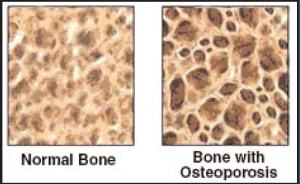
Bone is a living tissue that is constantly renewed through a process in which old bone is removed and replaced by new bone. In Bone there are two important types of cells – Osteoblasts and Osteoclasts. Osteoclasts are bone eroding cells and Osteoblasts are bone forming cells. The bone eroding cells invade the bone and erode it creating cavities in the bone and the bone forming cells fill the cavities with new bone. This is a natural process — nature’s way of restoring bones and keeping them strong.
In younger persons with good bone health, both the cells that erode bone and those that build bone work together. But as we age the bone builders are unable to keep pace with the bone excavators, and this results in loss of bone.
Estrogen has been found to play a major role in maintaining the balance by slowing the pace of bone erosion. When a woman’s estrogen levels fall dramatically, bone loss is accelerated.
During Menopause, a woman’s estrogen significantly decreases as her ovaries where nearly all estrogen is produced, cease to function. A woman can lose 2 to 5 % of her bone density each year during the first 5 to 10 years following menopause. However, not all women develop osteoporosis despite this accelerated bone loss. For example, a woman who enters menopause with a high bone density will be less likely to develop osteoporosis because she has more bone to start with. Other factors are also important including genetics, physical activity and nutrition.
Early Menopause
The relationship between bone health and estrogen raises great concern in women who experience premature menopause — menopause before the age of 45. Sometimes such a menopause occurs naturally, while other times it is medically induced through surgery or chemotherapy. Whatever the cause, early menopause can lead to significant bone loss.
Amenorrhea (Missed Periods)
Amenorrhea is a condition which can develop when a girl or young woman develops an eating disorder or when she is training in sports or other intensive physical activities where she over-exercises. In such cases her menstrual cycle may be disrupted and her estrogen production will decrease.
Periods of estrogen loss during this time of life — even if temporary — can have a profound effect on a woman’s bone health over her lifetime.
As a result, even if she does not develop osteoporosis early in life, she will reach menopause at a great disadvantage and be a likely candidate for postmenopausal osteoporosis.
Estrogen Halts Bone Loss
If used early enough this can prevent a woman’s bones from becoming osteoporotic. In cases where she has low bone density or has already fractured, estrogen can stabilize or even improve her bone density.
Research has provided enough evidence to make a strong case for the use of estrogen as both a preventive therapy and as a treatment for established osteoporosis.
Calcium & Vitamin D ~ An Essential Element for Bone Health
Importance of Calcium There is strong and convincing evidence that calcium is important for building strong bones in childhood, maintaining bone density in adults, and reducing the likelihood of fractures as we age.
Calcium is crucial for life. Every cell in the body needs calcium to function properly. Heart, Nerve and Muscles all need calcium for their activity. Bones need calcium to maintain strength. 99 % of body calcium is in the bones.
Our Body gets calcium from food we eat. If dietary source is deficient in calcium, our body gets it from our bones.
Calcium is essential for bony health for number of reasons. In childhood it is needed for proper formation of bony skeleton to support growing body. By the age 20 bones stop growing in length and by this time peak bony mass is reached. The density of your bones at this point will depend, in part, upon the extent of your calcium intake as a child. The greater this peak bone mass, the less likely your bones are to become porous and fragile later on.
Bone is living tissue, constantly renewing itself.Daily wear and tear causes structural defects which need to be taken care of. This process in the bones is termed as Bone remodelling. Remodelling is an ongoing, natural process and the cycle is completed every three to four months in a healthy young adult. With age this maintenance system becomes less efficient. In people who have relatively healthy bones, adequate calcium intake can help the remodelling process stay balanced. This means that replacement of new bone will remain more efficient, thus preventing a rapid decline in density.
Calcium and Menopause
Calcium is especially important at menopause because calcium absorption seems to slow down with the decrease in estrogen.
How Much Calcium Do You Need?
Following nutritional intake of calcium every day is essential, to maintain strong bones.
Recommended Daily Calcium Intake
Infants
birth-6 months – 400 mg / day
6-12 months – 600 mg / day
Children
1-5 years – 800 mg / day
6-11 years – 800-1200 mg / day
Adolescents & Young adults
11-24 years – 1200-1500 mg / day
Women 25-50 years – 1000 mg / day
Pregnant or lactating women – 1200-1500 mg / day
Postmenopausal women on estrogen – 1000 mg / day
Postmenopaural women not on estrogen – 1500 mg / day
Men (25-50 years) – 1000 mg / day
All women and men above 65 – 1500 mg / day
Is There Such a Thing as Too Much Calcium?No adverse effects have been observed in people who consume well above the recommended daily intake of calcium (up to 2500 mg per day). A high dietary intake of calcium used to be suspected of increasing the risk of kidney stones, but most experts now believe that this is incorrect.
To diagnose Osteoporosis we have to find out the calcium content of the bones. To put it more scientifically, the Bone Mineral Density ( BMD) has to be evaluated. The technology that is used to do this is known as Bone Densitometry.
Before the advent of BMD tests, osteoporosis was diagnosed by routine X-rays or by bone biopsy. By these methods osteoporosis could be rarely diagnosed before at least 25 % of the bone mass was lost, and by this time the disease is well advanced. Today BMD tests help in diagnosing the disease and also help in warning us from the likely hood of developing osteoporosis in the near future.
Indications for BMD tests
1. At Menopause, to decide regarding the need for Hormone therapy.
2. Those on glucocorticoids, to see if they are losing bone mass or not.
3. Recent fractures, where osteoporosis is suspected.
4. Those with osteoporosis and under treatment, to monitor the effectiveness of treatment.
5. Those with Primary Hyperparathyroidism.
6. A man with Hypogonadism.
7. Those on chemotherapy and may be losing bone mass.
The most common bone density test in use today is called dual energy x-ray absorptiometry (DXA). It is a non invasive procedure and the amount of radiation exposure is very little.The results are expressed in units referred to as standard deviations (SD). These SD units tell how far you differ (or deviate) from what is considered normal. If you are 2.5 SD units below normal (-2.5), you will be told that you have osteoporosis.
Heel Ultrasound: A new Technology for testing Bone Density
The test usually involves immersing your foot in a bath of warm water, allowing high frequency sound waves to pass through your heel. The test measures the density and quality of the bone in your heel. It has not yet become a standard testing procedure.
Diagnostic Classifications of Osteoporosis
Classification
Definition
Risk and Recommendations
Normal
BMD is not more than -1 SD below the average peak bone mass of a young person (30-45)
Risk of fracture is very low.
Low Bone Mass (sometimes referred to as Osteopenia)
BMD is between 1 and 2.5 SD below normal (between 1 and 2.5)
• Risk of fracture is usually low to moderate.
• Accelerated bone loss at menopause requires immediate intervention.
Osteoporosis
BMD is greater than 2.5 SD below normal (-2.5) and there have been no fractures
• Moderate to very high risk of fracture.
• Treatment is advised .
Severe Osteoporosis
BMD greater than 2.5 SD below normal (-2.5) with existing fractures
• Very high to extremely high risk of fracture.
• Treatment is strongly advised.

 Manbir Online ~ for Health & Fitness