Inability to detect Sarcasm may be early sign of Dementia.

Inability to detect Sarcasm may be early sign of Dementia.

A study conducted by a group of scientists at the University of California, San Francisco  has determined which areas if brain govern a person’s ability to detect sarcasm and lies.

The team used MRI to map their brains  which showed association between deteriorations of particular parts of brain and the inability to detect insincere speech.

Dementia

Dementia


All of us gradually slow down both physically and mentally with the passage of time as we get older.

There is a difference between occasional forgetfulness and many diseases which are cause of Dementia. Some indications are helpful in differentiating the conditions.

Dementia is a clinical syndrome characterized by loss of previously acquired intellectual functions in the absence of impairment of consciousness.

The term dementia is mostly associated with elderly but some disorders occur in the mid life which have Dementia as a prominent feature. Such diseases are also collectively called Pre-senile Dementia and these diseases also have a strong familial disposition.

Main features of Dementia
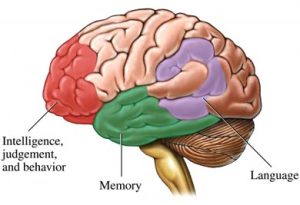
  • Loss of general intelligence
  • Memory impairment
  • Personality changes
  • Emotional changes

Loss of general intelligence:

Judgment and problem solving ability is reduced. Thinking is slow.

Memory impairment:

Minor degree of memory impairment is often the first sign of this disease. Forgetfulness in relation to day to day work and concerning personal possessions is prominent. People’s names are forgotten, appointments are missed. Declining memory may lead to secondary delusions.

Personality changes:

Decline in personal manner and social awareness. Behavior may become rude, tactless, and may be insensitive to feeling of others. Episodes of aggression, sexual indiscretion or even infringement of law may be seen. Deterioration in personal hygiene, urinary and fecal incontinence are common. General decline in interest of the surroundings. Patient may sit for hours without initiating any purposeful activity.

Emotional changes: Mood changes, depression, anxiety, irritability may be prominent in the early stages. In advanced dementia the emotional reaction may be blunted and patients becomes incapable of responding to emotionally charged events in their environment.

Things to look for:

  • Family history:  Some diseases run in families.  Some diseases have genetic predisposition.
  • Signs of memory loss and language difficulties. Is the person losing words, or forgetting the names of common objects? Has he or she forgotten how to do simple mathematics?
  • Is the loss of memory for recent events only?
  • Confusion and loss of attention span. Is the person unable to focus on a normal conversation?
  • Inappropriate behaviour and impaired judgment. If the person begins to act inappropriately or significantly out of character in social situations.
  • Physical coordination problems and physical confusion. People with senile dementia often forget how to do simple learned tasks that have been part of their daily life for many years.

Talking to the person and taking detailed history helps in differentiating and diagnosing the cause of dementia.

Causes of Dementia

Degenerative diseases:

Space occupying lesions:

  • Cerebral tumour
  • Subdural haematoma

Infections:

AIDS, Cerebral syphilis, Viral encephalitis

Others:

Post Traumatic dementia, Boxer’s encephalopathy, Secondary to Head Injury. Chronic Traumatic Encephalopathy
Cerebrovascular disease, Cerebral emboli.
Hypothyroidism, Hypopituitarism.
Liver disease, Renal failure, Alcoholism
Vitamin deficiency: Folic acid, B12

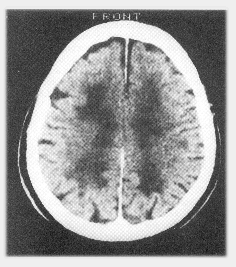
Cerebrovascular dementia: CT brain scan showing multiple diffuse areas of cerebral infarction.

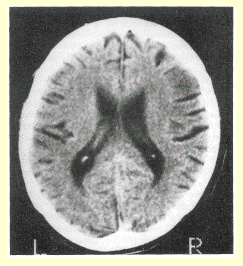
Alzheimer's disease: CT scan of brain showing cortical atrophy, widened sulci, and enlarged lateral ventricles.

Drug Therapy in Dementia

Dementia is a complex disorder which causes impairment in all areas of mental functions

  • Memory and intellectual impairment ( cognitive )
  • Anxiety and depression ( mood )
  • Paranoia and Hallucination ( perception )
  • Agression or withdrawal.

Various neurotransmitters are said to be involved in the causation of Dementia –

  • Acetylcholine
  • Dopamine
  • Serotonin

Drugs for Cognitive and functional impairments in Dementia

These drugs increase the availability of Acetylcholine.
Tacrine
Rivastigmine
Donepezil
Newer drugs in future – Venlacrine,Galanthamine,Hyperazine.

Brain blood flow enhancers

These drugs increase blood perfusion and redistribute blood in the deficient areas.
Cyclandelate
Hydergine

Miscellaneous Drugs

Piracetam – a metabolic enhancing agent of the brain.
Selgilne- a MAOinhibitor, which is used in Parkinson’s disease is also useful in Alzheimer’s disease.
Aspirin and Other Anti inflammatory agents (NSAIDS) have also been shown to slow down the process of dementia.
Oestrogen replacement therapy may be helpful in postmenopausal women with dementia.
Ginkgo biloba
Brahmi
Ashwagandha
Researchers found that taking vitamins C and E might help protect the aging
mind from decline in cognitive function, and some kinds of dementia.

Chronic Traumatic Encephalopathy
Inability to detect Sarcasm may be early sign 

Coffee and Parkinson’s disease

Coffee and Parkinson’s disease

Coffee drinkers may have a lower risk for Parkinson’s disease.

That’s the finding of a study published in the Journal of the American Medical Association.  Researchers came out with this observation after looking at a data on 8,004 Japanese-American men participating in the ongoing Honolulu Heart Program.  The men, whose average age was 53 when the study began, were asked about their coffee consumption twice, in 1965 and again in 1971.  The men who did not drink coffee were five times more likely to have Parkinson’s than those men who drank the most coffee – four to five cups per day.

The researchers could not say why coffee protected the men from Parkinson’s disease, but they hypothesize that caffeine is probably the factor that provides the benefit – the more caffeine consumed, the greater the benefit.  The researchers say caffeine may protect against the nerve cell destruction associated with Parkinson’s.  But they also say there could be something in the brain composition of coffee drinkers that both predisposes them to heavy coffee drinking and makes them resistant to Parkinson’s disease.

It is too early to recommend coffee as a treatment for Parkinson’s disease.  It also is not known if the results of this study will hold true for women or other ethnic groups.

Parkinson’s Disease

Parkinson’s Disease – Genetic & Environmental etiology

Parkinson’s Disease – Genetic & Environmental etiology

Parkinson’s disease is likely to be a multifactor disorder involving a combination of environmental and genetics factors. The cause of PD is unknown. Various factors have been implicated in the etiology of the disease, such as infection, metabolic factors, free radicals, growth factors and toxins. Until recently research mainly focused on connection between this disorder and environmental factors such as viral infection and neurotoxins. In the last few years studies have shown linkage between genetic factors and movement disorders, because of this interest has shifted from environment to genome.

In 1997, a study funded by the National Institute of Health in the US reported that a family of Greek and Italian origin with a parkinsonian syndrome had an abnormal gene on chromosome 4 which produced a protien called alpha-synuclein. This family was atypical because of relatively young mean age of onset of 45 years and the rapid course of 10 years from the onset to death.

However, in over 200 familial cases of PD, studies by other groups, Parkinsonism was not linked to the abnormal gene on chromosome 4.

Work done by different groups have shown linkage of PD with other chromosomes 2 and 6. The demonstration of three different genes, on 3 different chromosomes, producing parkinsonism, shows that there are multiple causes even within genetic category. There are certainly multiple genetic causes but in all probability in majority of patients there are significant non-genetic causes.

It may be that there are several different environmental risk factors just as there are several different genes on several different chromosomes which establish the background of susceptibility to Parkinson’s disease. The liability to develop the disease will depend on what one might say the dose of environmental factor and the dose of genetic predisposition combined.

Parkinson’s Disease

Parkinson’s Disease

Parkinson’s Disease

Is a chronic degenerative disorde. Its cause is still unknown.

Average age of onset: 57 years.

The disease was first identified in 1817.

Approximately 40,000 new American patients are diagnosed each year. In many cases the general “slowness” attributed to old age, may be an early symptom of PD.

People in rural areas are at higher risk of developing the disease than those in urban areas, perhaps because of exposure to pesticides, fungicides or herbicides through contaminated well water.

There is also a microorganism in the soil — Nocardia — that may damage dopaminergic neurons. Other high-risk environments include regions surrounding petroleum plants and pharmaceutical manufacturing plants.

Epidemiologists have noted that most PD patients have never smoked, and at least one study found a marked increase in the incidence of the disease among individuals with a history of mumps compared with those who never had mumps.

PD is not generally regarded as a genetic disease, although patients may inherit a predisposition. Some 14% of PD patients have one or more first-degree relatives who have the disease or a related disorder, compared to 5% of controls. Onset before age 40 is more often associated with a family history.

Low prevalence of Parkinsons’s disease among Indians is said to be due to the presence of some protective factors in the brain that inhibit the pathological changes leading to Parkinson’s disease.

Prevalence ratio:

North Americans: 280/100,000

Africans: 59/100,000

Chinese: 44/100,000

Indians: 19/100,000. Parsis living in India have the highest recorded prevalence rate of 328/100,000. (Parsis migrated to India from Persia now Iran.)

Parkinsonism is a syndrome consisting of three main components:
Tremor
Muscular Rigidity
Hypokinesis

(Hypokinesis is slowness in initiating & repeating voluntary movements)

Overall prevalence is about 1 / 1000 of the general population. There is a low prevalence of this disease among Indians. It is more common in elderly, the prevalence rising to 1% of those over 60 years.

Aetiology

The cause of the disease is not known. Genetic factors are not important in a typical case.
Environmental toxins may be a contributing factor.
Country areas frequently sprayed by herbicides show increased incidence of parkinsonism. Chemicals such as (MPTP) methyl-phenyl-tetrahydopyridine, paraquet have been implicated.

Clinical Features

Both sexes are affected equally. Onset of the disease is usually after 50 years. Very occasionally the symptoms may start in 3rd & 4th decade. Initially the classical symptoms may be absent. The disease may start as Tiredness, aching limbs, mental slowness, depression and small handwriting.
Face gives appearance of Expressionless face, Greasy skin, Fixed posture.

Tremor: Tremor at rest affecting one or both hands may be the first symptom. Tremor may also affect tongue, legs, mouth. Tremor may remain the only symptom for many years. Tremor is intermittent present at rest and when distracted. It diminishes on action.
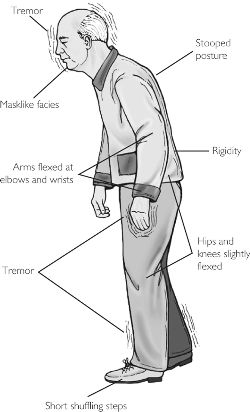
Hypokinesis: Difficulty in initiating rapid fine movements, slowness of gait, difficulty in tasks such as fastening buttons and writing.
Gait is typical – slow to start walking, shortened stride, rapid small steps, tendency to run, reduced arm swinging, and impaired balance on turning.

Rigidity of muscular tone: causes stiffness and flexed posture. Gradually the speech becomes softer and indistinct. Postural balance is disturbed because of impairment in the reflexes responsible for maintaining balance. Such patients are prone to falls. Rigidity is known as Cogwheel type in upper limbs and Plastic lead pipe type in the lower limbs.

Features of parkinsonism may be unilateral in the beginning but gradually they become bilateral. Muscle strength and reflexes remains normal. Facial reflexes are enhanced. Tapping of the forehead causes rapid blinking known as Glabellar tap sign. Intellectual faculties are not markedly affected. Some patients may get depressed and there may be some cognitive impairment as the disease advances.

Management

Drug therapy

L-DOPA

The rationale for using L-DOPA is that the enzyme step converting the precursor DOPA to Dopamine is dependent on the concentration of the substrate. Although in parkinsonism the number of dopamine releasing terminals in the striatum is diminished it is possible to overdrive the remaining neurons to produce more dopamine by administering DOPA.
More than 90% of the orally taken L-DOPA is decarboxylated in the gastrointestinal tract to dopamine and only a small amount reaches the brain. If L-DOPA is used alone there is high incidence of side effects such as nausea, vomiting, vasodilatation. This problem is solved by giving a peripherally acting decarboxylase inhibitor. This combination therapy permits use of low dose of L-DOPA.

L-DOPA + Carbidopa
L-DOPA + Benserazide
The combination should be started with low dose and gradually increased. Tremor, Rigidity and hypokynesis are improved.
With the progression of the disease there is loss of capacity to store dopamine. Late deterioration in response to L-DOPA therapy occurs after 3-5 years in 1/3 to 1/2 of patients.
Selegiline and Bromocriptine may be helpful at this stage.

Bromocriptine is preferably used as a low dose combination with L-DOPA. Especially in young patients who need treatment for many years.

Surgery

Stereotactic thalamotomy is occasionally performed in patients with severe unilateral tremors not responding to drugs.
Implantation of Fetal mid brain or Adrenal cells into the basal ganglion in parkinsonian patients has been tried.

Physiotherapy and Speech therapy is needed to reduce rigidity and to correct posture.

 Other drug:

Benxhexol 1-5 mg tid
Orphenadrine 50-100 mg tid

Have useful effect on tremor and rigidity. Do not help hypokynesis. They should be used in early stage of the disease when hypokynesis is not a problem.

Side effects: dryness of mouth, blurring of vision, difficulty in micturation and constipation.

Amantidine 100mg bid or tid

It has mild short lived action on hypokinesis.

Side effects: oedema, confusion, seizures.

Ropirinol – Requip – ( SmithKline Beecham )
Pramipexole – Mirapex – ( Pharmacia & Upjohn )
Tolcapone – Tasmar – ( Roche )

Disorders that may mimic Parkinsons disease

Benign essential or familial tremor, a slowly progressive condition that usually develops in the fourth and fifth decades.
Symptoms include a tremulous voice and shaky hands and/or head (the head may bob side to side or up and down).
The typical parkinsonian rigidity, stiffness and bradykinesia do not occur.

Hyperthyroidism can also cause tremor.

Other more serious conditions that may mimic PD include Progressive Supranuclear Palsy, Shy-Drager Syndrome.

Parkinson’s Gene
Parkinson’s Disease – Genetic & Environmental etiology
Coffee and Parkinson’s disease