Alcohol and Heart Diseases

Alcohol and Heart Diseases

Studies have shown some protective effect of alcohol intake for heart diseases. Researchers have shown that equivalent of two drinks per day of any kind of alcohol is associated with a decreased incidence of Coronary Heart Disease as compared with no drink. Higher doses than this results to increased risk of Heart Attacks and Stroke. 

The cardio protective effect of most alcoholic beverages are probably due to an elevation of high density lipoprotein HDL, the good cholesterol. Ability of alcohol to prevent platelet aggregation and increase fibrilolysis is also said to be the contributing factor.

Red Wine has increased favorable cardio protective effect as compared to the other type of wine. This is due to presence of Flavonoids in the red wine which are minimal in the white wine ( the the exception of Champagne).   The best researched flavonoids are Resveratrol and Quercetin which confer antioxidant properties more potent than alpha-tocopheraol.

Grape juice has about half the amount of Flavonoids by volume as compared to Red Wine.

Epidemiological studies have also suggested that the consumption of wine, particularly the red wine, reduces the incidence of mortality from coronary heart disease. This has given rise to what is now popularly known as “French Paradox“.

Even with all these fact it is not advisable to encourage alcohol consumption on regular basis. There is always chance for over consumption when it comes to alcohol use. 

TMT

TMT

TMT is the most widely used test in the diagnosis of ischemic heart disease. It  involves recording the 12-lead ECG before, during, and after exercise on a treadmill.
The test consists of a standardized gradual incremental increase in external workload while the patient’s ECG, symptoms, and arm blood pressure are continuously being  monitored. The test is discontinued upon evidence of chest discomfort, severe shortness of breath, dizziness, fatigue, ST-segment depression of greater than 0.2 mV (2 mm), a fall in systolic blood pressure exceeding 10 mmHg, or the development of a ventricular tachyarrhythmia.
This test helps to discover any relation between exercise and chest discomfort and the typical ECG signs of myocardial ischemia.
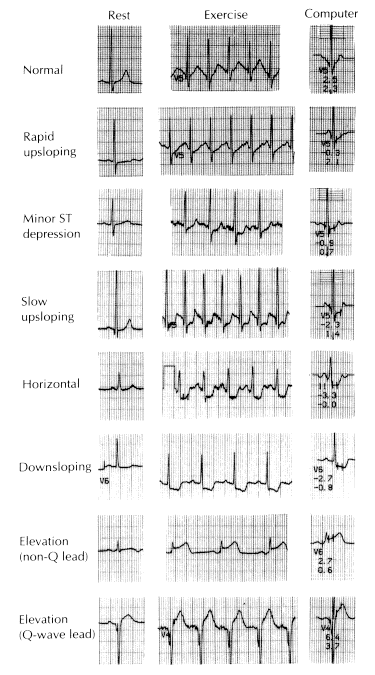
The ischemic ST-segment response is generally defined as flat depression of the ST segment of more than 0.1 mV below the baseline and lasting longer than 0.08 s. This type of depression is designated “square wave” or “plateau” and is flat or downsloping. Upsloping or junctional ST-segment changes are not considered characteristic of ischemia and do not constitute a positive test.
Although T-wave abnormalities, conduction disturbances, and ventricular arrhythmias that develop during exercise should be noted, they are also not diagnostic.
Negative exercise tests in which the target heart rate (85 percent of maximal heart rate for age and sex) is not achieved are considered to be nondiagnostic.
Overall, false-positive or negative results can occur in 15 percent of cases. However, a positive result on exercise indicates that the likelihood of CAD is 98 percent in males over 50 years of age with a history of typical angina pectoris who develop chest discomfort during the test. The likelihood decreases progressively and significantly if the patient has atypical or no chest pain. The incidence of false-positive tests is significantly increased in asymptomatic men under the age of 40 or in premenopausal women with no risk factors for premature atherosclerosis. It is also increased in patients taking cardioactive drugs such as digitalis and quinidine.
Since the overall sensitivity of exercise stress electrocardiography is only about 75 percent, a negative result does not exclude CAD, although it makes the likelihood of three-vessel or left main CAD extremely unlikely.
The physician should be present throughout the exercise test, and it is important to measure total duration of exercise, the times of the onset of ischemic ST-segment change and chest discomfort, The depth of the ST-segment depression and the time needed for recovery of these ECG changes are also important.
Because the risks of exercise testing are small but real estimated at one fatality and two nonfatal complications per 10,000 tests¾equipment for resuscitation should be available.
The normal response to exercise includes a progressive increase in heart rate and blood pressure. Failure of the blood pressure to increase or an actual decrease in blood pressure with signs of ischemia during the test is an important adverse prognostic sign, since it may reflect ischemia-induced global left ventricular dysfunction. The presence of pain or severe (>0.2 mV) ST-segment depression at a low workload and ST-segment depression that persists for more than 5 min after the termination of exercise increases the specificity of the test and suggests severe ischemic heart disease and a high risk of future adverse events.
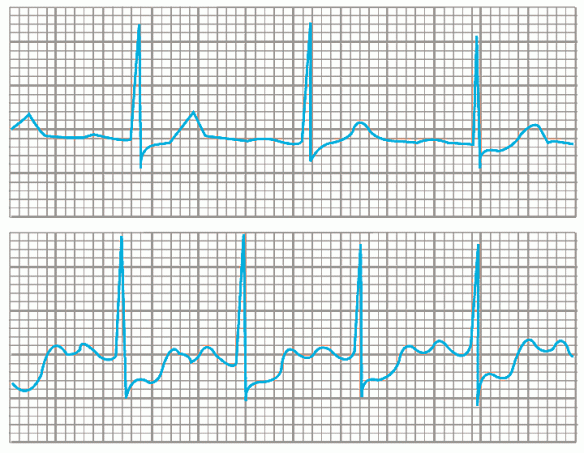
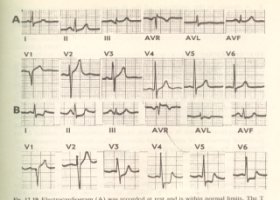
Lead V4 at rest (top) and after 41/2 min of exercise (bottom). There is 3 mm (0.3 mV) of horizontal ST-segment depression, indicating a positive test for ischemia.
Stress induced Electrocardiogram in a patient of Angina Pectoris
Illustration of typical exercise electrocardiographic (ECG) patterns at rest and at peak exertion. The patterns represent a gradient of worsening ECG response to myocardial ischemia.The first two tracings illustrate normal and rapid upsloping ST segments; both are normal responses to exercise.
Stress induced Electrocardiogram in a patient of Angina Pectoris
Normal Electrocardiogram
Angina Pectoris

Normal Electrocardiogram

Normal Electrocardiogram

ECG or Electrocardiogram, is recording of electrical activity in the heart.
The elctrocardiography is based on two basic principles.
1. When the electromagnetic force flows towards the positve electrode of a lead, the ecg would record an upward or positive deflection.
2. When the electomegnetic force flows away from the positve electrode of a lead or towards the negative electrode the ecg would record a downward or negative deflecton.
The electrocardiografic deflections are termed as P, QRS, T, and U.

Diagramatic representation of basic electrocardiografic deflections

The P wave represents atrial activation, the QRS complex represents ventricular activation, T wave represents ventricular recovery. The interpretation of U wave is uncertain. The ST segment, T wave and U wave together represent the ventricular recovery. The other significant portions of the ecg deflection are PR interval, QRS duration, ST segment.
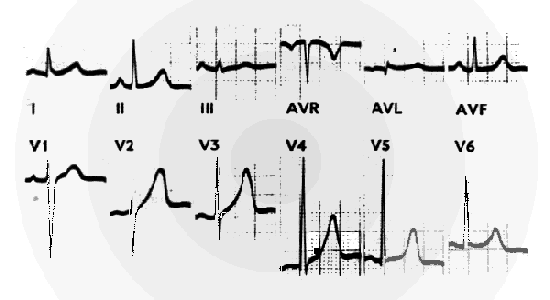
A routine electrocardiogram consists of 6 Limb leads and 6 Chest leads. The Limb Leads are marked as I, II, III, aVR,aVL, aVF and the Chest Leads are V1, V2, V3, V4, V5, V6. The limb leads are placed on the four limbs and the chest leads are put on the mid chest and the left half of the chest.
Normal pattern of electrocardiografic deflections in various leads
Angina Pectoris
Stress induced Electrocardiogram in a patient of Angina Pectoris
TMT

Angina Pectoris

Angina Pectoris

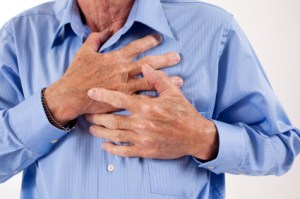
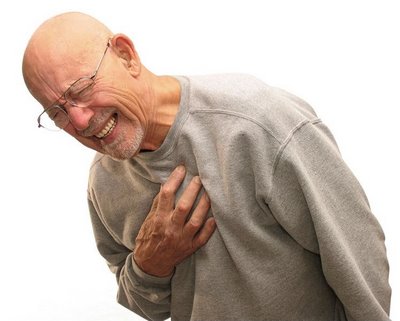
Angina Pectoris is the name given to a clinical syndrome used to describe discomfort due to transient myocardial ischaemia. The underlying cause may be Coronary atheroma. Spasm of coronary artery may also be underlying cause.
Factors that worsen Angina

  • Exercise
  • Anaemia
  • Hypertension
  • Hyperthyroidism
  • Tachycardia (increased heart rate)
  • Aortic valve disease

Features of of Angina
It is usually experienced as a sense of oppression or tightness in the middle of the chest ‘like a band round the chest’. It is induced by exertion and relieved by rest and lastsfor a few minutes.
The pain may be accompanied by discomfort in the arms more commonly in the left arm or even wrist or hands. The pain may radiate to neck or jaw or it may be present in the upper abdomen (epigastric region) or even back (interscapular region).
Situations precipitating Angina
Physical exertion like walking, or walking against wind, or while having a bath.
Cold exposure
Intense emotions
Heavy meals
Violent dreams
Lying flat

Relief of pain with Glyceryl trinitrate helps in diagnosis of Angina Pectoris.

Conditions that may mimic Angina Pectoris
Musculoskeleton pains: of the chest and back may at times confuse and create difficulty in the diagnosis of Angina. The pain of muscular origin is not totally relieved by rest and may persist even after rest. Local tenderness is present in case of pain of musculoskeletal in nature.
Pericardial pain: Pain of acute pericarditis is typically in the retrosternal region and often radiates to the neck and shoulders. It may be made worse by deep breath, movement or change of posture. A friction rub known as Pericardial Rub is diagnostic, and is best heard by a stethoscope at the left of lower sternum.
Oesophageal pain: Pain due to oesophagitis has a burning quality and is relieved by taking Antaacids. Oesophagial spasm pain may at times be indistinguishable from angina.

Risk Factors for Coronary Heart Disease

  • Smoking
  • Hyperlipidaemia
  • Hypertension
  • Diabetes Mellitus
  • Sedentary Lifestyle
  • Obesity
  • Diet defficient in Polyunsaturated fatty acids
  • Low Vitamin E & C
  • Blood Coagulation Factors Fibrinogen & Factor VII
  • High levels of lipoprotein (a), homocysteine, ApoB
Smoking has a definite dose related relationship with Ischaemic heart disease. The risk of death for smokers is highest in younger population.
Hereditary Hypercholesterolaemia ( Raised blood level of Cholesterol) : Patients with hereditary hypercholesterolaemia have high incidence of Coronary disease. Reduction of blood cholesterol has a definite effect in the reduction of morbidity and death from coronary heart disease.
It is estimated that the development of Ischaemic heart disease is controlled by both Genetic and Environmental factors, could be in the ratio of 40:60.
Major manifestations of Coronary Heart disease are Angina Pectoris & Myocardial Infarction

Normal Electrocardiogram