
|
Herpes Simplex virus Type 2 infection |
| Herpes simplex virus type 2 infection was one of the strongest risk factors for HIV acquisition among men who have sex with men. |
|
Herpes Simplex virus Type 2 infection |
| Herpes simplex virus type 2 infection was one of the strongest risk factors for HIV acquisition among men who have sex with men. |
| Hair | |
| Hair, is a characteristic of mammalian class of living beings.Hair follicle in the skin is the place where hair grows. | |
| The active living portion of the hair is the follicle. The hair that is visible is the hair shaft. It has no biochemical activity and is non active. The active portion of the hair is found in the follicle.The base or the bulb contains the cells that produce the hair shaft. Other structures of the hair follicle include the oil producing sebaceous gland which lubricates the hair and the erector pili muscles, which are responsible for causing hairs to stand-up. |  |
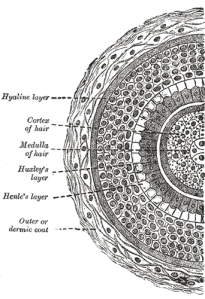 |
The strand of hair is made of the medulla, cortex and the cuticle. The cortex, or middle layer of the hair, is the primary source of mechanical strength. The cortex contains melanin which gives colour to the hair. The colour depends on the number, distribution and the type of melanin granules. |
| The shape of the follicle determines the shape of the cortex, and the shape of the fiber is related to how straight or curly the hair is. Asian hair typically has a round fiber and is quite straight. Oval and irregularly-shaped fibers are generally more wavy or even curly. The cuticle is the outer covering. Its complex structure slides as the hair swells and is covered with a single molecular layer of lipid that makes the hair repel water.The diameter of human hair varies from 17 to 180 µm (0.00067 to 0.0071 in). | |
| All natural hair colors are the result of two types of hair pigment eumelanin and pheomelanin. Both of these pigments are melanin types, produced inside the hair follicle. Generally, if more melanin is present, the color of the hair is darker; if less melanin is present, the hair is lighter. Levels of melanin can vary over time causing a person’s hair color to change, and it is possible to have hair follicles of more than one color.Eumelanin is the dominant pigment in dark-blond, brown, and black hair, and pheomelanin is dominant in red hair.Blond hair is the result of having little pigmentation in the hair strand.
Gray hair occurs when melanin decreases or disappears. |
|
| The hair found on the head serves as primary sources of heat insulation and cooling when sweat evaporates from soaked hair, as well as protection from ultra-violet radiation exposure.The hair on the human body does help to keep the internal temperature regulated. When the body is too cold, the arrector pili muscles attached to hair follicles cause the hair to stand up. These hairs then form a heat-trapping layer above the epidermis. This process is called piloerection. The opposite actions occur when the body is too warm. The arrector muscles make the hair lay flat on the skin which allows heat to leave. | |
| HIV Infection showing decline! |
| Report released by UNAIDS today said that: the global response to AIDS is showing results. As the world marks 30 years of AIDS, UNAIDS estimates about 34 million people are living with HIV and nearly 30 million people have died of AIDS-related causes since the first case of AIDS was reported on June 5, 1981. |
Some of the facts:
|
| HIV ~ Human Immunodeficiency Virus |
| HIV- Management |
| In HIV infection there is intense and persistent viral replication which leads to gradual depletion of CD4 cells. The primary goal in managing the HIV patients is to prevent this process of replication to as low as possible and to maintain it as long as possible. With this there is lower risk of clinical progression of the disease and prevention of opportunistic infection. |
| Classes of ANTIRETROVIRAL DRUGS: Anti retroviral drugs act by inhibiting the multiplication of the virus. The drugs mainly target 2 key enzymes the virus requires to multiply.These are PROTEASE , REVERSE TRASCRIPTASE. Drugs inhibiting the Reverse Transcriptase enzyme are divided into two types – Neucleoside Reverse Transcriptase Inhibitors (NRTIs) & Non-Neucleoside Reverse Transcriptase Inhibitors (NNRTIs). |
| Combination Therapy: HIV virus has the ability of developing resistance if any one drug is used alone. Hence current guidelines are to use at least 3 antiretroviral drugs in combination. This is the same principle used in the treatment of tuberculosis. This triple drug regime is commonly called HAART ( Highly Active Antiretoviral Therapy). HAART has been shown to inhibit viral replication to levels below the limit of detection. |
| Initiating Antiretroviral Therapy: The antiretroviral therapy is started in persons with sign of compromised immune system or indication of presence of Opportunistic infection. CD4+ cell count less than 500 cells/ micoliter or increase of viral load to more than 5,000 – 10,000 copies/ milliliter. are indications of reduced immune strength. All symptomatic patients with symptoms suggestive of active infection – wasting, thrush or unexplained fever for > 2 wks. should be started with antiretroviral drugs irrespective of the viral load. Proper counseling of the patients is also very important before commencing the therapy. Patients is told about the fact that the therapy has to be life long and it is not curative. Cost of the therapy and side effects should be known to the patient. Adherence to the treatment process should be thoroughly stressed. The patient should know that even if he or she is keeping fine transmission of the infection to others is possible and safe sex methods should be practiced. |
|
Commonly used initial Antiretroviral regimens |
|
|
Antiretroviral drug regimens are comprised of one choice each from column A and B. |
|
|
Column A |
Column B |
| Efavirenz | Stavudine + Didanosine |
| Indinavir | Stavudine + Lamivudine |
| Nelfinavir | Zidovudine + Lamivudine |
| Nevirapine | Zidovudine + Didanosine |
| Saquinavir | |
|
|

 Manbir Online ~ for Health & Fitness