Snake Structure Spitting Snakes Snakes – Some Facts How to keep snakes out of my yard? Protection from Snakes Snake Bite ~ Management Poisonous Snakes Dangerous Snakes in the World Deadliest Snakes in the World
Snake Bite ~ Management
Management of Snake Bite |
Allay anxiety and frightDeaths have been reported from shock due to fright even when the bites were by non-poisonous snakes. Hence, it is vital to reassure patients.
Reassurance helps reduce anxiety related high. blood pressure, palpitations, tremors, sweating and rapid breathing. Check if the bite is due to a poisonous or a non-poisonous snake. because people who are bitten can’t always positively identify a snake, they should seek prompt care for any bite, though they may think the snake is nonpoisonous. Even a bite from a so-called “harmless” snake can cause an infection or allergic reaction in some individuals. In cases where the snake is killed and brought to the clinic, examination of the snake helps differentiate whether it is poisonous or non-poisonous. In the absence of the snake, the bite mark should be examined using a magnifying lens.
|
|
|||
|
Under Medical SupervisionIn the management of the snake bite an estimate of the severity of envenomation should be made as soon as possible, before any antivenin is administered, since, for example, in approximately 20% of rattlesnake bites, venom may not be injected. The preferred route of administration is by intravenous infusion. However, many antivenin polyvalent may be administered intramuscularly. If the intramuscular route is used, the antivenin should be administered into a large muscle mass, preferably into the gluteal area, with care to avoid nerve trunks. It should be kept in mind that maximum blood concentrations may not be attained for 8 or more hours after intramuscular administration. Reconstituted antivenin polyvalent may be administered intravenously in a 1:1 to 1:10 dilution in 0.9% sodium chloride injection or 5% dextrose injection. Decisions concerning the dilution of antivenin to be used, and the rate of intravenous delivery of the diluted antivenin should take into account the age, weight, and cardiac status of the patient; the severity of the envenomation; and the interval between the bite and the initiation of specific therapy. The entire initial dose of antivenin should be administered as soon as possible, preferably within 4 hours after the bite. Antivenin is less effective when given 8 hours or more after envenomation and may be of questionable value when given after 12 hours. However, in severe poisonings, it is recommended that antivenin therapy be given even if 24 hours have elapsed since the bite. The initial 5 to 10 ml of the diluted antivenin should be infused over a 3 to 5 minute period, with careful observation of the patient for evidence of an untoward reaction If no symptoms or signs of an immediate systemic reaction appear, infusion of the diluted antivenin may be continued at the maximum rate considered safe for intravenous fluid administration. The decision to use additional antivenin should be based on the clinical response to the initial dose and on continuing assessment of the severity of poisoning. If swelling continues to progress, if systemic symptoms or signs of envenomation increase in severity, or if new manifestations appear (for example, fall in hematocrit or hypotension), intravenous administration of an additional 10 to 50 ml (contents of 1 to 5 vials) or more may be necessary. Pit viper bites on toes or fingers may require as much as 50% more antivenin due to difficulties in achieving adequate antivenin concentrations in the affected area. Administration of anti-venom: Polyvalent anti-snake venom contains antibodies against cobra, common krait and viper. 1/3 of the dose should be given subcutaneously (near bite but not in fingers or toes). The intravenous dose can be repeated every 6 hours till the symptoms disappear. For sea-snake bites, special antivenins are available. Manage toxic signs/symptoms: Anti-venom acts only against circulating toxin, not toxin fixed to tissue. Therefore, specific measures have to be taken. Take supportive measures: These include blood or plasma transfusion to combat shock, |
Snake Structure Spitting Snakes Snakes – Some Facts How to keep snakes out of my yard? Protection from Snakes Snake Bite ~ Management Poisonous Snakes Dangerous Snakes in the World Deadliest Snakes in the World
Poisonous Snakes
|
Types of Poisonous Snakes |
|
Poisonous Snakes are of Three types: |
|
| Approximately 2500 different species of snakes are known. Approximately 20 % of the total number of the snake species is poisonous. |
|
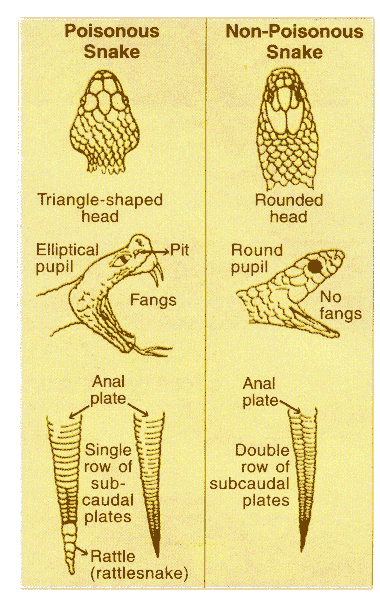
Features of Poisonous & Non-Poisonous snakes |
![]() |
Poisonous Snakes
|
Non Poisonous Snakes
|
|
Symptoms due to Snake bite Cobra or Krait Viper Sea Snakes |
Snake Structure Spitting Snakes Snakes – Some Facts How to keep snakes out of my yard? Protection from Snakes Snake Bite ~ Management Poisonous Snakes Dangerous Snakes in the World Deadliest Snakes in the World
Dangerous Snakes in the World
Dangerous Snakes in the World |
| Annually, throughout the world, it is estimated there are a minimum of 1 to 2 million snakebite “incidences.” This number includes bites by non-venomous species. Of that number roughly 50,000 to 60,000 bites result in fatalities. The country that has the largest number of snakebite deaths annually is the tiny island of Sri Lanka.Each year in the United States there are approximately 45,000 snake bite incidences, including non-venomous bites. Only about 8000 of that number are venomous snake bites but a mere 9 to 15 people die.The Most Dangerous Snakes that kill the most people according to the geographical locations are as given below : –In the United States the coral snake has a very toxic venom but has killed few people because it is small, secretive and gentle. The most dangerous are the rattlesnakes like the Eastern and Western Diamondbacks. These rattlesnakes are large, have large venom glands, are relatively common, and are more likely to hold their ground and bite.
In Africa common Egyptian Cobras, Saw-scaled Vipers, and Puff Adders would be the most dangerous. In Asia the common Cobra and the Russell’s Viper are the snakes that kill the most people. Although the Asian Cobra and Russell’s Viper probably kill most of the people who die of snake bite annually in the world neither of them are among the most Deadly Snakes. |
The most Deadly Snake, and the most Dangerous Snake are two entirely different concepts. Some of the snakes with the most toxic venom, that is, the most deadly, rarely bite people.The Most Dangerous Snakes are those that kill the most people. |
| Asian Cobra and Russell’s Viper probably kill most of the people who die of snake bite annually in the world |
Snake Structure Spitting Snakes Snakes – Some Facts How to keep snakes out of my yard? Protection from Snakes Snake Bite ~ Management Poisonous Snakes Dangerous Snakes in the World Deadliest Snakes in the World
Deadliest Snakes in the World
Deadliest Snakes in the World ![]() |
|
| There are many factors that influence the seriousness of a bite. |
The factors include the individual’s health, size, age, and psychological state. The nature of the bite may also vary, like penetration of one or both fangs, amount of venom injected, location of the bite, and proximity to major blood vessels. The health of the snake and the interval since it last used its venom mechanism is also important. These multiple variables make every bite unique. Depending on circumstances, the bite of a “mildly” venomous snake may be life-threatening and that of a “strongly” venomous snake may not.
As a precautionary tip, always seek immediate medical attention if bitten by a suspected venomous snake. Even having someone with proper CNA training to escort you to a medical facility will increase your chances of survival. Snake bites are never to be taken lightly.
The most Deadly Snake, and the most Dangerous Snake are two entirely different concepts. Some of the snakes with the most toxic venom, that is, the most deadly, rarely bite people.The Most Dangerous Snakes are those that kill the most people. |
| Asian Cobra and Russell’s Viper probably kill most of the people who die of snake bite annually in the world |
Snake Structure Spitting Snakes Snakes – Some Facts How to keep snakes out of my yard? Protection from Snakes Snake Bite ~ Management Poisonous Snakes Dangerous Snakes in the World Deadliest Snakes in the World