Chronic Traumatic Encephalopathy

Chronic Traumatic Encephalopathy

CTE. Chronic traumatic encephalopathy, is a dementia-like brain disease afflicting athletes exposed to repeated brain trauma.
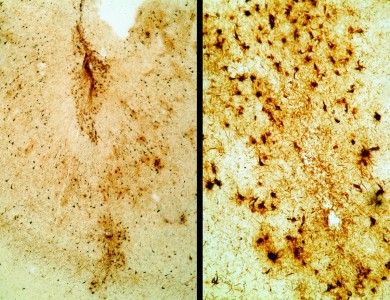
Abundant tau immunoreactive neurofibrillary tangles (dark brown dots) in the cerebral cortex in a pattern unique to chronic traumatic encephalopathy (CTE)

CTE has been found in the brains of 14 of 15 former NFL players thus far studied.

Their cases share a common thread — repeated concussions, sub-concussive blows to the head, or both. The picture beginning to emerge from these cases is that trauma could be causing brain damage.

A brain with CTE is riddled with dense clumps of a protein called tau. Under a microscope, tau appears as brown tangles seen in dementia. But the cases of CTE have shown this progressive, dementia-like array in players well in advance of a typical dementia diagnosis, which typically occurs in the 70s or 80s.
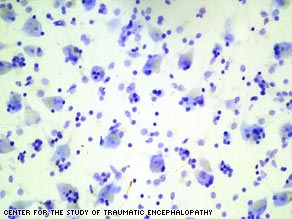
Healthy Brain Tissue

Scientists at Boston University have found evidence of CTE in the brain of an athlete as young as 18.

Symptoms that are common among many cases of CTE including problems with impulse control, an increasingly short fuse and headaches.

The alarming aspect is that we do seem to be seeing an increased rate in athletes who have early and moderate stage CTE.

CTE

Dementia

Breast Cancer ~ Some Facts

Breast Cancer ~ Some Facts

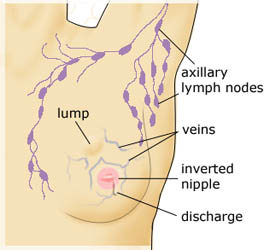
  • A painless lump in the breast is a highly suspicious of cancer breast.
  • Changes in breast size or shape.
  • Swelling in the armpit.
  • Changes in the Nipple or discharge from Nipple.
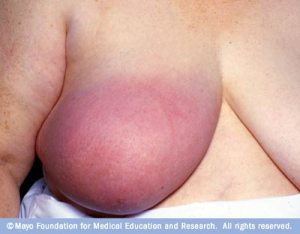
  • Inflammatory breast cancer is a rare, fast-growing type of cancer that often causes no distinct lump. Instead, breast skin may become thick, red, and may look pitted — like an orange peel. The area may also feel warm or tender and have smallbumps that look like a rash.

    Inflammatory Breast Cancer

  • The earlier breast cancer is found, the easier it is to treat and a better prognosis. Mammograms, X-rays of the breast, can detect tumors before they are large enough to feel. The American Cancer Society recommends yearly mammograms beginning at age 40 for women at average risk. While the U.S. Preventive Services Task Force recommends a screening mammogram every two years from age 50 to 74. It also notes that before age 50, each woman should check with a doctor to find out what screening schedule is right for her, considering the potential benefits and harms from screening.
  • Eighty percent of breast lumps are not cancerous. Lumps often turn out to be harmless cysts or tissue changes related to your menstrual cycle. But you should let your doctor know right away if you find anything unusual in your breast. If it is cancer, the earlier it’s found the better. And if it’s not, testing can give you peace of mind.
  • The only sure way to determine whether a lump is cancer is to do a biopsy. This involves taking a tissue sample for further examination in the lab, sometimes through a small needle. Sometimes surgery is done to take part of or the entire lump for testing. The results will show whether the lump is cancer, and if so, what type. There are several forms of breast cancer, and treatments are carefully matched to the type of cancer.
  • Some types of breast cancer are fuelled by the hormones estrogen or progesterone. A biopsy can reveal whether a tumor has receptors for estrogen (ER-positive) and/or progesterone (PR-positive). About two out of three breast cancers are hormone sensitive. There are several medications that keep the hormones from promoting further cancer growth.
  • In about 20% of patients, breast cancer cells have too many receptors for a protein called HER2. This type of cancer is known as HER2-positive, and it tends to spread faster than other forms of breast cancer. It’s important to determine whether a tumor is HER2-positive, because there are special treatments for this form of cancer.
  • Once breast cancer has been diagnosed, the next step is to determine how big the tumor is and how far the cancer has spread. This process is called staging. Doctors use Stages 0-4 to describe whether cancer is localized to the breast, has invaded nearby lymph nodes, or has spread to other organs, such as the lungs. Knowing the stage and type of breast cancer will help your health care team formulate a treatment strategy.
  • The odds of surviving breast cancer are strongly tied to how early it is found. According to the American Cancer Society, 100% of women with Stage 1 breast cancer live at least five years, compared to women without cancer – and many women in this group remain cancer-free for good.  The more advanced the cancer, the lower this figure becomes. By Stage 4, the five-year relative survival rate declines to 20%. But these rates can improve as more effective treatments are found.
  • There are many types of breast cancer surgery, from taking out the area around the lump (lumpectomy or breast-conservation surgery) to removing the entire breast (mastectomy.) It’s best to discuss the pros and cons of each of these procedures with your doctor before deciding what’s right for you.
  • Radiation therapy uses high-energy rays to kill cancer cells. It may be used after breast cancer surgery to wipe out any cancer cells that remain. It can also be used along with chemotherapy for treatment of cancer that has spread to other parts of the body. Side effects can include fatigue and swelling or a sunburn-like feeling in the treated area.
  • Chemotherapy uses drugs to kill cancer cells anywhere in the body. The drugs are often given by IV, but are sometimes taken by mouth or shot. Chemotherapy may be done after surgery to lower the odds of the cancer coming back. In women with advanced breast cancer, chemotherapy can help control the cancer’s growth. Side effects may include hair loss, nausea, fatigue, and a higher risk of infection.
  • Hormone therapy is an effective treatment for women with ER-positive or PR-positive breast cancer. These are cancers that grow more rapidly in response to the hormones estrogen or progesterone. Hormone therapy can block this effect. It is most often used after breast cancer surgery to help keep the cancer from coming back. It may also be used to reduce the chance of breast cancer developing in women who are at high risk.
  • Targeted therapies are newer drugs that target specific properties within cancer cells. For example, women with HER2-positive breast cancer have too much of a protein called HER2. Targeted therapies can stop this protein from promoting the growth of cancer cells. These drugs are often used in combination with chemotherapy. They tend to have milder side effects compared to chemotherapy.
  • There’s no doubt that cancer is a life-changing experience. The treatments can wear you out. You may have trouble managing daily chores, work, or social outings. This can lead to feelings of isolation. It’s crucial to reach out to friends and family for support. They may be able to go with you to treatments, help out with chores, or just remind you that you are not alone. Many people choose to join a support group — either locally or online.
  • Many women who have a breast removed choose to undergo reconstructive surgery. This replaces the skin, nipple, and breast tissue that are lost during a mastectomy. Reconstruction can be done with a breast implant or with tissue from somewhere else in your body, such as the tummy. Some women opt to begin reconstruction at the same time as their mastectomy. But it’s also possible to have reconstructive surgery months or years later.
  • An alternative to breast reconstruction is to be fitted for a breast form. This is a breast-shaped prosthesis that fits inside your bra. Wearing a breast form allows you to have a balanced look when you are dressed — without undergoing additional surgery. Like reconstructive surgery, breast forms are often covered by insurance.
  • The most obvious risk factor for breast cancer is being a woman. Men get the disease, too, but it is about 100 times more common in women. Other top risk factors include being over age 55 or having a close relative who has had the disease. But keep in mind that up to 80% of women with breast cancer have no family history of the illness.
  • Some women have a very high risk of breast cancer because they inherited changes in certain genes. The genes most commonly involved in breast cancer are known as BRCA1 and BRCA2. Women with mutations in these genes have up to an 80 percent chance of getting breast cancer at some point in life. Other genes may be linked to breast cancer risk as well.
  • Being overweight, getting too little exercise, and drinking more than one alcoholic beverage per day can raise the risk of developing breast cancer. Birth control pills and some forms of postmenopausal hormone therapy can also boost your risk. But the risk goes back to normal after these medications are stopped. Among survivors, good lifestyle choices may be helpful. Recent studies suggest that physical activity may help lower the risk of a recurrence and it’s a proven mood-booster.
  • Doctors continue to search for more effective and tolerable treatments for breast cancer.

Inability to detect Sarcasm may be early sign of Dementia.

Inability to detect Sarcasm may be early sign of Dementia.

A study conducted by a group of scientists at the University of California, San Francisco  has determined which areas if brain govern a person’s ability to detect sarcasm and lies.

The team used MRI to map their brains  which showed association between deteriorations of particular parts of brain and the inability to detect insincere speech.

Coffee and Parkinson’s disease

Coffee and Parkinson’s disease

Coffee drinkers may have a lower risk for Parkinson’s disease.

That’s the finding of a study published in the Journal of the American Medical Association.  Researchers came out with this observation after looking at a data on 8,004 Japanese-American men participating in the ongoing Honolulu Heart Program.  The men, whose average age was 53 when the study began, were asked about their coffee consumption twice, in 1965 and again in 1971.  The men who did not drink coffee were five times more likely to have Parkinson’s than those men who drank the most coffee – four to five cups per day.

The researchers could not say why coffee protected the men from Parkinson’s disease, but they hypothesize that caffeine is probably the factor that provides the benefit – the more caffeine consumed, the greater the benefit.  The researchers say caffeine may protect against the nerve cell destruction associated with Parkinson’s.  But they also say there could be something in the brain composition of coffee drinkers that both predisposes them to heavy coffee drinking and makes them resistant to Parkinson’s disease.

It is too early to recommend coffee as a treatment for Parkinson’s disease.  It also is not known if the results of this study will hold true for women or other ethnic groups.

Parkinson’s Disease

Parkinson’s Disease – Genetic & Environmental etiology

Parkinson’s Disease – Genetic & Environmental etiology

Parkinson’s disease is likely to be a multifactor disorder involving a combination of environmental and genetics factors. The cause of PD is unknown. Various factors have been implicated in the etiology of the disease, such as infection, metabolic factors, free radicals, growth factors and toxins. Until recently research mainly focused on connection between this disorder and environmental factors such as viral infection and neurotoxins. In the last few years studies have shown linkage between genetic factors and movement disorders, because of this interest has shifted from environment to genome.

In 1997, a study funded by the National Institute of Health in the US reported that a family of Greek and Italian origin with a parkinsonian syndrome had an abnormal gene on chromosome 4 which produced a protien called alpha-synuclein. This family was atypical because of relatively young mean age of onset of 45 years and the rapid course of 10 years from the onset to death.

However, in over 200 familial cases of PD, studies by other groups, Parkinsonism was not linked to the abnormal gene on chromosome 4.

Work done by different groups have shown linkage of PD with other chromosomes 2 and 6. The demonstration of three different genes, on 3 different chromosomes, producing parkinsonism, shows that there are multiple causes even within genetic category. There are certainly multiple genetic causes but in all probability in majority of patients there are significant non-genetic causes.

It may be that there are several different environmental risk factors just as there are several different genes on several different chromosomes which establish the background of susceptibility to Parkinson’s disease. The liability to develop the disease will depend on what one might say the dose of environmental factor and the dose of genetic predisposition combined.

Parkinson’s Disease