Poisonous Snakes

 Types of Poisonous Snakes

Poisonous Snakes are of Three types:

  • Cobra & Krait – these secrete Neurotoxic venom and cause Paralysis.
  • Viper – these secrete Haemotoxic venom and cause Haemolysis and Haemorrhage.
  • Sea Snakes – secrete myotoxic venom and cause Muscular pain.
Approximately 2500 different species of snakes are known. Approximately 20 % of the total number of the snake species is poisonous.

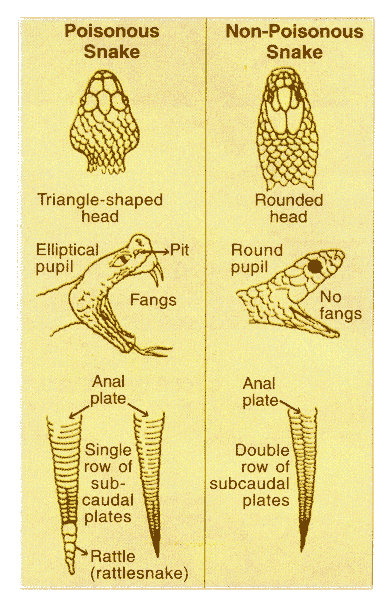
Features of Poisonous & Non-Poisonous snakes

 
Poisonous Snakes

  • Head – Triangle – except Cobra
  • Fangs – Present
  • Pupils – Elliptical pupil
  • Anal Plate – Single row of plates
  • Bite Mark – Fang Mark
Non Poisonous Snakes

  • Head – Rounded
  • Fangs – Not present
  • Pupils – Rounded
  • Anal Plate – Double row of plates
  • Bite Mark – Row of small teeth.

Symptoms due to Snake bite

Cobra or Krait
Mild
 Local symptoms — burning, redness, swelling, superficial necrosis.
Marked Neurotoxic effects.
Earliest symptom – Ptosis – inability to keep Eyes open.
Giddiness, Lethargy, Muscle weakness.
Spreading Paralysis – causing difficulty in speaking and breathing, Salivation, Vomiting. Frothing around mouth.

Viper
Haemotoxic venom is very painful
Severe
 Local symptoms — Intense Pain, Inflammation, Oozing of haemolytic blood.
Marked Vasculotoxic effects.
Bleeding from mucous membrane of the Mouth, Anus, Nose and haemorrhages under the skin.
Because of local damage to circulatory cells, hemotoxic venom spreads more slowly and has a slower action than the neurotoxins.
Vascular Collapse – Cold Skin, Rapid feeble Pulse, Dilated Pupils insensitive to light, Gradual loss of consciousness.

Sea Snakes
No Local symptoms.
Severe Pain while moving Neck, Trunk and Limbs. A few hours later urine turns Brown to Black due to the presence of muscle protein Myoglobin.

Snake Structure
Spitting Snakes
Snakes – Some Facts
How to keep snakes out of my yard?
Protection from Snakes
Snake Bite ~ Management
Poisonous Snakes
Dangerous Snakes in the World
Deadliest Snakes in the World

Dangerous Snakes in the World

Dangerous Snakes in the World
Annually, throughout the world, it is estimated there are a minimum of 1 to 2 million snakebite “incidences.” This number includes bites by non-venomous species. Of that number roughly 50,000 to 60,000 bites result in fatalities. The country that has the largest number of snakebite deaths annually is the tiny island of Sri Lanka.Each year in the United States there are approximately 45,000 snake bite incidences, including non-venomous bites. Only about 8000 of that number are venomous snake bites but a mere 9 to 15 people die.The Most Dangerous Snakes that kill the most people according to the geographical locations are as given below : –In the United States the coral snake has a very toxic venom but has killed few people because it is small, secretive and gentle. The most dangerous are the rattlesnakes like the Eastern and Western Diamondbacks. These rattlesnakes are large, have large venom glands, are relatively common, and are more likely to hold their ground and bite.

In Africa common Egyptian Cobras, Saw-scaled Vipers, and Puff Adders would be the most dangerous.

In Asia the common Cobra and the Russell’s Viper are the snakes that kill the most people.

Although the Asian Cobra and Russell’s Viper probably kill most of the people who die of snake bite annually in the world neither of them are among the most Deadly Snakes. 

The most Deadly Snake, and the most Dangerous Snake are two entirely different concepts. Some of the snakes with the most toxic venom, that is, the most deadly, rarely bite people.

The Most Dangerous Snakes are those that kill the most people.

Asian Cobra and Russell’s Viper probably kill most of the people who die of snake bite annually in the world
Snake Structure
Spitting Snakes
Snakes – Some Facts
How to keep snakes out of my yard?
Protection from Snakes
Snake Bite ~ Management
Poisonous Snakes
Dangerous Snakes in the World
Deadliest Snakes in the World

Deadliest Snakes in the World


Deadliest Snakes in the World 
  • Fierce Snake or Inland Taipan (Oxyuranus microlepidotus ), Australia. The most toxic venom of any snake. Maximum yield recorded (for one bite) is 110mg. That would porbably be enough to kill over 100 people or 250,000 mice. These rare snakes are vitually unknown in collections outside of Australia.
  • Australian Brown Snake (Pseudonaja textilis ), Australia. One 1/14,000 of an ounce of this vemon is enough to kill a person.
  • Malayan Krait (Bungarus candidus ), Southeast Asia and Indonesia. 50% of the bites from this snake are fatal even with the use of antivenin treatment.
  • Taipan (Oxyuranus scutellatus ), Australia. The venom delivered in a single Taipan bite is enough to kill up to 12,000 guinea pigs.
  • Tiger Snake (Notechis scutatus ), Australia.
  • Beaked Sea Snake (Enhydrina schistosa ), South Asian waters Arabian Sea to Coral Sea..
  • Saw Scaled Viper (Echis carinatus ), Middle East Asia.
  • Coral Snake (Micrurus fulvius ), North America.
  • Boomslang (Dispholidus typus ), Africa.
  • Death Adder (Acanthopis antarcticus ), Australia and New Guinea.
  • Black Mamba, both species of Green Mambas, and the Mojave Rattlesnake


 There are many factors that influence the seriousness of a bite.

The factors include the individual’s health, size, age, and psychological state.  The nature of the bite may also vary, like penetration of one or both fangs, amount of venom injected, location of the bite, and proximity to major blood vessels. The health of the snake and the interval since it last used its venom mechanism is also important. These multiple variables make every bite unique. Depending on circumstances, the bite of a “mildly” venomous snake may be life-threatening and that of a “strongly” venomous snake may not.

As a precautionary tip, always seek immediate medical attention if bitten by a suspected venomous snake.  Even having someone with proper CNA training to escort you to a medical facility will increase your chances of survival.  Snake bites are never to be taken lightly.

The most Deadly Snake, and the most Dangerous Snake are two entirely different concepts. Some of the snakes with the most toxic venom, that is, the most deadly, rarely bite people.

The Most Dangerous Snakes are those that kill the most people.

Asian Cobra and Russell’s Viper probably kill most of the people who die of snake bite annually in the world
Snake Structure
Spitting Snakes
Snakes – Some Facts
How to keep snakes out of my yard?
Protection from Snakes
Snake Bite ~ Management
Poisonous Snakes
Dangerous Snakes in the World
Deadliest Snakes in the World
First Rabies patient to survive !

First Rabies patient to survive

A teenager from Wisconsin, Jeanna Giese, 15 is the first human ever to survive rabies without a vaccination.

She received a desperate and a novel type of therapy by Dr Rodney Willoughby, Associate Professor of Paediatrics.

Doctors at the Children’s Hospital of Wisconsin put the critically ill girl into a drug induced coma and gave her 4 types of antiviral drugs.

Dr Charles Rupprecht of the disease control agency called the recovery as – Historic.

The result of this treatment has to be repeated elsewhere before the therapy could be considered a cure or a treatment.

Jeanna Giese was bitten by a bat at a church service on September 12, 2004.She did not visit a doctor and was not vaccinated as is standard medical practice for such exposure. On Oct 18, 2004 she was admitted to hospital with fluctuating consciousness and other symptoms typical of Rabies. Rabies is caused by a virus in the secretions from an infected animal. The vaccine against this disease stimulated antibodies to the virus and thus prevents the development of the disease. The vaccine has to be administered within days of the exposure.

Jeanna Giese is now a 21-year-old biology major, graduate at the Lakeland College campus in Sheboygan.

Rabies

More Japanese Celebrating 100

More Japanese Celebrating 100

Average life expectancy in Japan is 84 years for women and 77 years for men, according to the Health Ministry’s National Institute of Population and Social Security. That makes the Japanese the longest-living society in the world.The average American woman lives to 79; the average man lives to 73.Factors that are important in Japanese culture which may be important in this aspect are:

  • Japanese diet, which is rich in vegetables and seafood, helps Japanese
    live to see 100.
  • They eat less fatty food.
  • Also, the fact that Japanese culture emphasizes social harmony and not confrontation helps too.
  • And, often elderly Japanese live with families and are not excluded
    from family and social life as they get older. They’re still part of the family group. Recent research has shown elderly people with strong social connections live healthier lives.
