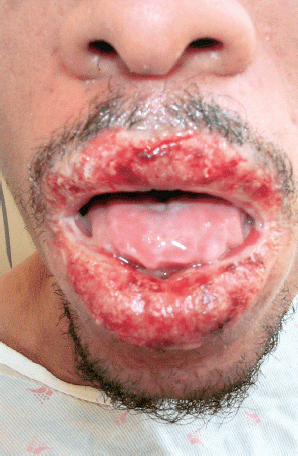
| Ringworm | |
Ringworm is a skin infection caused by a fungus. Ringworm can affect skin on your:
|
|
| Ringworm is contagious. It can be passed from one person to person. Or you may get it through contaminated items such as combs, unwashed clothing, and shower or pool surfaces. | ![]() |
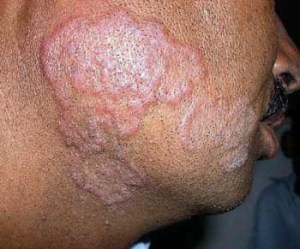
| You can also catch ringworm from pets that carry the fungus. Cats are common carriers. | ![]() |
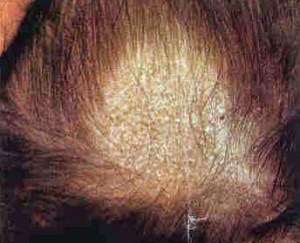
| The fungi that cause ringworm thrive in warm, moist areas. It is more likely when you have frequent wetness such as from sweating. | ![]() |
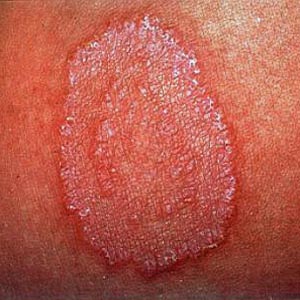
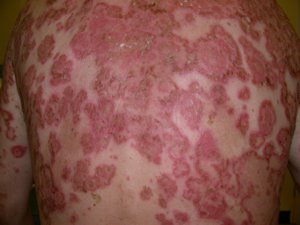
| Features of this disease are: Itchy, red, raised, scaly patches which are raised on the outer side around a normal looking skin.On scalp they form red itchy patches and may leave bald areas.
If nails are infected, they become discoloured, thick, and even crumble. In groin area – Itchy, burning rash. Feet have itching, burning and cracked skin between toes. |
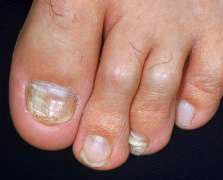
![]() |
| The disease may be cured by using over the counter antifungal preparations containing Miconazole or Clotrimazole. | ![]() |
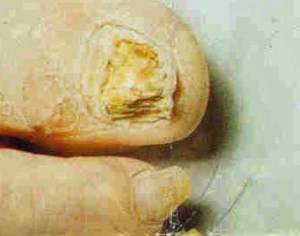
| If this does not give relief one may need to see a doctor who may give other preparations like Ketokonazole. Antibiotics may be needed for secondary infection.Treatment of Onychomycosis is challenging because the infection is embedded within the nail. As nail is not a very vascular structure it is difficult for medication to reach. As a result, removal of the disease is very slow and may take a year or more. | ![]() |
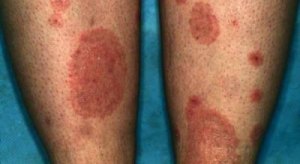
| For prevention, keep your skin and feet clean and dry. Do not share clothing, towels, hairbrushes, combs, headgear, or other personal care items. | ![]() |
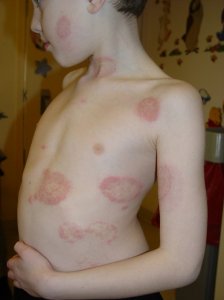
| Skin Diseases | |
Category Archives: Diseases & Conditions
Short Stature ~ Cause
| Causes of Short Stature |
| Short Stature is a comparative evaluation of an individual’s height with his genetic background and in relation to that of a large population of a similar genetic background. Growth Failure and Short Stature may not be the same thing. Often these two are confused as the same thing. Short stature is often a normal variant. On the other hand Short Stature may be a sign of a wide variety of pathologic conditions or inherited disorders. |
Majority of patients with Short Stature come under following groups:
|
Important Causes of Short Stature
|
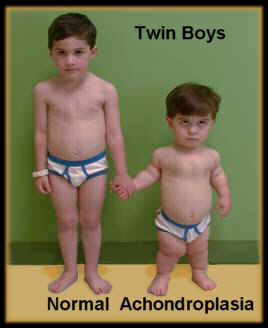
| Clinically, syndromes of Short Stature present with specific physical findings which may aid in diagnosing the illness, like –Growth Hormone deficiency – Frontal bossing, Central Obesity, High pitched voice. Hypothyroidism – Dry skin, coarse hairs, immature facies Cushing syndrome – Striae, central obesity, hypertension Gonadal dysgenesis – Delayed sexual development, webbed neck, multiple pigmented navi, shield chest Pseudohypoparathyroidism – Mental retardation, moon facies, obesity, short metacarpals. Bone Cartilage dysplasia – Abnormal proportions, macrocephaly Russell Silver Dwarfism – Small at birth, pointed facies, asymmetry |
| To reach the final diagnosis regarding the cause of the short stature in an individual detailed history and clinical examination is important followed by some screening tests which may pin point the actual cause of short stature.
Some of these test are – |
Sun Burns
| Sun Burns |
| When our skin is exposed to the ultraviolet (UV) rays of the sun, it produces a substance called melanin, which protects the skin and gives it color. UV rays stimulate production of melanin. So, the more skin is exposed to these rays, the more tanned it becomes. When our body can’t produce enough melanin to counter-act the UV rays absorbed by the skin, a sunburn results. |
| Fair-skinned people with light-colored hair are at greatest risk of sunburn because their bodies produce lower amounts of melanin. Environmental and genetic factors also play roles. People with fair skin, eyes and hair, the blue-eyed blondes and redheads — are particularly prone to burn easily. Because of their genetics, they are more susceptible to skin cancer than people with more natural pigment. |
| Sunburn destroys cells on the skin’s outer layer. In most cases, these burns are minor, causing red, tender, sometimes blistered skin that sheds after several days. Regular overexposure to the sun can age your skin prematurely, causing sagging, wrinkling, wart-like growths, and a leathery appearance. It also can lead to skin cancer. |
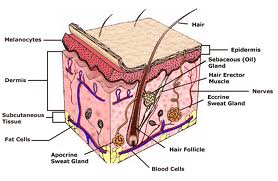
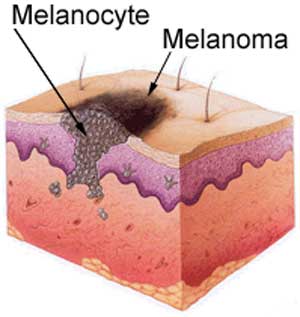
The appearance of the skin is partly due to the reddish pigment in the blood of the superficial vessels. However, it is mainly determined by melanin, a pigment manufactured by dendritic cells called melanocytes, found among the basal cells of the epidermis. Their numbers in any one region of the body, range from about 1,000- 2,000 per square millimetre. It is roughly the same within and between races. The blondest whites have as many as the darkest blacks. Colour differences are due solely to the amount of melanin produced and the nature of the pigment granules. When the skin becomes tanned on exposure to sunlight, the melanocytes do not increase in number, only in activity. Not only do melanocytes produce a tan, they are also responsible for the form of cancer called melanoma. Melanoma is caused by UV radiation damage to melanocytes. |
|
Treatment
|
|
Prevention Sunscreens protect your skin from harmful UV rays. Sunscreens are rated for their protection ability. SPF – sun protection factor. The higher the number, the greater the protection. One should choose the SPF number based on ones skin type and the length of time expect to be in the sun. Broad-spectrum sunscreens with a protection factor of 15 or higher should be preferred. Individuals can help prevent skin cancer by using sunscreens, limiting exposure, and wearing hats and protective clothing. Most of the lifelong skin damage caused by the sun is done before age 18. Apply sunscreen liberally and frequently. Re-apply sunscreen after swimming and after profuse sweating. It should be remembered that radiation is at the greatest intensity between 10 a.m. and 4 p.m. |
Skin Burns & Cancer: Skin cancer is the most common form of cancer. There are three major types of skin cancer: basal cell, squamous cell carcinoma and melanoma. The vast majority of skin cancers are basal and squamous cell.A lesion that won’t heal, bleeds easily and is traumatized easily could be cancer.Long-term sun exposure not only increases the risk of skin cancer but also leads to wrinkles and sun spots.Environmental and genetic factors also play roles. People with fair skin, eyes and hair — the blue-eyed blondes and redheads — are particularly prone to burn easily. Because of their genetics, they are more susceptible to skin cancer than people with more natural pigment. |
Melanoma Skin Diseases |
Ricin
| Ricin |
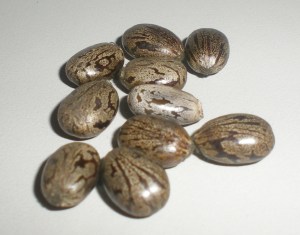
Ricin is one of the most toxic naturally occurring substances.It is derived from seeds of the castor bean plants. These seeds are also used to make castor oil. Accidental exposure to ricin is highly unlikely, except through the ingestion of castor beans. Castor beans are processed throughout the world to make castor oil. Ricin is part of the waste “mash” produced when castor oil is made.It can be in the form of a powder, a mist, or a pellet, or it can be dissolved in water. It is a stable substance under normal conditions, but can be inactivated by heat above 80 degrees Centigrade. |
| Symptoms of ricin poisoning by inhalation may occur within 8 hours of exposure. It would cause pulmonary edema and respiratory distress.If someone swallows a significant amount of ricin, he or she would develop vomiting and diarrhea that may become bloody.Ricin is unlikely to be absorbed through normal skin. Contact with ricin powders or products may cause redness and pain of the skin and the eyes. |
| In 1978, Bulgaruian dissident Georgi Markow was killed in London using this poison. The poison was injected into him from the tip of an umbrella as Markow was waiting for a bus.
In the 1940s the U.S. military experimented with using ricin as a possible warfare agent. In some reports ricin has possibly been used as a warfare agent in the 1980s in Iraq and more recently by terrorist organizations. |
Pemphigus Vulgaris
| Pemphigus Vulgaris | |
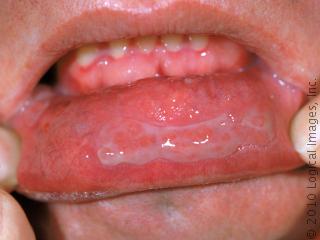
| Pemphigus is a group of rare autoimmune blistering disorders of the skin in which blisters and sores occur in skin and mucous membrane. It is a disease of immune system. The immune system produces antibodies which normally attack hostile viruses and bacteria in the blood in an effort to keep us healthy. In an affected individual however, the antibodies erroneously perceive the skin and/or mucous membrane tissue as foreign and attacks them. This produces burn-like lesions that will not heal. In some cases, these sores can cover a significant area of the skin. The disease can give a horrifying image and if not managed properly may lead to death. There is no cure for this disease. Steroids are only hope and give dramatic relief. | |
| There are three main categories of Pemphigus.Paraneoplastic Pemphigus, Pemphigus vulgaris and Pemphigus foliaceusPemphigus vulgarisIt is most frequently diagnosed form of pemphigus. Sores and blisters almost always start in the mouth. Large bullae occur on skin. Those in the oral cavity soon rupture leaving a ragged slough over a shallow ulcer. It has a high rate of mortality.
There is a research which shows that there is a genetic predisposition to Pemphigus Vulgaris, based primarily on the observation that this disease appears to occur more frequently than normal in Askenazi Jews. Microscopic Features: Characteristic features under microscope are “Intraepithelial clefting” and “tombstoning”.
|
Pemphigus Vulgaris![]() |
| Pemphigus foliaceusWith pemphigus foliaceus, blisters and sores do not occur in the mouth. Crusted sores or fragile blisters usually first appear on the face and scalp and later involve the chest and back.The blisters are superficial and often itchy, but are not usually as painful as in pemphigus vulgaris. In PF disfiguring skin lesions can occur but the mortality rate from the disease is much lower than in PV | Pemphigus Vulgaris![]() |
| Paraneoplastic pemphigusThis is the most serious form of pemphigus, which occurs most often in someone who has already been diagnosed with a Cancer. |
Paraneoplastic Pemphigus |
| Treatment Prednisone is the most important medication for these patients and those not put on steroids may rapidly deteriorate and die. Dose of prednisone has to be according to the need of individual patient. Other drugs used include Azathioprine, Cyclophosphamide, Methotrexate, Dapsone, Gold, Tetracycline, Minocycline. Diet high in protein, low in carbohydrates, low in salt, low in fat is beneficial. In extensive lesions fluid loss may have to be managed. Mouth lesions may hamper nutrition of the patient which also has to be taken care of. Blood calcium and potassium levels may be disturbed. Fungal infections have also to be managed in such patients. |
|
| Skin Diseases | |


However, it is mainly determined by melanin, a pigment manufactured by dendritic cells called melanocytes, found among the basal cells of the epidermis. Their numbers in any one region of the body, range from about 1,000- 2,000 per square millimetre. It is roughly the same within and between races. The blondest whites have as many as the darkest blacks. Colour differences are due solely to the amount of melanin produced and the nature of the pigment granules. When the skin becomes tanned on exposure to sunlight, the melanocytes do not increase in number, only in activity. Not only do melanocytes produce a tan, they are also responsible for the form of cancer called melanoma. Melanoma is caused by UV radiation damage to melanocytes.
squamous cell carcinoma and
Castor beans are processed throughout the world to make castor oil. Ricin is part of the waste “mash” produced when castor oil is made.It can be in the form of a powder, a mist, or a pellet, or it can be dissolved in water. It is a stable substance under normal conditions, but can be inactivated by heat above 80 degrees Centigrade.