Genes & Chromosomes

Genes & Chromosomes

Whether or not a specific trait or disorder is inherited is determined by hereditary material called “genes.” Genes are the units of hereditary material. They contain coded instructions which direct the development of every cell and tissue in the human body. You might think of genes as blueprints, specifying how the body will develop and function.
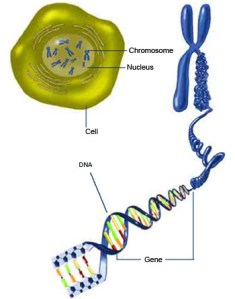
A gene is a stretch of DNA that tells a cell how to make a protein. Each amino acid is coded for by a three-letter sequence. The cell machinery reads this code, grabs the appropriate amino acids, and strings them together to make a protein. Most researchers believe we have around 100 000 genes.

The human genome comes in 23 pieces, packaged in proteins to form chromosomes. Our cells have two copies of each chromosome–one from each parent–making 46 in all. The 23rd pair consists of the sex chromosomes.

Thousands of genes are found on thread-like structures, called chromosomes, which are located in the center or “nucleus” of each cell. Genes and chromosomes exist in pairs. At the time of conception, each parent contributes one gene and one chromosome from each of his or her gene and chromosome pairs. The genes and chromosomes from each parent combine into new pairs which determine the traits a child inherits.

Most often, genes produce normal traits. Sometimes, however, a gene becomes altered from its original form. A gene that is thus changed is called a “mutant” gene. Although researchers know that mutations occur, the reasons for their occurrence is not completely understood. Some mutations are not harmful, but most often a mutant gene functions improperly and causes a disorder, malfunction, or malformation within the body. Mutations can occur in any generation. If a spontaneous mutation occurs, it is then possible for a child to be the first family member to get a genetic disorder such as Marfan syndrome, even though both parents are normal.

A mutation is a misspelling in the code for a protein that can be passed from one generation to the next–an A instead of a G, say. The result can be a disease, such as cystic fibrosis.

There are present multiple variations of a gene (called alleles) at the same genetic location. For most locations, each individual possesses two alleles, one derived from each parent. If the two alleles are identical, the individual is said to be homozygous; if they are different, the individual is heterozygous.

In addition to mutations, the “inheritance pattern” or the way in which genetic traits or disorders are expressed also varies. The Marfan syndrome follows a pattern of inheritance called “autosomal dominant inheritance.” “Autosomal” means the inheritance is linked to any chromosome other than those which determine the sex of the child. “Dominant” means the effects of the Marfan gene dominate or override the effects of the normal gene in the pair. Therefore, if one parent contributes the Marfan gene and one parent contributes a normal gene, the child will inherit the Marfan disorder. There is a 50% chance during each pregnancy that the affected parent will pass on the Marfan gene and the child will get the Marfan syndrome. There is, of course, also a 50% chance that the affected parent will pass on his or her normal gene, in which case the child will not get the disorder.

It is important to remember that parents have no control over which genes they pass on to their children, and, therefore, should not feel at fault if one of their children inherits a disorder such as the Marfan syndrome.

Y Chromosome

Rabies in Animals

Rabies in Animals

Rabies is primarily a disease of animals. The most commonly involved and frequently associated animal is the Dog. It can also be seen in other animals with which man has been in close contact since ages.

DOG

The incubation period of this disease is about 10 days to 2 months and sometimes even longer. In the initial stage the dog stars behaving differently and abnormally. It goes to dark corners, becomes restless, shows unusual agitation and develops fever. There are two clinical varieties that are seen of this disease. Furious Rabies and the Dump Rabies.

Furious Rabies: is the more common variety. In this the dog becomes dangerously aggressive, bites – may be its own chain, stone, paper, wood iron and other metal objects and even man or any other animal. Later there is paralysis of the jaws and there is drooling of the saliva and the vocal cord paralysis which leads to change in tone of bark. In the end there is paralysis of the limbs and trunk and death occurs due to respiratory paralysis and convulsions.

Dump Rabies: is less common. In this there are mainly paralytic features. The paralytic feature  start with the muscles of head and back regions. The animal has difficulty in the swallowing. At times the owner tries to help the pet in feeding and thus gets exposed to this disease.

The survival for the animal is generally for 3-5 days.

OTHER ANIMALS

In Cats it is mostly the furious variety. The cat may strike in air as if trying to catch mice. The death is due to convulsions and respiratory paralysis.

Cows & Horses get rabies from bite by another animal mainly the Dog. In cows there is profuse salivation and excitation and paralysis. Horses may show excitation and occasionally show aggression. Wild animals may lose fear of man and the nocturnal animals are seen during day time and may attack man.

Laboratory Diagnosis: in case of animals is done after the death of the animal. It is done by the examination of the brain. This is done —

  • by demonstration of Negri bodies by seller’s stain.
  • by detection of rabies viral antigen by fluorescent antibody test – it is quick and the best method.,

Immunization of Animals

Tissue culture vaccine is used for Pre-Exposure Immunization. For Dogs and Cats 2 injections at 2 months age and another one month later is given. Then a booster every year.
Rabies

Administering a Rabies vaccine

Administering a Rabies vaccine

General considerations:

The combination of local treatment of the wound, passive immunization with Rabies lmmunoglobulin (RIG) and vaccination is recommended for all severe exposure (category 111) to rabies. Prompt and thorough cleansing of the wound, and administration of purified Equine or Human Rabies lmmunoglobulin (ERIG or HRIG) and cell culture rabies vaccine immediately after exposure virtually guarantee complete protection, and the risk of post-exposure treatment complications is much lower than with brain-tissue vaceines.

Intramuscular schedule:

All intramuscular injections must be given into the deltoid region or,

in small children, into the anteriolateral area of the thigh muscle.

The vaccine should never be administered in the gluteal region.

The most widely used WHO scheme calls for a single 1.0 ml dose IM, administered in the upper deltoid (anteriolateral area of thigh for children) on day 0, 3, 7, 14 and 30 with an optional further dose on day 90.

Often the day 90 dose is omitted except in those also given passive immunisation with RIG (usually categ III bite).

The gluteal region is not recommended on account of high fat content in this region which retards the absorption of the vaccine.

Age and/or weight & dose:

Neonates can be given the anti-rabies vaccine without any additional side effects vis-a-vis older children or adults. Modern tissue culture rabies vaccine should not be given in reduced dosage  irrespective of the age and/ or weight.

The dosage schedule for the modern tissue culture vaccine remains same for all age groups. Continue reading

Rabies Vaccination

Vaccination procedure for persons who have not been vaccinated


Pre-exposure vaccination Days 0,28,56 & once one year later, or Days 0,7,21 & once one yr. later
Post -exposure vaccination Days 0,3,7,14,30 & 90 (optional)
Post-exposure simultaneous prophylaxis Vaccination as above, plus Human Rabies Immunoglobulin 20 I.U./ Kg bwt or Rabies immune serum 40 I.U / Kg bwt with the first dose of vaccine or no later than 8 days. Half of total amount of immunoglobulin to be infiltrated in the region of the wound. The remainder is preferably to be injected intragluteally.

Local treatment of the wound should always be carried out. Usually the time interval between the last dose of the vaccine and the date of pre-exposure are taken into consideration. 
Previous Vaccinations using a rabies vaccine with a potency of >2.5 I.U./dose, which date back:- Vaccination Scheme
Less than One year 1 vaccination on day 0. For high-degree exposure 2 vaccinations on day 0 & 3.
1 to 5 years 2 vaccinations: day 1 & 3 For high degree exposure: 3 vaccinations day 0, 3 & 7
More than 5 years A complete course of vaccination including RIG if indicated.

Regimen for post-exposure treatment of a previously vaccinated person

Cases of high degree of exposure, category 11 and III Persons who have previously received pre or post exposure treatment with vaccines of unproven potency, and those who have not demonstrated an acceptable rabies neutralizing antibody titre should receive a complete post-exposure course, including Rabies lmmunoglobulin (RIG) if indicated.

It may be appropriate to double the first dose of the vaccine in the following situations:

  • In patients with underlying chronic diseases e.g. liver cirrhosis.
  • In patients who are congenitally immunodeficient or suffering from AIDS.
  • In patients taking immuno suppressive drugs including corticosteroids and anti  malarials.
  • In severely malnourished.
  • In patients who come for treatment after a delay of 48 hr. or more.
  • In patients where RIG is indicate but is unavailable.


 Continue reading 

Rabies

Rabies

Rabies is caused by a rhabdovirus which infects the central nervous tissue and salivary glands of a wide range of mammals, and is usually conveyed, by saliva, through bites or licks on abrasions or on intact mucous membranes. Man is most frequently infected from dogs. In Europe the maintenance host is the fox and in recent years the zoonosis has spread from Poland westwards through Germany and France.

The incubation period, during which the virus is spreading centripetally along axons to the brain, varies in man from a minimum of 9 days to many months but is usually between 4 and 8 weeks. Severe bites, especially on head or neck are associated with short incubation period.

Louis Pasteur was the founder of the science of microbiology, proved the germ theory of disease, invented the process of pasteurization, and developed vaccines for several diseases, including rabies. Louis Pasteur spent his life working on the causes of various diseases—including septicemia, cholera, diphtheria, tuberculosis, and smallpox—and their prevention by means of vaccination. He is best known for his investigations concerning the prevention of Rabies. Pasteur developed an attenuated form of the virus that could be used for inoculation. In July 6, 1885, with the help of vaccine developed by him , the first human victim of active rabies was saved.

Clinical Features

Only a proportion of people bitten by rabid animal develop the disease, but once menifest it is almost always fatal. At the onset there may be fever and paraesthesia at athe sit of the bite. Prodromal period of 1 to 10 days during which the patient is increasingly anxious, leads to characteristic fear of water, “Hydrophobia”. Although the patient is thirsty attempts to drink water lead to violent contraction of muscles of diaphragm and other inspiratory muscles and thereafter even the sight or sound of water may provoke distressing spasms and attacks of panic. Delusions, hallucination may develop with spitting biting and mania. Cranial nerve lesions develop with terminal hyperpyrexia. Death occurs within a week of the onset of symptoms. In some ascending paralysis is seen without mental excitment, and these patients servive on average 12 days.

Clinical Features

Only a proportion of people bitten by rabid animal develop the disease, but once menifest it is almost always fatal. At the onset there may be fever and paraesthesia at athe sit of the bite. Prodromal period of 1 to 10 days during which the patient is increasingly anxious, leads to characteristic fear of water, “Hydrophobia”. Although the patient is thirsty attempts to drink water lead to violent contraction of muscles of diaphragm and other inspiratory muscles and thereafter even the sight or sound of water may provoke distressing spasms and attacks of panic. Delusions, hallucination may develop with spitting biting and mania. Cranial nerve lesions develop with terminal hyperpyrexia. Death occurs within a week of the onset of symptoms. In some ascending paralysis is seen without mental excitment, and these patients servive on average 12 days.

Investigation

Diagmnosis is usually on clinical grounds.

Immunofluoroscent techneques can detect antigen in the corneal smear impression and skin biopsies.

Management

Only a few patients with rabies have survived, and all of them had received some form of prophylaxis and needed intensive care to control respiratory and cardiaac failure. Once symptoms appear only palliative measures cn be taken.

Prevention

Pre-exposure prophylaxis is a must for those at a risk with antirabies vaccination.

Post-exposure prophylaxis

  • Thorough cleaning of the wound with detergents or soap.
  • Damaged tissue to be excised and wound left unsutured.
  • Antirabies vaccine: The safest vaccine is the Human Diploid Cell Strain Vaccine. 1.0 ml given in the deltoid region days 0,3,7,14,30,90
  • Human rabies Immunoglobulin 20 I.U. / Kg bwt. Half of the dose is infiltrated around the wound and the remaining half is given I.M. Hyperimmune animal serum 40 I.U. / Kg bwt.may also be used.
Rabies Vaccination
Rabies Transmission by Oral and Other Non-bite Routes
Rabies in Animals