Bed wetting

Bed wetting

Bed wetting or Enuresis is a psychosomatic disorder. Its an emotional disturbance causing dysfunction of organs controlled by autonomic nervous system. Many children with this disorder also have behavioural disorders. Such children are usually timid and nervous. By age 5, one in five still wets the bed and at age 6, the numbers drop to one in 10. Boys are more likely than girls to wet their beds.

Stages of Bladder Control in children

  • At 6 months – the child usually wakes up before wetting.
  • Between 12 and 18 months the child urinated when placed on the pot.
  • After 2 years the child is capable of retaining urine even when the bladder is full.
  • At 3 years – the child goes to the toilet, takes off this clothes and passes urine.
  • At 5 years – the child can empty the bladder even when its not full.

It is also suspected that bed-wetting may be caused by slow development of the nerves that control the bladder. Among other less common causes is Small Bladder. Even a small bladder unable to hold the urine produced during the night can result in bed-wetting. Bed-wetting can be a symptom of a serious illness (e.g., diabetes or a urinary tract infection), especially if it starts in a child who has previously been dry through the night.

Large majority of children who wet the bed have no underlying disease. In fact, a true organic cause is identified in only about 1% of children who wet the bed.

Secondary bedwetting is bedwetting that starts again after the child has been dry at night for a significant period of time (at least six months). Secondary bedwetting can be a sign of an underlying medical or emotional problem. The child with secondary bedwetting is much more likely to have other symptoms, such as daytime wetting.

Common causes of secondary bedwetting are:

  • Urinary Tract Infection
  • Diabetes
  • Structural or anatomical abnormality: An abnormality in the organs, muscles, or nerves involved in urination can cause incontinence or other urinary problems that could show up as bed wetting.
  • Emotional problems: A stressful home life, as in a home where the parents are in conflict, sometimes causes children to wet the bed. Major changes, such as starting school, a new baby, or moving to a new home, are other stresses that can also cause bed wetting.
  • Pinworm infection: characterized by intense itching of the anal and/or genital area.

    Treatment

    It is probably a good time to seek medical help when the child is 5-7 years of age.

    Bedwetting is typically seen more as a social disturbance than a medical disease. It creates embarrassment and anxiety in the child and sometimes conflict with parents. The single most important thing parents can and should do is to be supportive and reassuring rather than blaming and punishing. Primary nocturnal enuresis has a very high rate of spontaneous resolution.

Some Tips:

  • Your patience and love will go a long way to help a child who wets the bed. Making the child feel guilty, getting angry or acting disgusted will only delay solving this problem. Try to be understanding and supportive.
  • Set an alarm clock two to three hours after your child falls asleep so he or she can be awakened to go to the bathroom.
  • Make sure your child urinates before getting into bed.
Drugs used for Bed wetting:

Desmopressin, Imipramine, Oxybutynin and Hyoscyamine

Desmopressin acetate is a synthetic form of antidiuretic hormone (ADH), a substance that occurs naturally in the body and is responsible for limiting the formation of urine.

Imipramine is a tricyclic antidepressant that has been used to treat bedwetting for about more than 30 years. How it works is not clear, but it is known to have a relaxing effect on the bladder and to decrease the depth of sleep in the last third of the night.
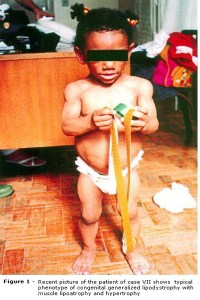
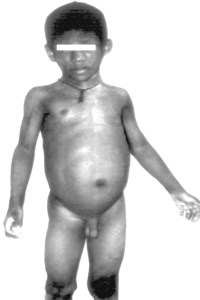
Congenital Generalized Lipodystrophy

Congenital Generalized Lipodystrophy

Synonym
Berardinelli-Seip Syndrome

Congenital Generalized Lipodystrophy is a rare genetic disease. It is characterized by near complete absence of body fat. It is inherited as an autosomal recessive disorder. It is a disease involving the adipose tissue (fat tissue) of the body.

Parents are carriers of the genes but are not affected. There is a 25% chance of transmission of both defective genes to the affected children. The ratio of affected to unaffected children is 1:4.

Clinical features

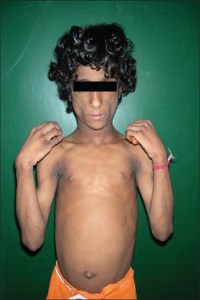
  • The diagnosis is evident at birth or immediately afterwards. These infants look very muscular due to the absence of fat. Nearly the entire body is affected, only the palms, soles and scalp are spared.
  • These patients also have accelerated growth during their childhood and have a voracious appetite.
  • The onset of diabetes is usually during the pubertal years and requires high dose of insulin to control the blood glucose levels.
  • They have Severe insulin resistance; high serum insulin and triglyceride levels and low levels of high-density lipoprotein (HDL) cholesterol.
  • Also have acanthosis nigricans (dark velvety pigmentation of the skin) in the axilla, neck or groin.
  • Enlarged hands, feet and prominent mandible (acromegaloid features), umbilical hernia .
  • They have lytic lesions (look like bone is eaten-up on X-rays) in the long bones of the body such as the humerus, femur.
  • Females present with enlarged clitoris, increased body hair, absence of or irregular menstrual cycles and polycystic ovaries
  • A gene for CGL has been identified on the long arm of chromosome 9 (9q34).
Acquired Generalized Lipodystrophy
Familial Partial Lipodystrophy

Familial Partial Lipodystrophy

Familial Partial Lipodystrophy

Familial partial lipodystrophy – Dunnigan Variety is a rare genetic disease. It is transmitted as an autosomal dominant trait. Both males and females of several generations may be affected. The possibility of transmission from an affected person to the offspring is 50 %.

There is another variety of FPLD called Kobberling variety. In this Loss of fat is limited to the extremities with normal amounts of fat in the face and normal or even excess fat in the truncal area.

Clinical features

  • Normal appearance at birth.
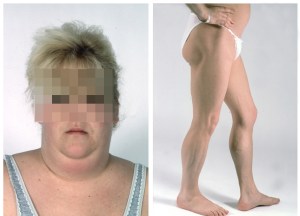
  • Absence of subcutaneous fat from the upper and lower extremities during childhood or puberty. The trunk, arms and legs are affected by fat loss while the neck and face have more than normal fat deposits. A “buffalo hump” can be observed between the shoulder blades.
  • The arms and legs appear very muscular.
  • In women, lack of fat in the buttocks is striking — flat hips.
  • In some patients, excess fat may accumulate in the face and neck, causing them to have a double chin.
  • They usually have high levels of serum triglycerides and low HDL cholesterol levels.
  • Approximately one-third of these patients may have acanthosis nigricans.
  • The onset of glucose intolerance or diabetes mellitus usually occurs after age 20.
  • Some women may have irregular menstrual cycles and polycystic ovaries.

Acquired Generalized Lipodystrophy

Acquired Generalized Lipodystrophy

Synonym
Lawrence Syndrome

Acquired Generalized Lipodystrophy is a rare disease. It is characterized by generalized disappearance of body fat after birth. These patients have normal fat at birth.

The onset of lipodystrophy occurs in the childhood and adolescence and may occur following infections such as varicella, measles, pertussis, diphtheria, pneumonia, osteomyelitis, parotitis, infectious mononucleosis, and hepatitis.

Clinical features

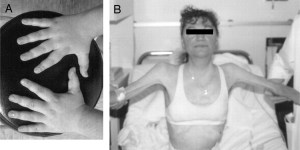
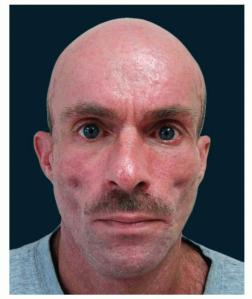
  • Patients lose body fat over a period of months or years. Eventually generalized loss of fat may occur resulting in muscular appearance and prominent superficial veins. Almost all areas of the body can be affected although in some patients some areas may be spared.
  • Increased linear growth may be seen in the children.
  • Dark velvety pigmentation (acanthosis nigricans) may also occur in the axilla and neck.
  • Excess body hair, enlargement of genitalia (clitoromegaly) and occasional ovarian cysts may be seen in the females.
  • These patients also have elevated basal metabolic rate and a voracious appetite.
  • Levels of serum triglycerides are high. Diabetes occurs usually after the onset of lipodystrophy
  • Patients with acquired generalized lipodystrophy may also develop other autoimmune disorders like vitiligo (light-colored spots on skin), sicca syndrome, rheumatoid arthritis, dermatomyositis, thyroiditis and chronic active hepatitis.
  • There is a female preponderance with a male to female ratio of 1:3, respectively.
Familial Partial Lipodystrophy 
Congenital Generalized Lipodystrophy

Amphetamines ~ Adverse effects

Adverse effects of Amphetamines

Amphetamine, Dextroamphetamine, Methamphetamine.

Amphetamines are central nervous system stimulant.  Amphetamines  (dexedrine) are being miss used by many.  Psychological dependence and tolerance may occur with amphetamines following prolonged use or high doses.

Amphetamines are used in the treatment of Attention-deficit hyperactivity disorder.

Amphetamines are indicated as an integral part of a total treatment program that includes other remedial measures (psychological, educational, social) for a stabilizing effect in children  with attention-deficit hyperactivity disorder, characterized by moderate to severe distractibility, short attention span, hyperactivity, emotional lability, and impulsivity.

Due to their high potential for abuse, amphetamines are not recommended for use as appetite suppressants. Amphetamines should not be used to combat fatigue or to replace rest in normal subjects.

More frequent adverse effects
CNS stimulation – false sense of well-being; irritability; nervousness; restlessness; trouble in sleeping, drowsiness, fatigue, trembling, or mental depression may follow the stimulant effects.

With prolonged use or high doses
Cardiomyopathy – chest discomfort or pain; difficulty in breathing; dizziness or feeling faint; irregular or pounding heartbeat; unusual tiredness or weakness. Irregular heart beat.

Increase in blood pressure

Psychotic reactions – mood or mental changes

Less frequent adverse effects

Allergic reaction – skin rash or hives

Chest pain, fast or pounding heartbeat; increased sweating

Tourette’s syndrome – uncontrolled movements of the head, neck, arms, and legs

Hyperthermia – extremely high body temperature

Blurred vision

Changes in sexual desire or decreased sexual ability

Constipation, diarrhea loss of appetite nausea stomach cramps or pain, weight loss, vomiting, dizziness lightheadedness headache; dryness of mouth or unpleasant taste.

Symptoms indicating possible withdrawal – after medication is discontinued

Mental depression; nausea stomach cramps or pain vomiting; trembling; unusual tiredness or weakness