Menopause

Menopause

The menopause is defined as the final episode of menstrual bleeding in women. The term is used commonly to refer to the transitional period up to and after the last episode of menstrual bleeding. During this period, there is a progressive loss of ovarian function and a variety of changes due to hormonal upset.The median age of women at the time of cessation of menstrual bleeding is 50 to 51 years. In the 5 years before menopause there is gradual increase in the number of anovulatory cycles – i.e. cycles without ovulation. During this period the estrogen secretion falls and there is increased pituitary secretion of LH and FSH hormones.  The age of menopause varies widely. Before the menopause the interval between the menses is variable and it becomes longer and longer.The menopause is the consequence of the exhaustion of folicles in the ovaries of a female. The decrease in the number of ova begins in the womb itself. By the time of the menopause, few ova remain, and these appear to be non-functional. Only a small number of ova are lost as the result of ovulation during reproductive life. The stopping of follicular development results in decreased production of estradiol and other hormones.Estrogen and androgen levels in plasma are reduced but not absent.
Clinical Features

About 3 of 4 women experience menopausal symptoms, but in 50 percent to 75 percent of sufferers they last a year or less. In about one-third of sufferers, they persist for up to five years, and in a small percentage, they last longer.

  •  Irregular periods commonly precede the menopause.
  • Hot Flashes and sweating. Hot flashes may start even when the paerson still has regular periods.
  • Nervousness, Anxiety, Emotional lability, Irritability, Depression.
  • Increased Vaginal Infection, Vaginal dryness, atrophy of urogenital epithelium.
  • Urgency of micturition.
  • Decrease in the size of breasts.
  • Approximately 40 percent of menopausal women develop symptoms serious enough to seek medical assistance.
  • Osteoporosis – reduction of Calcium in bones, is one of the crippling afflictions of aging, and there is a close relationship between estrogen deprivation and its development. Approximately one-fourth of aging women and one-tenth of elderly men sustain a vertebral or hip fracture between the ages of 60 and 90, and the incidence is highest in elderly white women. Such fractures are a major cause of death and morbidity. 

Many factors affect the development of osteoporosis, including diet, activity, smoking, and general health, and estrogen deprivation is of particular importance. White postmenopausal women are more predisposed to osteoporosis and its consequences. It is known that fall in the secretion of estrogen is associated with initial rapid loss of bone mass. Vertebral compression fracture, fracture neck femur and radius is seen more in females in  comparison to males. Those women who smoke are at a greater risk. Excessive alcohol and lack of exercise add to this risk. Earlier the menopause greater is the problem. Oestrogen started at the time of menopause is shown to prevent the bone loss. Many factors affect the development of osteoporosis, including diet, activity, smoking, and general health, and estrogen deprivation is of particular importance. White postmenopausal women are more predisposed to osteoporosis and its consequences. It is known that fall in the secretion of estrogen is associated with initial rapid loss of bone mass. 

  • After the menopause women experience an increase in the incidence of cardiovascular disease.

Management

  • Many women do not need any treatment. Explaining the problem and reassurance is what most of them need.
  • Imipramine, may be helpful to relieve anxiety and depression.
  • Hot flashes and sweating – may be helped by Clonidine 50 µg twice daily. But in many patients estrogen therapy is required.
  • Oestrogen Replacement Therapy

Oral Oestrogen – cyclical Ethinyl oestrogen 0.01-0.02 mg / day for 21 days with Medroxyprogesterone acetate 5 mg daily for the last 10  days.

Percutaneous Patches with reservoir of oestradiol 25-50 µg / day. Change every 3-4 days. Add oral Progestogen for 10 days per month.

Topical oestradiol – for Atrophic Vaginitis 0.01 % Dienoestrol cream.

  • Isoflavones: from plant sources esp. Soya, has oestrogen like activity. They do help to relieve symptoms to large extent in many women. They can be given in combination with Calcium, Magnesium and Vitamin D.

Hormone Replacement Therapy (HRT)~Risks

Microcephaly

Microcephaly

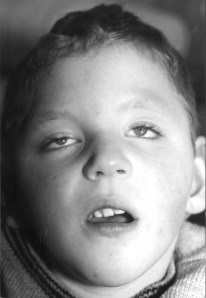
Microcephaly is a rare, neurological disorder in which the circumference of the head is smaller than the average for the age and gender of the infant. Microcephaly may be congenital or it may develop in the first few years of life.

This disorder may be caused by a wide variety of conditions that effect the growth of brain. It is often associated with chromosomal abnormality.

Infants with microcephaly may be born with a normal or reduced head size. The head fails to grow while the face continues to develop at a normal rate, producing a child with a small head, a large face, and a loose, often wrinkled scalp. As the child grows the smallness of the head becomes more obvious. Whole body is also underdeveloped. Motor functions and speech are delayed. Motor ability may vary, and it may be clumsy movements or even quadriplegia (paralysis of both upper and lower limbs).Hyperactivity and mental retardation are common. Convulsions may also occur.

The is no specific treatment in such cases. Treatment is symptomatic and supportive. Life expectancy is low and the prognosis for normal brain function is poor.


The Causes of Microcephaly can be Genetic and Non genetic

Genetic

  1. Autosomal Recessive (Familial)
  2.  Autosomal Dominant
  3.  Syndromes

Syndromes

  • Aicardi Syndrome
  • Beckwith-Wiedemann Syndrome
  • Bloom Syndrome
  • Cohen Syndrome
  • Cornelia de Lange
  • Cri-du-chat (5p-)
  • Dubowitz Syndrome
  • Rubinstein-Taybi Syndrome
  • Smith-Lemli-Opitz Syndrome
  • Trisomy 21
  • Trisomy 18
  • Trisomy 13
  • Xeroderma Pigmentosum

Non Genetic

1. Congenital CNS Anomalies

      • Agenesis of the Cerebellar Vermis
      • Agenesis of the Corpus Callosum
      • Craniosynostosis
      • Encephalocele
      • Holoprosencephaly
      • Lissencephaly
      • Macrogyria
      • Porencephaly
      • Schizencephaly

2. Congenital Infections

      • CMV
      • Rubella
      • Toxoplasmosis
      • Varicella

3. Drugs

      • Alcohol
      • Aminopterin
      • Dilantin
      • Methyl Mercury

4. Hypoxic-Ischemic Encephalopathy

5. Infections

      • Encephalitis
      • Meningitis

6. Metabolic

      • Maternal Diabetes Mellitus
      • Maternal PKU
      • Inborn Errors of Metabolism
      • Neuronal Ceroid Lipofuscinoses

7. Others

      • Radiation
      • Hyperthermia

Melanoma

Melanoma
 Skin cancer is the most common of all cancers.  Melanoma, the most serious form, accounts for 4 percent of skin cancer cases but causes 79 percent of skin-cancer deaths.


 Melanoma originates from melanocytes, pigment cells present normally in the skin. The tumor can affect adults of all ages, even young individuals (starting in the mid-teens). The incidence has increased dramatically -a 300 percent increase in the past 40 years or so.  
The individuals most susceptible to development of melanoma are those with fair complexions, red or blond hair, blue eyes, and freckles and who tan poorly and sunburn easily. Increased risk include a family history of Melanoma. Dark-skinned populations (such as those of India and Puerto Rico), blacks, and East Asians have rates 10 to 20 times lower than lighter-skinned whites.Typically they start as a mole. Sometimes a mole of many years changes in size, shape, color or elevation, or starts to bleed.  
                 How to suspect a Mole:

  • You should be able to draw a line through the middle of a mole or lesion and have it look the same on both halves.
  • You should have a nice, clean regular border around your mole.
  • Change in color is a major indicator of a potential problem.
  • More than about six millimeters in diameter can be suspicious.
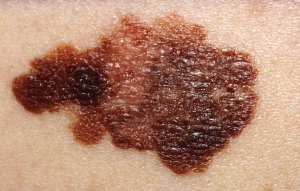
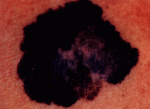
 Early detection of melanoma may be facilitated by applying the “ABCD rules”:A– asymmetry, benign lesions are usually symmetricB– border irregularity, most nevi have clear-cut borders

C– color variegation, benign lesions usually have uniform light or dark pigment

D – diameter > 6 mm (the size of a pencil eraser).

   
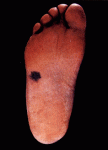
Acral lentiginous melanoma is more common in blacks, Asians, and Hispanics and occurs as an enlarging hyperpigmented macule or plaque on the palms and soles.

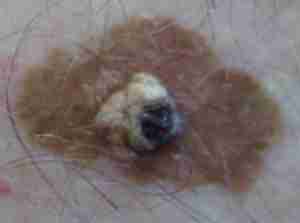
Nodular melanoma most commonly manifests itself as a rapidly growing, often ulcerated or crusted black nodule.

Impetigo

Impetigo
Impetigo (Pyoderma) is a superficial infection of the skin caused primarily by group A streptococci and occasionally by other streptococci or by Staphylococcus aureus.This condition is seen most often in young children, tends to occur during the warmer months, and is more common in semitropical or tropical climates than in cooler regions. The infection occurs especially often among children living under conditions of poor hygiene. Minor trauma, such as a scratch or an insect bite, may then serve to lodge bacteria into the skin and cause this infection. While the bacteria causing impetigo may have been caught from someone else with impetigo or boils, impetigo usually begins out of the blue without any apparent source of infection. Impetigo is best prevented, therefore, by attention to adequate hygiene.


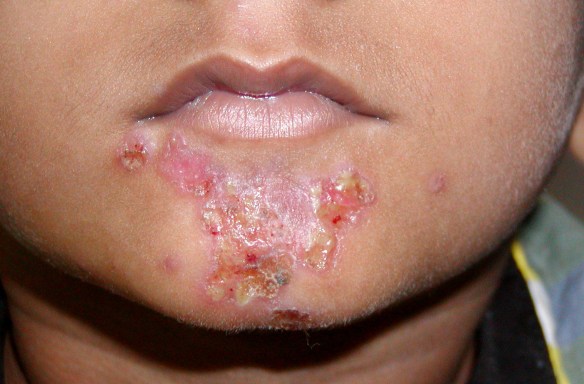
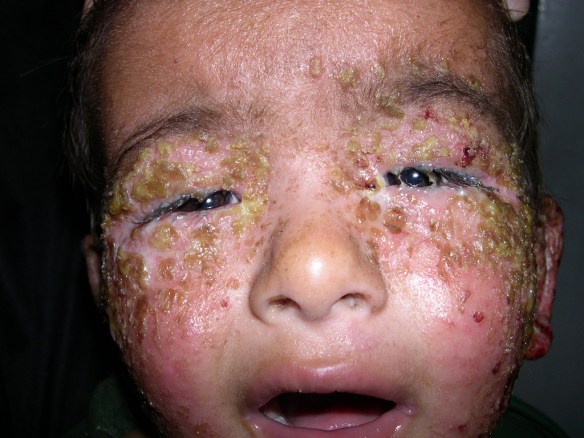
The usual sites of involvement are the face (particularly around the nose and mouth) and the legs, although lesions may occur at other locations.
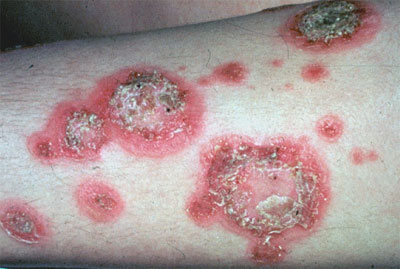
Individual lesions begin as red papules, which turn quickly to vesicular and then pustular lesions that break down and coalesce to form characteristic honeycomb-like crusts. Lesions generally are not painful, and patients do not appear ill. Fever is not a feature of impetigo.


Bullous impetigo is a distinctive form of impetigo characterized by the presence of more extensive, bullous lesions that break down and leave thin paper like crusts instead of the thick amber crusts of impetigo.  
Treatment Consists of cleaning the lesions with soap and water and topical and systemic antiboiotics.

  • Antibiotics usually clear up impetigo in four or five days. It’s important for the antibiotic to be taken faithfully until the prescribed supply is completely used up.
  • An antibiotic ointment, such as Polysporin, should be applied thinly four times daily. Polysporin can be purchased without a prescription.
  • Crusts should be removed before the ointment is applied. Soak a soft, clean cloth in a mixture of one-half cup of white vinegar and a quart of lukewarm water. Press this cloth on the crusts for 10-15 minutes three or four times daily. Then gently wipe off the crusts and apply a little antibiotic ointment. You can stop soaking the impetigo when crusts no longer form. When the skin is healed, stop the antibiotic ointment.

Among the antibiotics useful are dicloxacillin, cephalexin, or topical mupirocin ointment provide the most reliable treatment for impetigo, although penicillin or erythromycin are cheaper alternatives and equally effective.

A possible complication of Impetigo is glomerulonephritis, a type of kidney disease.

Precautions:Impetigo is contagious when there is crusting or oozing. While it’s contagious, take the following precautions:

  • Patients should avoid close contact with other people.
  • Children should be kept home from school until the lesions crust over.
  • Use separate towels for the patient. The patient’s towels, pillowcases, and sheets should be changed after the first day of treatment. His or her clothing should be changed and laundered daily for the first two days.
  • Usually the contagious period ends within two days after treatment starts.
Skin Diseases
Ecthyma

Kaposi’s Sarcoma

Kaposi’s Sarcoma
Kaposi’s sarcoma is a cancer of the walls of the blood vessels or lymphatic system. Kaposi’s Sarcoma is a malignant tumor frequently associated with AIDS. It mainly involves the skin. Human herpesvirus-8 (HHV-8) is associated with development of Kaposi’s Sarcoma.
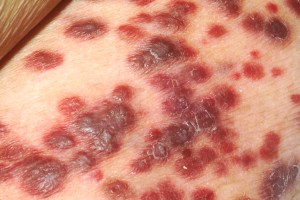
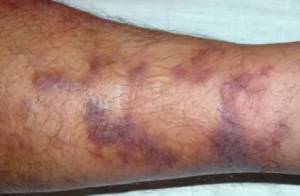
Before the AIDS epidemic, Kaposi’s sarcoma was seen primarily in elderly Italian and Jewish men and developed slowly in these people.In AIDS patients, it can develop aggressively and often involves the skin, lungs, gastrointestinal tract and other organs.It is more frequently associated with AIDS in homosexual men than AIDS in IV drug users. The malignancy results in purplish grape-like lesions in the skin, gastrointestinal tract and other organs.Symptoms associated with Kaposi’s Sarcoma in the gastrointestinal lesions is bleeding. With lesions in the lungs it may cause shortness of breath and bloody sputum.The disease usually progresses slowly and can remain stable for years or decades. However, the skin tumors do have a substantial impact on quality of life in these patients, due both to the stigma associated with the visible skin tumors and the pain they can cause.The cancer usually occurs in people with weakened immune systems, such as those with AIDS or patients who are on immune-suppressing drugs following an organ transplant. The disease is rarely fatal and can often be successfully treated with chemotherapy or other therapies.The appearance of Kaposi’s sarcoma is a poor prognostic sign for individuals with AIDS. It was seen very rare in the United States before the AIDS epidemic.Treatment depends on the site and extent of the lesions. Radiation therapy or cryotherapy can be used in selected cases. Lesions can recur after treatment.


Cancer causing Virus can be spread by Kissing

John Pauk, M.D., M.P.H., formerly of the University of Washington in Seattle, and his associates found out that most cases of new infection of human herpesvirus-8 (HHV-8), which caused an explosion in the number of Kaposi’s sarcoma cases at the beginning of the AIDS epidemic, the virus was most likely transmitted through saliva. This cancer-causing form of herpes disproportionately affects homosexual men.

This study was done on 27 homosexual men. Comparing the sexual history of these patients with those of other homosexual men who were not infected with HHV-8, Pauk found that “deep” kissing (in which saliva is exchanged) with an HIV-positive partner or a partner with Kaposi’s sarcoma and the use of amyl nitrate capsules (“poppers”) or inhaled nitrates (both used to enhance the sexual experience) were associated with an increased risk of infection.

HIV ~ Human Immunodeficiency Virus