Unknown's avatar

About Manbir & Gurpreet

Gurpreet Kaur’s journey in this world .... Gurpreet Kaur was a Musician. She was a singer and a composer of music. Her interest was composing and singing Gurbani Shabads in Indian Classical style. She sang Shabads in All the Raags mentioned in Sri Guru Granth Sahib Ji. She also taught Gurmat Sangeet at Gurmat Gian Missionary College, Jawadi, Ludhiana. Elder child to Pushpinder Kaur and Dr. Brig. Harminder Singh, was born in Amritsar on 13th Jan 1962. She attended various convent schools as a child because her father would get frequent Army postings as a dental surgeon. She graduated with Music Honors from Govt. College for Women, Chandigarh. Music was her hobby and she composed and sang Raag based Gurbani Shabads. Doing Kirtan was part of growing up nurtured by her parents. She learned music from her father Dr. Brigadier Harminder Singh who was a dental surgeon in Indian Army and a very good singer himself. Gurpreet’s Bhua (father’s sister), Ajit Kaur retied as a Head of Department of Music from Govt. College for Women Ludhiana, and was a renounced Punjabi singer of her time. Gurpreet Kaur also learned nuances of Indian Classical Music from Pandita Sharma. She was a mother of three children, and a grandmother. Her daughter Keerat Kaur is a Computer Engineer. Her two sons Gurkeerat Singh and Jaskeerat Singh are doctors in USA. Her daughter Keerat Kaur too was part of her group ~ Gurmat Gian Group. Gurpreet Kaur left this world at the age of 54yrs on 12th Sept 2016 in Baltimore USA. She had recorded around 25 cds of Gurbani Keertan. 'Raag Ratan' Album (6 CDs) is a Compilation of Shabads in All the 31 Sudh Raags of Sri Guru Granth Sahib Ji. 'Gauri Sagar' Album (3 CDs) is a Compilation of All forms of Raag Gauri in Sri Guru Granth Sahib Ji. 'Nanak Ki Malhaar' ~ ((3 CDs) is an album of Raag Malhar Shabads in various forms of Malhar. 'Gur Parsaad Basant Bana' ~ (3 CDs) is an album of Shabads in Raag Basant sung in various forms of Raag Basant. Har Ki Vadeyai Sarni Aayea Sewa Priya Kee Preet Piyaree Mohan Ghar Aavho Karo Jodariya Mo Kao Taar Le Raama Taar Le Tere Kavan Kavan Gun Keh Keh Gawan Mera Baid Guru Govinda Saajanrraa Mera Saajanrraa

Huntington's chorea

Huntington’s chorea

Chorea, the Greek word for “dance,” is used to describe the involuntary movements of the body especially of arms, legs and face. In Huntington’s chorea, these movements tend to be spastic and ballistic, and they dramatically affect normal functioning.

Huntington’s chorea is a dominantly inherited disease which is passed down through families by an autosomal dominant form of inheritance. It was first described by George Huntington in 1872. Incidence is 5-10/100,000.

The disease often presents as “nervousness“, and depression. Eventually progresses to include dementia and slowed eye movements. In juvenile HD, rigidity and parkinsonian tremor may be the primary manifestation. Generally, symptoms are first observed when the victim is in the ’20s or ’30s, and the degeneration slowly progresses, ending in the victim’s death some 10 to 20 years later.

The disease progresses with increasing chorea and loss of mental abilities. Eventually, abnormal movements and dementia become so severe that the person can no longer care for his or her self. 

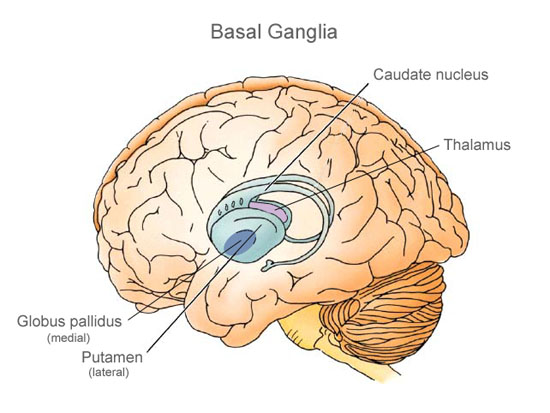
Huntington’s chorea is due to slow degeneration in the basal ganglia, which eventually leads to cell death in the brain and the decrease and increase of various neurotransmitters. The symptoms of the disease are caused by a significant reduction (volume and activity) of two principal neurotransmitters (naturally occurring chemicals in the brain) – namely Acetylcholine and GABA, in turn affecting the activity of the neurotransmitter Dopamine, which becomes hyperactive. The disorder is partly characterized by an increase in the availability of dopamine, which can cause symptoms of chorea. HD is a basal ganglia disease; the portions most severely affected are caudate and putamen.

Huntingtons can be diagnosed on MRI by caudate atrophy with appropriate history, and also by genetic testing.

At present, there is no cure. The aim is to treat symptoms and support and protect the patient. Drugs can control the chorea somewhat, but benefits are often outweighed by the side effects. Caretakers must see to the person’s basic needs.

These include

  • hygiene
  • skin care
  • bowel and bladder care
  • feeding.

One must stay alert for suicide attempts. The person’s family often needs emotional support. Caring for the person at home is often beyond the family’s capacity.

Down syndrome

Down syndrome

It is one of the most frequently occurring chromosomal abnormalities found in humans, occurring once in approximately every 800 to 1,000 live births.
John Langdon Down, an English physician, published an accurate description of a person with Down syndrome. It was this scholarly work, published in 1866, which earned Down the recognition as the “father” of the syndrome. Although other people had previously recognized the characteristics of the syndrome, it was Down who described the condition as a distinct and separate entity.
In 1959, the French physician, Jerome Lejeune, identified Down syndrome as a chromosomal anomaly. Instead of the usual 46 chromosomes present in each cell, Lejeune observed 47 in the cells of individuals with Down syndrome.

Down syndrome affects people of all races and economic levels. Women age 35 and older have a significantly increased risk of having a child with Down syndrome. A 35-year-old woman has a one in 400 chance of conceiving a child with Down syndrome, and this chance increases gradually to one in 110 by age 40. At age 45 the incidence becomes approximately one in 35.

Diagnosis

The diagnosis of Down syndrome is usually suspected after birth as a result of the baby’s appearance.

There are many physical characteristics which form the basis for suspecting an infant has Down syndrome. If Down syndrome is suspected, a karyotype will be performed to ascertain the diagnosis. Some infants with Down syndrome have only a few of these traits, while others have many.

Among the most common traits are:

  • Muscle hypotonia, low muscle tone
  • Flat facial profile, a somewhat depressed nasal bridge and a small nose.
  • Oblique palpebral fissures, an upward slant to the eyes.
    Dysplastic ear, an abnormal shape of the ear. Simian crease, a single deep crease across the centre of the palm.
  • Hyper flexibility, an excessive ability to extend the joints
    Dysplastic middle phalanx of the fifth finger, fifth finger has one flexion furrow instead of two.
  • Epicanthal folds, small skin folds on the inner corner of the eyes.
  • Excessive space between large and second toe.
  • Enlargement of tongue in relationship to size of mouth.

All people with Down syndrome have some level of mental retardation. however, the level usually falls into the mild to moderate range .Children with Down syndrome learn to sit, walk, talk, play, toilet train and do most other activities, only somewhat later than others. Speech is often delayed.

Most people with Down syndrome have IQs that fall in the mild to moderate range of retardation. Children with Down syndrome are definitely educable

Today those with Down syndrome are working in various jobs and doing productive work. Banks, hotels, music, computer and many types of industries are employing individuals with Down syndrome.

People with Down syndrome date, socialize and form on-going relationships. Some are beginning to marry. Women with Down syndrome can and do have children, but there is a 50 percent chance that their child will have Down syndrome. Men with Down syndrome are believed to be sterile, with only one documented instance of a male with Down syndrome who has fathered a child.

Children with Down syndrome are at increased risk for certain health problems. Congenital heart defects, increased susceptibility to infection, respiratory problems, obstructed digestive tracts and childhood leukemia occur with greater frequency among children who have Down syndrome. However, advances in medicine have rendered most of these health problems treatable, and the majority of people born with Down syndrome today have a life expectancy of approximately fifty-five years.

Adults with Down syndrome are at increased risk for Alzheimer’s disease. Whereas approximately 6% of the general population will develop the disease, the figure is about 25% for people with Down syndrome.

Up to 50 percent of individuals with Down syndrome are born with congenital heart defects. The majority of heart defects in children with Down syndrome can now be surgically corrected with resulting long-term health improvements.

Leukemia – Individuals with Down syndrome have a 15 to 20 times greater risk of developing leukemia. The majority of cases are categorized as acute megakaryoblastic leukemia, which tends to occur in the first three years of life, and for which there is a high cure rate. A transient form of leukemia is also seen in newborns with Down syndrome, disappearing spontaneously during the first two to three months of life.

Screening tests for Down syndrome

There are two types of procedures available to pregnant women: Screening tests and diagnostic tests. Screening tests estimate the risk of the fetus having Down syndrome; diagnostic tests tell whether or not the fetus actually has the condition.

The most commonly used screening tests are the Triple Screen and the Alpha-fetoprotein Plus. These tests measure quantities of various substances in the blood (alpha-fetoprotein, human chorionic gonadotropin and unconjugated estriol) and together with the woman’s age, estimate her risk of having a child with Down syndrome. These screening tests are typically offered between fifteen and twenty weeks of gestation.

Screening tests are of limited value and are often performed in conjunction with a detailed sonogram. These tests are only able to accurately detect about sixty percent of fetuses with Down syndrome.

The procedures available for prenatal diagnosis of Down syndrome are chorionic villus sampling (CVS), amniocentesis and percutaneous umbilical blood sampling (PUBS). Each one of these procedures carries a small risk of miscarriage as tissue is extracted from the placenta or the umbilical cord to examine the fetus’s chromosomes. The procedures are about 98 to 99 percent accurate in the detection of Down syndrome.
Genetic disorders

Aside

Some Interesting genetic disorders

Frequency of Chromosomal disorders
Y Chromosome
Genes & Chromosomes
Genetic counselling


Frequency of Chromosomal disorders Among Live Born Infants

Frequency of Chromosomal disorders  Among Live Born Infants 

Autosomal Abnormalities

Trisomy 21

1 in 800

Trisomy 18

1 in 5,000

Trisomy 13

1 in 15,000

Marfan syndrome

1 in 10,000


Sex Chromosomal Abnormalities

Klinefelter Syndrome (47,XXY)

1 in 1000 males

XYY Syndrome (47,XYY)

1 in 800 males

Turner Syndrome (45X or 45X/46XX or 45X/46XY)

1 in 3000 females

Triple X syndrome (47,XXX)

1 in 1000 females


Y Chromosome

Genes & Chromosomes

Genes & Chromosomes

Genes & Chromosomes

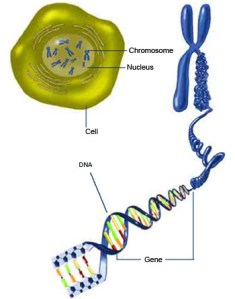
Whether or not a specific trait or disorder is inherited is determined by hereditary material called “genes.” Genes are the units of hereditary material. They contain coded instructions which direct the development of every cell and tissue in the human body. You might think of genes as blueprints, specifying how the body will develop and function.

A gene is a stretch of DNA that tells a cell how to make a protein. Each amino acid is coded for by a three-letter sequence. The cell machinery reads this code, grabs the appropriate amino acids, and strings them together to make a protein. Most researchers believe we have around 100 000 genes.

The human genome comes in 23 pieces, packaged in proteins to form chromosomes. Our cells have two copies of each chromosome–one from each parent–making 46 in all. The 23rd pair consists of the sex chromosomes.

Thousands of genes are found on thread-like structures, called chromosomes, which are located in the center or “nucleus” of each cell. Genes and chromosomes exist in pairs. At the time of conception, each parent contributes one gene and one chromosome from each of his or her gene and chromosome pairs. The genes and chromosomes from each parent combine into new pairs which determine the traits a child inherits.

Most often, genes produce normal traits. Sometimes, however, a gene becomes altered from its original form. A gene that is thus changed is called a “mutant” gene. Although researchers know that mutations occur, the reasons for their occurrence is not completely understood. Some mutations are not harmful, but most often a mutant gene functions improperly and causes a disorder, malfunction, or malformation within the body. Mutations can occur in any generation. If a spontaneous mutation occurs, it is then possible for a child to be the first family member to get a genetic disorder such as Marfan syndrome, even though both parents are normal.

A mutation is a misspelling in the code for a protein that can be passed from one generation to the next–an A instead of a G, say. The result can be a disease, such as cystic fibrosis.

There are present multiple variations of a gene (called alleles) at the same genetic location. For most locations, each individual possesses two alleles, one derived from each parent. If the two alleles are identical, the individual is said to be homozygous; if they are different, the individual is heterozygous.

In addition to mutations, the “inheritance pattern” or the way in which genetic traits or disorders are expressed also varies. The Marfan syndrome follows a pattern of inheritance called “autosomal dominant inheritance.” “Autosomal” means the inheritance is linked to any chromosome other than those which determine the sex of the child. “Dominant” means the effects of the Marfan gene dominate or override the effects of the normal gene in the pair. Therefore, if one parent contributes the Marfan gene and one parent contributes a normal gene, the child will inherit the Marfan disorder. There is a 50% chance during each pregnancy that the affected parent will pass on the Marfan gene and the child will get the Marfan syndrome. There is, of course, also a 50% chance that the affected parent will pass on his or her normal gene, in which case the child will not get the disorder.

It is important to remember that parents have no control over which genes they pass on to their children, and, therefore, should not feel at fault if one of their children inherits a disorder such as the Marfan syndrome.

Y Chromosome