Unknown's avatar

About Manbir & Gurpreet

Gurpreet Kaur’s journey in this world .... Gurpreet Kaur was a Musician. She was a singer and a composer of music. Her interest was composing and singing Gurbani Shabads in Indian Classical style. She sang Shabads in All the Raags mentioned in Sri Guru Granth Sahib Ji. She also taught Gurmat Sangeet at Gurmat Gian Missionary College, Jawadi, Ludhiana. Elder child to Pushpinder Kaur and Dr. Brig. Harminder Singh, was born in Amritsar on 13th Jan 1962. She attended various convent schools as a child because her father would get frequent Army postings as a dental surgeon. She graduated with Music Honors from Govt. College for Women, Chandigarh. Music was her hobby and she composed and sang Raag based Gurbani Shabads. Doing Kirtan was part of growing up nurtured by her parents. She learned music from her father Dr. Brigadier Harminder Singh who was a dental surgeon in Indian Army and a very good singer himself. Gurpreet’s Bhua (father’s sister), Ajit Kaur retied as a Head of Department of Music from Govt. College for Women Ludhiana, and was a renounced Punjabi singer of her time. Gurpreet Kaur also learned nuances of Indian Classical Music from Pandita Sharma. She was a mother of three children, and a grandmother. Her daughter Keerat Kaur is a Computer Engineer. Her two sons Gurkeerat Singh and Jaskeerat Singh are doctors in USA. Her daughter Keerat Kaur too was part of her group ~ Gurmat Gian Group. Gurpreet Kaur left this world at the age of 54yrs on 12th Sept 2016 in Baltimore USA. She had recorded around 25 cds of Gurbani Keertan. 'Raag Ratan' Album (6 CDs) is a Compilation of Shabads in All the 31 Sudh Raags of Sri Guru Granth Sahib Ji. 'Gauri Sagar' Album (3 CDs) is a Compilation of All forms of Raag Gauri in Sri Guru Granth Sahib Ji. 'Nanak Ki Malhaar' ~ ((3 CDs) is an album of Raag Malhar Shabads in various forms of Malhar. 'Gur Parsaad Basant Bana' ~ (3 CDs) is an album of Shabads in Raag Basant sung in various forms of Raag Basant. Har Ki Vadeyai Sarni Aayea Sewa Priya Kee Preet Piyaree Mohan Ghar Aavho Karo Jodariya Mo Kao Taar Le Raama Taar Le Tere Kavan Kavan Gun Keh Keh Gawan Mera Baid Guru Govinda Saajanrraa Mera Saajanrraa

Creutzfeldt-Jakob Disease

Creutzfeldt-Jakob Disease (“CJD”) is a rare, fatal brain disorder which causes a rapid, progressive dementia and associated neuromuscular disturbances

Incidence of this disease is One in per million people per year.
Affects both men and women of diverse ethnic backgrounds usually between the ages of 50 to 75 years. The disease occurs world wide.

Cause of the Disease

There had been much debate on the cause of the disease. Now it is accepted that that a transmissible agent is responsible for causing Creutzfeldt-Jakob Disease, as shown by experiments involving the injection of CJD-affected brains into the normal brains of healthy animals. The identification of this transmissible agent has been the subject of much scientific inquiry and debate.
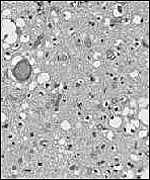
Prion

The agent responsible is either a slow virus or Prion.

In 1996, scientists confirmed that they had discovered a new strain or variant of the disease among young people This is now referred to as vCJD.

The emergence of vCJD came after the biggest ever epidemic of BSE in cattle. Since that epidemic was in the UK and most vCJD victims lived in the UK, most scientists believed the two were linked.

They say the most likely cause of vCJD in humans was eating BSE-infected beef between the years of 1986 and 1989, when contaminated meat probably got into the food chain in large quantities.

Mode of Transmission

There appear to be three general categories for classifying the means through which CJD may be acquired.
First, the disease can occur sporadically.
Second, the disease can be inherited.
Third, the disease can be transmitted through infection.

Sporadic Creutzfeldt-Jakob Disease

Sporadic CJD refers to those cases in which there is no known infectious source and no evidence of the disease in the prior or subsequent generations of the patient’s family. Most CJD cases occur sporadically, thereby leaving their origins a mystery.

Inherited Creutzfeldt-Jakob Disease

Approximately 10 to 15 per cent of CJD cases are inherited. These familial cases exhibit a mutation in the gene coding for the prion protein. Genetic factors are thought to be responsible for the elevated numbers of CJD cases in some communities in Czechoslovakia and Chile, as well as among Libyan-born Jews.

Creutzfeldt-Jakob Disease Through Infection

Although CJD can be aquired by a transmissible agent it is not a contagious disease. The family members do not have increased risk of contracting the disease.
Iatrogenic transmission of CJD has occurred in cases involving
corneal transplants,
implantation of electrodes in the brain,
duramater grafts,
contaminated surgical instruments
and the injection of natural human growth hormone derived from cadaveric pituitaries.

Thus, one may become infected with CJD from direct contamination with infected neural tissue.

Studies are currently being conducted to determine if CJD is transmitted to humans through blood. The infectious agent has been found in blood but there have been no documented cases of blood transmission of CJD in humans.

In Britain, scientists have struggled to ascertain if there is a connection between bovine spongiform encephalopathy (“BSE”) and CJD. BSE or “mad cow disease” was initially discovered in Britain in 1986 and thought to have resulted from the use of cattle feed containing ground offal from scrapie-infected sheep.
It is now believed that here was a possible link between BSE and CJD. This new acknowledgement arose from the identification of an apparently new strain of CJD which was discovered in 10 people under the age of 42, including some teenagers. Additionally, five of the people were associated with the meat and livestock industry. Scientists decided that the most likely explanation for this unusual outbreak was the consumption of beef from diseased cattle before 1989, when regulations were adopted for the disposal of potentially infectious cattle offal, including brains, and the use of sheep entrails as feed ceased.

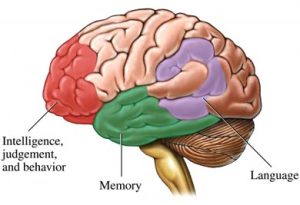
Inability to detect Sarcasm may be early sign of Dementia.

Inability to detect Sarcasm may be early sign of Dementia.

A study conducted by a group of scientists at the University of California, San Francisco  has determined which areas if brain govern a person’s ability to detect sarcasm and lies.

The team used MRI to map their brains  which showed association between deteriorations of particular parts of brain and the inability to detect insincere speech.

Dementia

Dementia


All of us gradually slow down both physically and mentally with the passage of time as we get older.

There is a difference between occasional forgetfulness and many diseases which are cause of Dementia. Some indications are helpful in differentiating the conditions.

Dementia is a clinical syndrome characterized by loss of previously acquired intellectual functions in the absence of impairment of consciousness.

The term dementia is mostly associated with elderly but some disorders occur in the mid life which have Dementia as a prominent feature. Such diseases are also collectively called Pre-senile Dementia and these diseases also have a strong familial disposition.

Main features of Dementia
  • Loss of general intelligence
  • Memory impairment
  • Personality changes
  • Emotional changes

Loss of general intelligence:

Judgment and problem solving ability is reduced. Thinking is slow.

Memory impairment:

Minor degree of memory impairment is often the first sign of this disease. Forgetfulness in relation to day to day work and concerning personal possessions is prominent. People’s names are forgotten, appointments are missed. Declining memory may lead to secondary delusions.

Personality changes:

Decline in personal manner and social awareness. Behavior may become rude, tactless, and may be insensitive to feeling of others. Episodes of aggression, sexual indiscretion or even infringement of law may be seen. Deterioration in personal hygiene, urinary and fecal incontinence are common. General decline in interest of the surroundings. Patient may sit for hours without initiating any purposeful activity.

Emotional changes: Mood changes, depression, anxiety, irritability may be prominent in the early stages. In advanced dementia the emotional reaction may be blunted and patients becomes incapable of responding to emotionally charged events in their environment.

Things to look for:

  • Family history:  Some diseases run in families.  Some diseases have genetic predisposition.
  • Signs of memory loss and language difficulties. Is the person losing words, or forgetting the names of common objects? Has he or she forgotten how to do simple mathematics?
  • Is the loss of memory for recent events only?
  • Confusion and loss of attention span. Is the person unable to focus on a normal conversation?
  • Inappropriate behaviour and impaired judgment. If the person begins to act inappropriately or significantly out of character in social situations.
  • Physical coordination problems and physical confusion. People with senile dementia often forget how to do simple learned tasks that have been part of their daily life for many years.

Talking to the person and taking detailed history helps in differentiating and diagnosing the cause of dementia.

Causes of Dementia

Degenerative diseases:

Space occupying lesions:

  • Cerebral tumour
  • Subdural haematoma

Infections:

AIDS, Cerebral syphilis, Viral encephalitis

Others:

Post Traumatic dementia, Boxer’s encephalopathy, Secondary to Head Injury. Chronic Traumatic Encephalopathy
Cerebrovascular disease, Cerebral emboli.
Hypothyroidism, Hypopituitarism.
Liver disease, Renal failure, Alcoholism
Vitamin deficiency: Folic acid, B12

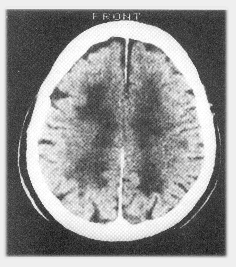
Cerebrovascular dementia: CT brain scan showing multiple diffuse areas of cerebral infarction.

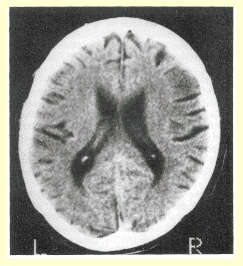
Alzheimer's disease: CT scan of brain showing cortical atrophy, widened sulci, and enlarged lateral ventricles.

Drug Therapy in Dementia

Dementia is a complex disorder which causes impairment in all areas of mental functions

  • Memory and intellectual impairment ( cognitive )
  • Anxiety and depression ( mood )
  • Paranoia and Hallucination ( perception )
  • Agression or withdrawal.

Various neurotransmitters are said to be involved in the causation of Dementia –

  • Acetylcholine
  • Dopamine
  • Serotonin

Drugs for Cognitive and functional impairments in Dementia

These drugs increase the availability of Acetylcholine.
Tacrine
Rivastigmine
Donepezil
Newer drugs in future – Venlacrine,Galanthamine,Hyperazine.

Brain blood flow enhancers

These drugs increase blood perfusion and redistribute blood in the deficient areas.
Cyclandelate
Hydergine

Miscellaneous Drugs

Piracetam – a metabolic enhancing agent of the brain.
Selgilne- a MAOinhibitor, which is used in Parkinson’s disease is also useful in Alzheimer’s disease.
Aspirin and Other Anti inflammatory agents (NSAIDS) have also been shown to slow down the process of dementia.
Oestrogen replacement therapy may be helpful in postmenopausal women with dementia.
Ginkgo biloba
Brahmi
Ashwagandha
Researchers found that taking vitamins C and E might help protect the aging
mind from decline in cognitive function, and some kinds of dementia.

Chronic Traumatic Encephalopathy
Inability to detect Sarcasm may be early sign 

Coffee and Parkinson’s disease

Coffee and Parkinson’s disease

Coffee drinkers may have a lower risk for Parkinson’s disease.

That’s the finding of a study published in the Journal of the American Medical Association.  Researchers came out with this observation after looking at a data on 8,004 Japanese-American men participating in the ongoing Honolulu Heart Program.  The men, whose average age was 53 when the study began, were asked about their coffee consumption twice, in 1965 and again in 1971.  The men who did not drink coffee were five times more likely to have Parkinson’s than those men who drank the most coffee – four to five cups per day.

The researchers could not say why coffee protected the men from Parkinson’s disease, but they hypothesize that caffeine is probably the factor that provides the benefit – the more caffeine consumed, the greater the benefit.  The researchers say caffeine may protect against the nerve cell destruction associated with Parkinson’s.  But they also say there could be something in the brain composition of coffee drinkers that both predisposes them to heavy coffee drinking and makes them resistant to Parkinson’s disease.

It is too early to recommend coffee as a treatment for Parkinson’s disease.  It also is not known if the results of this study will hold true for women or other ethnic groups.

Parkinson’s Disease

Parkinson’s Disease – Genetic & Environmental etiology

Parkinson’s Disease – Genetic & Environmental etiology

Parkinson’s disease is likely to be a multifactor disorder involving a combination of environmental and genetics factors. The cause of PD is unknown. Various factors have been implicated in the etiology of the disease, such as infection, metabolic factors, free radicals, growth factors and toxins. Until recently research mainly focused on connection between this disorder and environmental factors such as viral infection and neurotoxins. In the last few years studies have shown linkage between genetic factors and movement disorders, because of this interest has shifted from environment to genome.

In 1997, a study funded by the National Institute of Health in the US reported that a family of Greek and Italian origin with a parkinsonian syndrome had an abnormal gene on chromosome 4 which produced a protien called alpha-synuclein. This family was atypical because of relatively young mean age of onset of 45 years and the rapid course of 10 years from the onset to death.

However, in over 200 familial cases of PD, studies by other groups, Parkinsonism was not linked to the abnormal gene on chromosome 4.

Work done by different groups have shown linkage of PD with other chromosomes 2 and 6. The demonstration of three different genes, on 3 different chromosomes, producing parkinsonism, shows that there are multiple causes even within genetic category. There are certainly multiple genetic causes but in all probability in majority of patients there are significant non-genetic causes.

It may be that there are several different environmental risk factors just as there are several different genes on several different chromosomes which establish the background of susceptibility to Parkinson’s disease. The liability to develop the disease will depend on what one might say the dose of environmental factor and the dose of genetic predisposition combined.

Parkinson’s Disease