
Unknown's avatar

About Manbir & Gurpreet

Gurpreet Kaur’s journey in this world .... Gurpreet Kaur was a Musician. She was a singer and a composer of music. Her interest was composing and singing Gurbani Shabads in Indian Classical style. She sang Shabads in All the Raags mentioned in Sri Guru Granth Sahib Ji. She also taught Gurmat Sangeet at Gurmat Gian Missionary College, Jawadi, Ludhiana. Elder child to Pushpinder Kaur and Dr. Brig. Harminder Singh, was born in Amritsar on 13th Jan 1962. She attended various convent schools as a child because her father would get frequent Army postings as a dental surgeon. She graduated with Music Honors from Govt. College for Women, Chandigarh. Music was her hobby and she composed and sang Raag based Gurbani Shabads. Doing Kirtan was part of growing up nurtured by her parents. She learned music from her father Dr. Brigadier Harminder Singh who was a dental surgeon in Indian Army and a very good singer himself. Gurpreet’s Bhua (father’s sister), Ajit Kaur retied as a Head of Department of Music from Govt. College for Women Ludhiana, and was a renounced Punjabi singer of her time. Gurpreet Kaur also learned nuances of Indian Classical Music from Pandita Sharma. She was a mother of three children, and a grandmother. Her daughter Keerat Kaur is a Computer Engineer. Her two sons Gurkeerat Singh and Jaskeerat Singh are doctors in USA. Her daughter Keerat Kaur too was part of her group ~ Gurmat Gian Group. Gurpreet Kaur left this world at the age of 54yrs on 12th Sept 2016 in Baltimore USA. She had recorded around 25 cds of Gurbani Keertan. 'Raag Ratan' Album (6 CDs) is a Compilation of Shabads in All the 31 Sudh Raags of Sri Guru Granth Sahib Ji. 'Gauri Sagar' Album (3 CDs) is a Compilation of All forms of Raag Gauri in Sri Guru Granth Sahib Ji. 'Nanak Ki Malhaar' ~ ((3 CDs) is an album of Raag Malhar Shabads in various forms of Malhar. 'Gur Parsaad Basant Bana' ~ (3 CDs) is an album of Shabads in Raag Basant sung in various forms of Raag Basant. Har Ki Vadeyai Sarni Aayea Sewa Priya Kee Preet Piyaree Mohan Ghar Aavho Karo Jodariya Mo Kao Taar Le Raama Taar Le Tere Kavan Kavan Gun Keh Keh Gawan Mera Baid Guru Govinda Saajanrraa Mera Saajanrraa

Angina Pectoris

Angina Pectoris

Angina Pectoris is the name given to a clinical syndrome used to describe discomfort due to transient myocardial ischaemia. The underlying cause may be Coronary atheroma. Spasm of coronary artery may also be underlying cause.

Factors that worsen Angina

  • Exercise
  • Anaemia
  • Hypertension
  • Hyperthyroidism
  • Tachycardia (increased heart rate)
  • Aortic valve disease

Features of of Angina
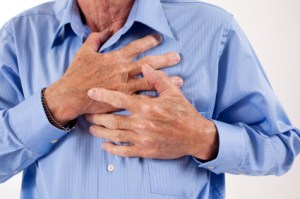
It is usually experienced as a sense of oppression or tightness in the middle of the chest ‘like a band round the chest’. It is induced by exertion and relieved by rest and lastsfor a few minutes.
The pain may be accompanied by discomfort in the arms more commonly in the left arm or even wrist or hands. The pain may radiate to neck or jaw or it may be present in the upper abdomen (epigastric region) or even back (interscapular region).

Situations precipitating Angina
Physical exertion like walking, or walking against wind, or while having a bath.
Cold exposure
Intense emotions
Heavy meals
Violent dreams
Lying flat

Relief of pain with Glyceryl trinitrate helps in diagnosis of Angina Pectoris.

Conditions that may mimic Angina Pectoris
Musculoskeleton pains: of the chest and back may at times confuse and create difficulty in the diagnosis of Angina. The pain of muscular origin is not totally relieved by rest and may persist even after rest. Local tenderness is present in case of pain of musculoskeletal in nature.
Pericardial pain: Pain of acute pericarditis is typically in the retrosternal region and often radiates to the neck and shoulders. It may be made worse by deep breath, movement or change of posture. A friction rub known as Pericardial Rub is diagnostic, and is best heard by a stethoscope at the left of lower sternum.
Oesophageal pain: Pain due to oesophagitis has a burning quality and is relieved by taking Antaacids. Oesophagial spasm pain may at times be indistinguishable from angina.

Risk Factors for Coronary Heart Disease

  • Smoking
  • Hyperlipidaemia
  • Hypertension
  • Diabetes Mellitus
  • Sedentary Lifestyle
  • Obesity
  • Diet defficient in Polyunsaturated fatty acids
  • Low Vitamin E & C
  • Blood Coagulation Factors Fibrinogen & Factor VII
  • High levels of lipoprotein (a), homocysteine, ApoB
Smoking has a definite dose related relationship with Ischaemic heart disease. The risk of death for smokers is highest in younger population.
Hereditary Hypercholesterolaemia ( Raised blood level of Cholesterol) : Patients with hereditary hypercholesterolaemia have high incidence of Coronary disease. Reduction of blood cholesterol has a definite effect in the reduction of morbidity and death from coronary heart disease.
It is estimated that the development of Ischaemic heart disease is controlled by both Genetic and Environmental factors, could be in the ratio of 40:60.
Major manifestations of Coronary Heart disease are Angina Pectoris & Myocardial Infarction

Normal Electrocardiogram

Eating Tips 1

Eating Tips

  • For a nourishing start to your day, choose a whole-grain bran cereal packed with fiber, such as raisin bran or bran flakes.  Add fruit and low-fat milk for the most nutritious beginning.
  • Low-fat popcorn is crunchy, delicious, and a source of whole grain fiber. Plus, you can enjoy a large, filling portion! Look for popcorn made with “94% Fat Free Butter” or air-popped popcorn.
  • Choose light ice creams, or frozen yogurts which are low in fats and calories.
  • Enjoy thin-crust frozen pizza or with grilled chicken or veggies. Avoid the sausage, pepperoni, and extra cheese. Limit your portion to two slices and add a salad to complete the meal.
  • 100% fruit juices are naturally rich in vitamins, minerals, and disease-fighting antioxidants. In fact, they’re the next best thing to eating whole fruit.
    “Fruit juice drinks,” however, are usually packed with sugar and empty calories.
  • Frozen Meals Can Be Healthy, Too!: Look for frozen meals that have lean protein, plenty of vegetables, whole grains, and a low-fat or simple sauce.
  • Avoid fried frozen food, or creamy casseroles. Frozen meals that are baked, grilled, steamed, or sautéed are healthier and lower in calories.
  • Spaghetti – A Healthy Favorite: Try the new whole-wheat pasta blends. Even the kids will like it if you top the spaghetti with your favorite tomato sauce. Macaroni and cheese are low in fiber and loaded with fat and calories.
  • Fat-Free Frozen Shrimp & Prawns: Shrimp are a tastier and healthier alternative to breaded fish sticks. You can buy them already cooked and shelled. Eat them cold with cocktail sauce, grill them, or sauté with veggies.

Anthrax as Biological Weapon

Anthrax as Biological Weapon

  • Anthrax is an imperfect weapon because it is hard to obtain and disperse. 
  • It is extremely difficult to transform the Bacillus anthracis into a weapon for mass destruction.
  • It is one thing to have anthrax and another to infect people with it.
  • To make anthrax into a powder needs sophisticated technology.
  • You cannot contact anthrax by touching a door-nob or stair railing or any other object.
  • Anthrax spores can survive for almost 24 hours in the air when spread as  airborne aerosol. The spores are killed by the sunlight. They may persist for years if buried in the soil. Although the anthrax spores can contaminate the building surfaces for several hours, they would adhere to the surfaces and would be unlikely to re-aerosolised to cause pulmonary infection.  
  • To make the anthrax stain into its most leathal form – pulmonary anthrax the spores have to be of exact size. B. anthracis spores as airborne particles < 5 um in diameter need to be deposited directly into the alveoli or alveolar ducts ( the remote location in the lung ) of the lungs. If the spores are too small they would be exhaled out during breathing and would not be able to do any damage. Larger size spores will not be inhaled and would not reach the exact site of the lung to start the disease process.

    Anthrax spores

  • Bombs carrying anthrax may not be effective in dispersing the germs because the explosion would destroy them.
  • Spreading the bacterium with aerosol is a hard task. Unless it is in the form of spores it cannot be sprayed. In this context the attempt by Aum Shinrikyo cult of Japan to kill people traveling in the metro trains by spraying mist of Anthrax can be mentioned. The attempt did not succeed. The members of this cult squirted the agent in its liquid form. In this form the bacteria is less likely to reside in the victims’ lungs.     

Anthrax

Anthrax

Anthrax is an acute bacterial infection caused by an organism called Bacillus anthracis. It is mainly a disease of herbivorous animals.

Humans become infected when spores of B. anthracis are introduced into the body by:

  • contact with infected animals
  • contaminated animal products
  • insect bites
  • inhalation
  • ingestion

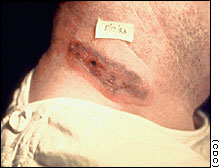
In human beings the most common form of this infection is Cutaneous Anthrax. It is characterized as a localized skin lesion with a central eschar surrounded by marked edema or swelling.

Other forms are more dangerous –

Anthrax spores

Inhalation Anthrax (woolsorters’ disease) – it involves hemorrhagic mediastinitis, rapidly progressive systemic infection, and a very high mortality rate.

Gastrointestinal Anthrax is rare and is also associated with a high mortality rate.

Approximately 95 percent of human cases of anthrax are the cutaneous form and about 5 percent the inhalation form. Gastrointestinal anthrax is rare. Anthrax meningitis occurs in a small percentage of all cases and is a frequent complication of overwhelming infection with B. anthracis and this is also associated with a high mortality rate.

CUTANEOUS ANTHRAX

Cutaneous anthrax is caused when spores of B. anthracis are introduced into the skin through cuts or abrasions or by biting flies. The spores germinate within hours, and the vegetative cells multiply and produce anthrax toxin. These lesions are more often found on the exposed areas of the body.

Within days a small red macule appears. During the next week, the lesion progresses through papular and vesicular or pustular stages to the formation of an ulcer with a blackened necrotic eschar surrounded by a zone of brawny edema. There may be itching in the early lesion and the fully developed lesion is painless.

Small satellite vesicles may surround the original lesion, and painful regional lymph nodes may be present. Most patients do not have fever and may have no constitutional symptoms. In severe cases, the edema may be extensive and associated with shock. Spontaneous healing occurs in 80 to 90 percent of untreated cases, but edema may persist for weeks. In the 10 to 20 percent of untreated patients who have progressive infection, bacteremia develops and is often associated with high fever and rapid death.

Other conditions that may be confused with this disease are staphylococcal skin infections, tularemia, plague.

Cutaneous anthrax should be considered when patients have painless ulcers associated with and edema and have had contact with animals or animal products.

INHALATION ANTHRAX

In this form of the disease the spores of the B.anthracis are deposited directly in to the alveoli of the lungs. B. anthracis spores as airborne particles 5 um in diameter need to be deposited directly into the alveoli or alveolar ducts ( the remote location in the lung ) of the lungs. From here the spores are taken up by the phagocytes and carried to the mediastenal nodes where they germinate. Hemorrhagic mediastinitis takes place with necrosis of the nodes. Infection rapidly spreads leading to death.

Clinical presentation of the patient is similar to severe acute viral respiratory infection and diagnosis at early stage is difficult.  After 1 to 3 days, there is increasing fever, dyspnea, stridor, hypoxia, and hypotension usually leading to death within 24 h.

GASTROINTESTINAL ANTHRAX

Gastrointestinal anthrax usually results from ingestion of inadequately cooked meat from animals with anthrax. Primary lesion can be in the intestines or it may be oral and pharynx or at the tonsils.

Symptoms may be fever, nausea and vomiting, abdominal pain, bloody diarrhea, and sometimes rapidly developing ascites. Sore throat and dysphagia may be present in case of lesions in the throat.

TREATMENT

Bacillus.anthracis is highly sensitive to penicillin. Ciprofloxacin is also drug of choice.

PREVENTION

Inhalation anthrax was essentially eliminated in England before 1940 through the development of methods to decontaminate wool and goat’s hair and the improvement of working conditions for handlers of animal products.

Non living vaccine  are used in the United Kingdom and the United States for the immunization of agricultural workers, veterinary personnel, and others at risk of exposure to anthrax.

Live attenuated vaccines containing spores of B. anthracis are used in both developed and developing countries to immunize domestic herbivores animals. These preparations are also used to immunize humans in Russia but not in the United States.

Improved anthrax vaccines for humans are needed. . In addition to agricultural and industrial anthrax, the possible use of B. anthracis as an agent of biological warfare is a stimulus for the development of an improved vaccine. Carcasses of animals that die due to anthrax should be buried intact or cremated. Butchering of infected animals should be avoided.

Anthrax as Biological Weapon

Chronic Traumatic Encephalopathy

Chronic Traumatic Encephalopathy

CTE. Chronic traumatic encephalopathy, is a dementia-like brain disease afflicting athletes exposed to repeated brain trauma.

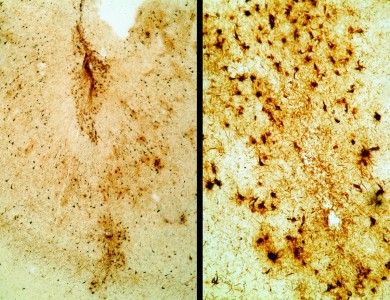
Abundant tau immunoreactive neurofibrillary tangles (dark brown dots) in the cerebral cortex in a pattern unique to chronic traumatic encephalopathy (CTE)

CTE has been found in the brains of 14 of 15 former NFL players thus far studied.

Their cases share a common thread — repeated concussions, sub-concussive blows to the head, or both. The picture beginning to emerge from these cases is that trauma could be causing brain damage.

A brain with CTE is riddled with dense clumps of a protein called tau. Under a microscope, tau appears as brown tangles seen in dementia. But the cases of CTE have shown this progressive, dementia-like array in players well in advance of a typical dementia diagnosis, which typically occurs in the 70s or 80s.

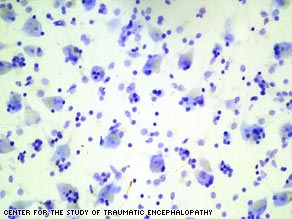
Healthy Brain Tissue

Scientists at Boston University have found evidence of CTE in the brain of an athlete as young as 18.

Symptoms that are common among many cases of CTE including problems with impulse control, an increasingly short fuse and headaches.

The alarming aspect is that we do seem to be seeing an increased rate in athletes who have early and moderate stage CTE.

CTE

Dementia