Unknown's avatar

About Manbir & Gurpreet

Gurpreet Kaur’s journey in this world .... Gurpreet Kaur was a Musician. She was a singer and a composer of music. Her interest was composing and singing Gurbani Shabads in Indian Classical style. She sang Shabads in All the Raags mentioned in Sri Guru Granth Sahib Ji. She also taught Gurmat Sangeet at Gurmat Gian Missionary College, Jawadi, Ludhiana. Elder child to Pushpinder Kaur and Dr. Brig. Harminder Singh, was born in Amritsar on 13th Jan 1962. She attended various convent schools as a child because her father would get frequent Army postings as a dental surgeon. She graduated with Music Honors from Govt. College for Women, Chandigarh. Music was her hobby and she composed and sang Raag based Gurbani Shabads. Doing Kirtan was part of growing up nurtured by her parents. She learned music from her father Dr. Brigadier Harminder Singh who was a dental surgeon in Indian Army and a very good singer himself. Gurpreet’s Bhua (father’s sister), Ajit Kaur retied as a Head of Department of Music from Govt. College for Women Ludhiana, and was a renounced Punjabi singer of her time. Gurpreet Kaur also learned nuances of Indian Classical Music from Pandita Sharma. She was a mother of three children, and a grandmother. Her daughter Keerat Kaur is a Computer Engineer. Her two sons Gurkeerat Singh and Jaskeerat Singh are doctors in USA. Her daughter Keerat Kaur too was part of her group ~ Gurmat Gian Group. Gurpreet Kaur left this world at the age of 54yrs on 12th Sept 2016 in Baltimore USA. She had recorded around 25 cds of Gurbani Keertan. 'Raag Ratan' Album (6 CDs) is a Compilation of Shabads in All the 31 Sudh Raags of Sri Guru Granth Sahib Ji. 'Gauri Sagar' Album (3 CDs) is a Compilation of All forms of Raag Gauri in Sri Guru Granth Sahib Ji. 'Nanak Ki Malhaar' ~ ((3 CDs) is an album of Raag Malhar Shabads in various forms of Malhar. 'Gur Parsaad Basant Bana' ~ (3 CDs) is an album of Shabads in Raag Basant sung in various forms of Raag Basant. Har Ki Vadeyai Sarni Aayea Sewa Priya Kee Preet Piyaree Mohan Ghar Aavho Karo Jodariya Mo Kao Taar Le Raama Taar Le Tere Kavan Kavan Gun Keh Keh Gawan Mera Baid Guru Govinda Saajanrraa Mera Saajanrraa

Its not the Wine but the healthy lifestyle that is important

Its not the Wine but the healthy lifestyle that is important

According to the findings of scientists at Duke University, North Carolina, and the Institute of Preventive Medicine in Copenhagen, the wine drinkers live longer and healthier lives because they consume more fruits and vegetables and have higher fiber intakes and a lower prevalence of smoking.

By contrast the teetotalers were found to have the worst lifestyles, smoking more cigarettes and munching their way through fatty, unhealthy foods. They are also less likely to exercise regularly and are generally fatter and unfit.

The investigators found that the beer and the spirit drinkers fall between these two extremes.

These researchers decided to analyze a long term health study of  4,500 graduates of North Carolina University. The researchers divided the subjects to five categories – wine-drinkers, beer-drinkers, spirit sippers, teetotalers and those who drink anything put in front of them.   The researchers then analyzed their diet habits, exercise regimen and other habits. The result published in the coming issue of the American Journal of Clinical Nutrition, revealed that wine-drinkers simply have the best lifestyles, regardless of income or socio-economic status. Beer, spirit and general drinkers were less healthy and the non-drinkers were the worst.

Subjects who preferred wine had healthier diets than those who preferred beer or spirits or had no preferences. Wine drinkers reported eating more servings of vegetables and fruits and fewer servings of red fried meats. The diets of wine drinkers contained less cholesterol , saturated fats and more fibre.

The team concludes that wine’s apparent health benefits may instead be due to the effects of dietary habits. There is nothing that directly confers any health benefit in a glass or two of wine – except that comfort given to  the drinker that he or she has such a sensible way of life.

Alcohol and Heart Diseases

Alcohol and Heart Diseases

Studies have shown some protective effect of alcohol intake for heart diseases. Researchers have shown that equivalent of two drinks per day of any kind of alcohol is associated with a decreased incidence of Coronary Heart Disease as compared with no drink. Higher doses than this results to increased risk of Heart Attacks and Stroke. 

The cardio protective effect of most alcoholic beverages are probably due to an elevation of high density lipoprotein HDL, the good cholesterol. Ability of alcohol to prevent platelet aggregation and increase fibrilolysis is also said to be the contributing factor.

Red Wine has increased favorable cardio protective effect as compared to the other type of wine. This is due to presence of Flavonoids in the red wine which are minimal in the white wine ( the the exception of Champagne).   The best researched flavonoids are Resveratrol and Quercetin which confer antioxidant properties more potent than alpha-tocopheraol.

Grape juice has about half the amount of Flavonoids by volume as compared to Red Wine.

Epidemiological studies have also suggested that the consumption of wine, particularly the red wine, reduces the incidence of mortality from coronary heart disease. This has given rise to what is now popularly known as “French Paradox“.

Even with all these fact it is not advisable to encourage alcohol consumption on regular basis. There is always chance for over consumption when it comes to alcohol use. 

TMT

TMT

TMT is the most widely used test in the diagnosis of ischemic heart disease. It  involves recording the 12-lead ECG before, during, and after exercise on a treadmill.
The test consists of a standardized gradual incremental increase in external workload while the patient’s ECG, symptoms, and arm blood pressure are continuously being  monitored. The test is discontinued upon evidence of chest discomfort, severe shortness of breath, dizziness, fatigue, ST-segment depression of greater than 0.2 mV (2 mm), a fall in systolic blood pressure exceeding 10 mmHg, or the development of a ventricular tachyarrhythmia.
This test helps to discover any relation between exercise and chest discomfort and the typical ECG signs of myocardial ischemia.
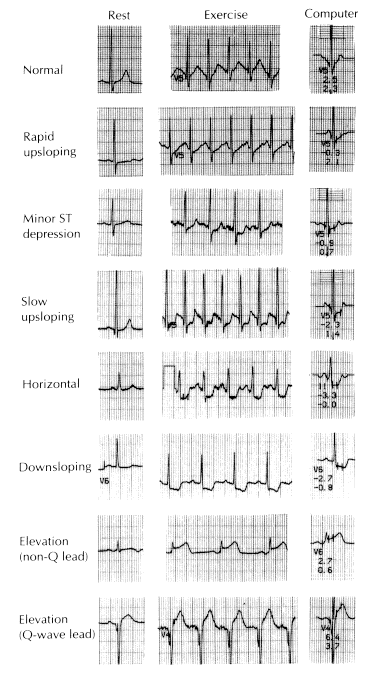
The ischemic ST-segment response is generally defined as flat depression of the ST segment of more than 0.1 mV below the baseline and lasting longer than 0.08 s. This type of depression is designated “square wave” or “plateau” and is flat or downsloping. Upsloping or junctional ST-segment changes are not considered characteristic of ischemia and do not constitute a positive test.
Although T-wave abnormalities, conduction disturbances, and ventricular arrhythmias that develop during exercise should be noted, they are also not diagnostic.
Negative exercise tests in which the target heart rate (85 percent of maximal heart rate for age and sex) is not achieved are considered to be nondiagnostic.
Overall, false-positive or negative results can occur in 15 percent of cases. However, a positive result on exercise indicates that the likelihood of CAD is 98 percent in males over 50 years of age with a history of typical angina pectoris who develop chest discomfort during the test. The likelihood decreases progressively and significantly if the patient has atypical or no chest pain. The incidence of false-positive tests is significantly increased in asymptomatic men under the age of 40 or in premenopausal women with no risk factors for premature atherosclerosis. It is also increased in patients taking cardioactive drugs such as digitalis and quinidine.
Since the overall sensitivity of exercise stress electrocardiography is only about 75 percent, a negative result does not exclude CAD, although it makes the likelihood of three-vessel or left main CAD extremely unlikely.
The physician should be present throughout the exercise test, and it is important to measure total duration of exercise, the times of the onset of ischemic ST-segment change and chest discomfort, The depth of the ST-segment depression and the time needed for recovery of these ECG changes are also important.
Because the risks of exercise testing are small but real estimated at one fatality and two nonfatal complications per 10,000 tests¾equipment for resuscitation should be available.
The normal response to exercise includes a progressive increase in heart rate and blood pressure. Failure of the blood pressure to increase or an actual decrease in blood pressure with signs of ischemia during the test is an important adverse prognostic sign, since it may reflect ischemia-induced global left ventricular dysfunction. The presence of pain or severe (>0.2 mV) ST-segment depression at a low workload and ST-segment depression that persists for more than 5 min after the termination of exercise increases the specificity of the test and suggests severe ischemic heart disease and a high risk of future adverse events.
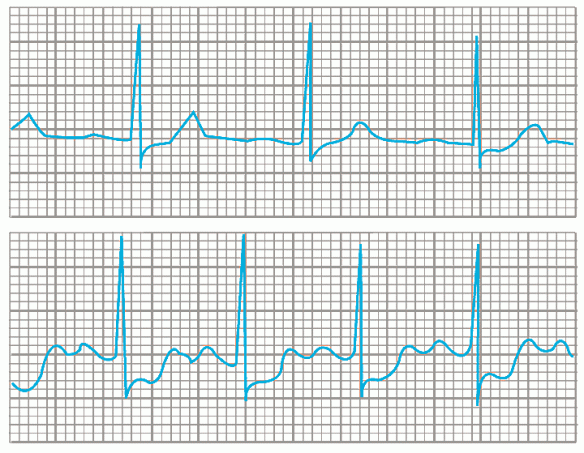
Lead V4 at rest (top) and after 41/2 min of exercise (bottom). There is 3 mm (0.3 mV) of horizontal ST-segment depression, indicating a positive test for ischemia.
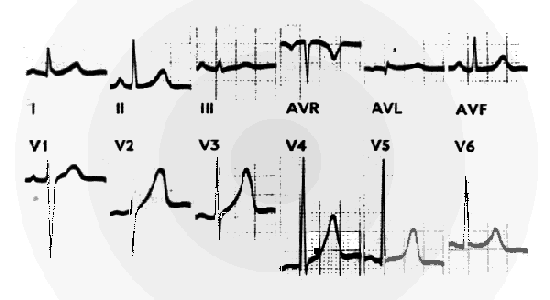
Stress induced Electrocardiogram in a patient of Angina Pectoris
Illustration of typical exercise electrocardiographic (ECG) patterns at rest and at peak exertion. The patterns represent a gradient of worsening ECG response to myocardial ischemia.The first two tracings illustrate normal and rapid upsloping ST segments; both are normal responses to exercise.
Stress induced Electrocardiogram in a patient of Angina Pectoris
Normal Electrocardiogram
Angina Pectoris

Normal Electrocardiogram

Normal Electrocardiogram

ECG or Electrocardiogram, is recording of electrical activity in the heart.
The elctrocardiography is based on two basic principles.
1. When the electromagnetic force flows towards the positve electrode of a lead, the ecg would record an upward or positive deflection.
2. When the electomegnetic force flows away from the positve electrode of a lead or towards the negative electrode the ecg would record a downward or negative deflecton.
The electrocardiografic deflections are termed as P, QRS, T, and U.

Diagramatic representation of basic electrocardiografic deflections

The P wave represents atrial activation, the QRS complex represents ventricular activation, T wave represents ventricular recovery. The interpretation of U wave is uncertain. The ST segment, T wave and U wave together represent the ventricular recovery. The other significant portions of the ecg deflection are PR interval, QRS duration, ST segment.
A routine electrocardiogram consists of 6 Limb leads and 6 Chest leads. The Limb Leads are marked as I, II, III, aVR,aVL, aVF and the Chest Leads are V1, V2, V3, V4, V5, V6. The limb leads are placed on the four limbs and the chest leads are put on the mid chest and the left half of the chest.
Normal pattern of electrocardiografic deflections in various leads
Angina Pectoris
Stress induced Electrocardiogram in a patient of Angina Pectoris
TMT