Unknown's avatar

About Manbir & Gurpreet

Gurpreet Kaur’s journey in this world .... Gurpreet Kaur was a Musician. She was a singer and a composer of music. Her interest was composing and singing Gurbani Shabads in Indian Classical style. She sang Shabads in All the Raags mentioned in Sri Guru Granth Sahib Ji. She also taught Gurmat Sangeet at Gurmat Gian Missionary College, Jawadi, Ludhiana. Elder child to Pushpinder Kaur and Dr. Brig. Harminder Singh, was born in Amritsar on 13th Jan 1962. She attended various convent schools as a child because her father would get frequent Army postings as a dental surgeon. She graduated with Music Honors from Govt. College for Women, Chandigarh. Music was her hobby and she composed and sang Raag based Gurbani Shabads. Doing Kirtan was part of growing up nurtured by her parents. She learned music from her father Dr. Brigadier Harminder Singh who was a dental surgeon in Indian Army and a very good singer himself. Gurpreet’s Bhua (father’s sister), Ajit Kaur retied as a Head of Department of Music from Govt. College for Women Ludhiana, and was a renounced Punjabi singer of her time. Gurpreet Kaur also learned nuances of Indian Classical Music from Pandita Sharma. She was a mother of three children, and a grandmother. Her daughter Keerat Kaur is a Computer Engineer. Her two sons Gurkeerat Singh and Jaskeerat Singh are doctors in USA. Her daughter Keerat Kaur too was part of her group ~ Gurmat Gian Group. Gurpreet Kaur left this world at the age of 54yrs on 12th Sept 2016 in Baltimore USA. She had recorded around 25 cds of Gurbani Keertan. 'Raag Ratan' Album (6 CDs) is a Compilation of Shabads in All the 31 Sudh Raags of Sri Guru Granth Sahib Ji. 'Gauri Sagar' Album (3 CDs) is a Compilation of All forms of Raag Gauri in Sri Guru Granth Sahib Ji. 'Nanak Ki Malhaar' ~ ((3 CDs) is an album of Raag Malhar Shabads in various forms of Malhar. 'Gur Parsaad Basant Bana' ~ (3 CDs) is an album of Shabads in Raag Basant sung in various forms of Raag Basant. Har Ki Vadeyai Sarni Aayea Sewa Priya Kee Preet Piyaree Mohan Ghar Aavho Karo Jodariya Mo Kao Taar Le Raama Taar Le Tere Kavan Kavan Gun Keh Keh Gawan Mera Baid Guru Govinda Saajanrraa Mera Saajanrraa

Spread of HIV/AIDS

Quote

Spread of HIV/AIDS

Young people are increasingly responsible for the spread of HIV/AIDS around the world.

Every 14 seconds a person between 15 and 24 is infected with the virus. They now account for half all new cases of the disease, the U.N. Population Fund said in its annual State of the World’s Population report.


Botox

Botox

Botox is made from toxin produced by the bacterium Clostridium botulinum. It’s the same toxin that causes a life-threatening type of food poisoning called botulism. Doctors use it in small doses to treat health problems. It is now routinely used by plastic surgeons to soften facial lines by paralyzing the muscles beneath the skin, and is also used during surgery to immobilize muscles.

  • Temporary removal of facial wrinkles
  • Severe underarm sweating
  • Cervical dystonia – a neurological disorder that causes severe neck and shoulder muscle contractions
  • Blepharospasm – uncontrollable blinking
  • Strabismus – misaligned eyes
  • Children with cerebral palsy have been shown to benefit from injections of botulinum toxin (botox), the toxin, which is injected into calf muscles, can help youngsters to walk better.

The muscles of people with cerebral palsy often contract spontaneously and over-react to stimulation, a characteristic called spasticity. Injection of botulinum toxin helps to reduce spasticity and allows the person a greater degree of control over muscle movement.

Botox injections work by weakening or paralyzing certain muscles or by blocking certain nerves. The effects last about three to four months.

Side effects can include pain at the injection site, flu-like symptoms, headache and upset stomach. Injections in the face may also cause temporary drooping eyelids.

Botulism

Botulism

Botulism

Botulism is a disease that occasionally strikes people who eat badly canned food or fish in which the bacteria has grown. The bacteria for botulism are also found in soil. The bacteria produce an extremely toxic substance, botulinum that causes blurred vision, dry mouth, difficulty in swallowing or speaking, weakness, paralysis, respiratory failure and death.
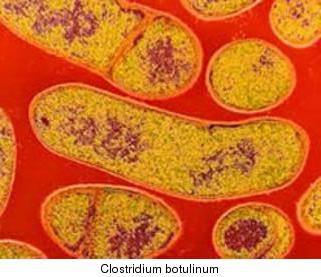
The organism causing this disease is Clostridium botulinum.
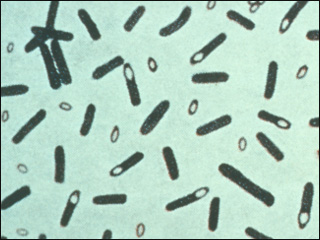
The disease may be classified as

(1) food-borne botulism, from ingestion of preformed toxin in food contaminated with C. botulinum
(2) wound botulism, from toxin produced in wounds contaminated with the organism
(3) infant botulism, from ingestion of spores and production of toxin in the intestine of infants

C. botulinum, is a group of anaerobic gram-positive organisms that form spores, is found in soil and marine environments throughout the world and produces the most potent bacterial toxin known. These are all neurotoxins.

Toxin can be inactivated during home cooking by exposure to a temperature of 100°C for 10 min. In the gastrointestinal tract, toxin resists degradation. Spores are highly heat-resistant, and their inactivation requires exposure to a temperature of 120°C (e.g., in steam sterilizers or pressure cookers).

Clinical Features

Food-Borne Botulism

After ingestion of food containing toxin, the illness may be a mild condition for which no medical advice is sought or it may also be a very severe disease that can result in death within 24 h. The onset of symptoms is with Cranial nerve involvement, which produces

  • diplopia – double vision
  • dysarthria – difficulty in speech
  • dysphagia – difficulty in swallowing

Weakness progresses, often rapidly, from the head to involve the neck, arms, thorax, and legs. The weakness is mostly symmetrical but may occasionally be asymmetric. Nausea, vomiting, and abdominal pain may precede or follow the onset of paralysis.

Patients are generally alert and oriented, but they may be drowsy, agitated.

Ptosis (drooping of eyelids) is frequent. Fixed or dilated pupils are noted in half of patients.

Paralytic ileus, severe constipation, and urinary retention may be present.

Wound Botulism

When wounds are contaminated with C. botulinum spores, the spores may germinate into vegetative organisms that produce toxin. This rare condition resembles food-borne illness except that the incubation period is longer, averaging about 10 days, and gastrointestinal symptoms are lacking. Wound botulism has been seen after traumatic injury involving contamination with soil, in chronic drug abusers, and after cesarean delivery. The illness has occurred even after antibiotics have been given to prevent wound infection. The wound may appear benign.

Infant Botulism

In infant botulism the most common form of the disease the Toxin is produced in and absorbed from the intestine after the germination of ingested spores. The severity ranges from mild illness with failure to thrive to fulminant severe paralysis with respiratory failure and may be one cause of sudden infant death. Contamination of honey with spores has been found to be one of the causes. This has led to the recommendation that honey not be fed to children less than 12 months of age. Most cases cannot be attributed to a particular food source. Cases usually involve infants less than 6 months of age.

There is another group in which the disease resembles the infant botulism in that the  toxin is produced in the intestine of a person colonized with the organism. In such cases the toxin and the spores may be found in the stool for a prolonged period. Gastrointestinal disease or surgery may predispose to such an illness.

DIAGNOSIS

A diagnosis of botulism is suspected in a person a febrile ( no fever ), mentally intact patients who have symmetric descending paralysis without sensory findings.

Conditions often confused with botulism include myasthenia gravis and Guillain-Barre syndrome, which is characterized by ascending paralysis, sensory abnormalities, and elevation of the protein concentration in cerebrospinal fluid. Other conditions resembling botulism are Lambert-Eaton syndrome, poliomyelitis, tick paralysis, diphtheria, and intoxications from mushrooms, medications, or chemicals.

PROGNOSIS

Mortality in botulism is higher among patients above age 60 than among younger patients. With improved respiratory and intensive care, the case-fatality rate in food-borne illness has been reduced.

BOTULINUM TOXIN THERAPY

Botulinum toxin is being used as therapy for strabismus, blepharospasm, and other dystonias.

Botox
Bed wetting

Bed wetting

Bed wetting or Enuresis is a psychosomatic disorder. Its an emotional disturbance causing dysfunction of organs controlled by autonomic nervous system. Many children with this disorder also have behavioural disorders. Such children are usually timid and nervous. By age 5, one in five still wets the bed and at age 6, the numbers drop to one in 10. Boys are more likely than girls to wet their beds.

Stages of Bladder Control in children

  • At 6 months – the child usually wakes up before wetting.
  • Between 12 and 18 months the child urinated when placed on the pot.
  • After 2 years the child is capable of retaining urine even when the bladder is full.
  • At 3 years – the child goes to the toilet, takes off this clothes and passes urine.
  • At 5 years – the child can empty the bladder even when its not full.

It is also suspected that bed-wetting may be caused by slow development of the nerves that control the bladder. Among other less common causes is Small Bladder. Even a small bladder unable to hold the urine produced during the night can result in bed-wetting. Bed-wetting can be a symptom of a serious illness (e.g., diabetes or a urinary tract infection), especially if it starts in a child who has previously been dry through the night.

Large majority of children who wet the bed have no underlying disease. In fact, a true organic cause is identified in only about 1% of children who wet the bed.

Secondary bedwetting is bedwetting that starts again after the child has been dry at night for a significant period of time (at least six months). Secondary bedwetting can be a sign of an underlying medical or emotional problem. The child with secondary bedwetting is much more likely to have other symptoms, such as daytime wetting.

Common causes of secondary bedwetting are:

  • Urinary Tract Infection
  • Diabetes
  • Structural or anatomical abnormality: An abnormality in the organs, muscles, or nerves involved in urination can cause incontinence or other urinary problems that could show up as bed wetting.
  • Emotional problems: A stressful home life, as in a home where the parents are in conflict, sometimes causes children to wet the bed. Major changes, such as starting school, a new baby, or moving to a new home, are other stresses that can also cause bed wetting.
  • Pinworm infection: characterized by intense itching of the anal and/or genital area.

    Treatment

    It is probably a good time to seek medical help when the child is 5-7 years of age.

    Bedwetting is typically seen more as a social disturbance than a medical disease. It creates embarrassment and anxiety in the child and sometimes conflict with parents. The single most important thing parents can and should do is to be supportive and reassuring rather than blaming and punishing. Primary nocturnal enuresis has a very high rate of spontaneous resolution.

Some Tips:

  • Your patience and love will go a long way to help a child who wets the bed. Making the child feel guilty, getting angry or acting disgusted will only delay solving this problem. Try to be understanding and supportive.
  • Set an alarm clock two to three hours after your child falls asleep so he or she can be awakened to go to the bathroom.
  • Make sure your child urinates before getting into bed.
Drugs used for Bed wetting:

Desmopressin, Imipramine, Oxybutynin and Hyoscyamine

Desmopressin acetate is a synthetic form of antidiuretic hormone (ADH), a substance that occurs naturally in the body and is responsible for limiting the formation of urine.

Imipramine is a tricyclic antidepressant that has been used to treat bedwetting for about more than 30 years. How it works is not clear, but it is known to have a relaxing effect on the bladder and to decrease the depth of sleep in the last third of the night.

Congenital Generalized Lipodystrophy

Congenital Generalized Lipodystrophy

Synonym
Berardinelli-Seip Syndrome

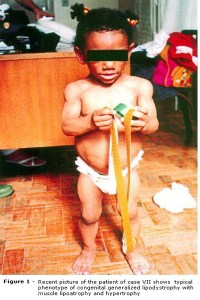
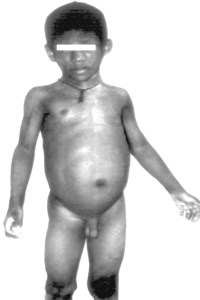
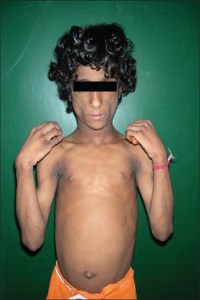
Congenital Generalized Lipodystrophy is a rare genetic disease. It is characterized by near complete absence of body fat. It is inherited as an autosomal recessive disorder. It is a disease involving the adipose tissue (fat tissue) of the body.

Parents are carriers of the genes but are not affected. There is a 25% chance of transmission of both defective genes to the affected children. The ratio of affected to unaffected children is 1:4.

Clinical features

  • The diagnosis is evident at birth or immediately afterwards. These infants look very muscular due to the absence of fat. Nearly the entire body is affected, only the palms, soles and scalp are spared.
  • These patients also have accelerated growth during their childhood and have a voracious appetite.
  • The onset of diabetes is usually during the pubertal years and requires high dose of insulin to control the blood glucose levels.
  • They have Severe insulin resistance; high serum insulin and triglyceride levels and low levels of high-density lipoprotein (HDL) cholesterol.
  • Also have acanthosis nigricans (dark velvety pigmentation of the skin) in the axilla, neck or groin.
  • Enlarged hands, feet and prominent mandible (acromegaloid features), umbilical hernia .
  • They have lytic lesions (look like bone is eaten-up on X-rays) in the long bones of the body such as the humerus, femur.
  • Females present with enlarged clitoris, increased body hair, absence of or irregular menstrual cycles and polycystic ovaries
  • A gene for CGL has been identified on the long arm of chromosome 9 (9q34).
Acquired Generalized Lipodystrophy
Familial Partial Lipodystrophy