
Unknown's avatar

About Manbir & Gurpreet

Gurpreet Kaur’s journey in this world .... Gurpreet Kaur was a Musician. She was a singer and a composer of music. Her interest was composing and singing Gurbani Shabads in Indian Classical style. She sang Shabads in All the Raags mentioned in Sri Guru Granth Sahib Ji. She also taught Gurmat Sangeet at Gurmat Gian Missionary College, Jawadi, Ludhiana. Elder child to Pushpinder Kaur and Dr. Brig. Harminder Singh, was born in Amritsar on 13th Jan 1962. She attended various convent schools as a child because her father would get frequent Army postings as a dental surgeon. She graduated with Music Honors from Govt. College for Women, Chandigarh. Music was her hobby and she composed and sang Raag based Gurbani Shabads. Doing Kirtan was part of growing up nurtured by her parents. She learned music from her father Dr. Brigadier Harminder Singh who was a dental surgeon in Indian Army and a very good singer himself. Gurpreet’s Bhua (father’s sister), Ajit Kaur retied as a Head of Department of Music from Govt. College for Women Ludhiana, and was a renounced Punjabi singer of her time. Gurpreet Kaur also learned nuances of Indian Classical Music from Pandita Sharma. She was a mother of three children, and a grandmother. Her daughter Keerat Kaur is a Computer Engineer. Her two sons Gurkeerat Singh and Jaskeerat Singh are doctors in USA. Her daughter Keerat Kaur too was part of her group ~ Gurmat Gian Group. Gurpreet Kaur left this world at the age of 54yrs on 12th Sept 2016 in Baltimore USA. She had recorded around 25 cds of Gurbani Keertan. 'Raag Ratan' Album (6 CDs) is a Compilation of Shabads in All the 31 Sudh Raags of Sri Guru Granth Sahib Ji. 'Gauri Sagar' Album (3 CDs) is a Compilation of All forms of Raag Gauri in Sri Guru Granth Sahib Ji. 'Nanak Ki Malhaar' ~ ((3 CDs) is an album of Raag Malhar Shabads in various forms of Malhar. 'Gur Parsaad Basant Bana' ~ (3 CDs) is an album of Shabads in Raag Basant sung in various forms of Raag Basant. Har Ki Vadeyai Sarni Aayea Sewa Priya Kee Preet Piyaree Mohan Ghar Aavho Karo Jodariya Mo Kao Taar Le Raama Taar Le Tere Kavan Kavan Gun Keh Keh Gawan Mera Baid Guru Govinda Saajanrraa Mera Saajanrraa

How to keep snakes out of my yard?

How to keep snakes out of my yard?

Every animal needs a particular environment best suited to its living conditions. Some environment conditions close to human dwellings are also liked by snakes and other pests. Many a times our love of nature has created environments they need. Small ponds, gardens and bird feeders are typical manmade environments which provide shelter, water and food to snakes.
Snakes exist in big part of this earth. If left alone, they prefer not to conflict with man. But we continue to invade their domain. This displacement leads to confrontation. Snakes are drawn to our yards, homes and buildings because we unintentionally create environments they like. Most snakes encountered are non-poisonous. People tend to believe any snake they see is venomous when in fact the opposite is probably true.The most common snakes eat small rodents such as rats or mice. So, definitely snakes would like to dwell in such places where they have abundant food available. You may find snake nests where there is such food. This may be in a crawl space, an attic or around water. Bird feeders attract rodents which will definitely attract snakes. If these rodents have invaded your attic, the snakes will soon follow. Closely inspect all creeks around your property. These are likely feeding areas for a variety of water snakes living on frogs and small fish. These frogs are food for many types of snakes. If you have frogs around your pool then snakes will come to take advantage of this food supply.Thus implementing a good rodent control program will cause any snakes to relocate to other place.
If there is some type of wood pile, rock pile or general debris which is serving as a nest, remove it.
If there are too many snakes or if conditions are such that you expect to have some coming in from time to time, you may have to set up some type of snake control program. There is no spray for snakes. There is a repellent, however, called Snake Away which is suppose to keep snakes away from designated areas. This material is simply sprinkled onto grass and acts as a fumigant. The odour repels snakes and may last for several months. It is safe around children and pets and is ideal for creating a barrier between suspected snake nests and play areas in the yard. There are also Snake Traps available if you need to trap them.Dogs and cats are naturally well suited to dealing with snakes. The mere presence of a dog or cat in the yard, and their associated odors, will often discourage a snake from venturing into your pet’s “territory” Snakes see the household pet as a predator and will prefer to avoid them if possible.

Chemicals such as garden variety powdered sulfur also can be used as snake repellent. Also, any noxious smelling substance like naphthalene mothballs will discourage any ground crawling animals, including snakes, from the treated area.

Dr. T’s Snake-A-Way

Snake Structure
Spitting Snakes
Snakes – Some Facts
How to keep snakes out of my yard?
Protection from Snakes
Snake Bite ~ Management
Poisonous Snakes
Dangerous Snakes in the World
Deadliest Snakes in the World

Protection from Snakes

Protection from Snakes

People who frequent wild areas, as well as those who camp, hike, or live in snake-inhabited areas, should be aware of potential dangers posed by venomous snakes. A bite from one of these, in which the snake may inject varying degrees of toxic venom, should always be considered a medical emergency.
Few basic first-aid techniques according to the American Red Cross are:

  • Wash the bite with soap and water.
  • Immobilize the bitten area and keep it lower than the heart.
  • Get medical help.
  • If a victim is unable to reach medical care within 30 minutes, a bandage, wrapped two to four inches above the bite, may help slow venom. The bandage should not cut off blood flow from a vein or artery. A good rule of thumb is to make the band loose enough that a finger can slip under it.
    A suction device may be placed over the bite to help draw venom out of the wound without making cuts. Suction instruments often are included in commercial snakebite kits.
Avoiding Snakebites
Some bites, such as those inflicted when snakes are accidentally stepped on or encountered in wilderness settings, are nearly impossible to prevent. Few precautions can lower the risk of being bitten:

  • Leave snakes alone. Many people are bitten because they try to kill a snake or get a closer look at it.
  • Stay out of tall grass unless you wear thick leather boots.
  • Keep hands and feet out of areas you can’t see. Don’t pick up rocks or firewood unless you are out of a snake’s striking distance. (A snake can strike half its length)
  • Be cautious and alert when climbing rocks.
  • What do you do if you encounter a snake when hiking or picnicking? — Just walk around the snake, giving it a little berth–six feet is plenty. But leave it alone and don’t try to catch it.
Safety Precautions With SnakesFollowing floods, snakes are often forced into places where they are not usually found. If you live in an area where snakes inhabit, take the following precautions:

  • Learn how to identify poisonous snakes common to your area.
  • Be alert for snakes in unusual places. They may be found in or around homes, barns, outbuildings, driftwood, leaves, dikes, dams, stalled automobiles, piles of debris, building materials, trash or any type of rubble or shelter.
  • Before beginning any clean-up or rescue operations, search the premises thoroughly for snakes. They may be under or near any type of protective cover.
  • In rescue or clean-up operations, wear heavy leather or rubber high-topped boots and heavy gloves. Wear trouser legs outside boots. Be extremely careful around debris. Use rakes, pry bars or other long-handed tools when removing debris. Never expose your hands, feet or other parts of your body in a place were a snake might be hiding.
  • Do not allow children to play around debris.
  • Nonpoisonous snakes can be captured by pinning the snake down with a longer stick or pole, preferably forked at one end, and then removed by scooping up with a snow shovel or flat-blade shovel.
  • As a last resort, you may need to kill a poisonous snake. Club it with a long stick, rod or other tool. Never attempt to kill a poisonous snake with an instrument that brings you within the snake’s striking range.
  • If you realize you are near a snake, avoid sudden movement. Sudden movement may cause the snake to strike. If you remain still the snake may leave. If the snake does not move away from you after a few minutes, slowly back away from it.
  • Most snakes are not harmful or poisonous. Most snakes can be coaxed to leave the area, or will leave on their own.


Snake Structure
Spitting Snakes
Snakes – Some Facts
How to keep snakes out of my yard?
Protection from Snakes
Snake Bite ~ Management
Poisonous Snakes
Dangerous Snakes in the World
Deadliest Snakes in the World
Snake Bite ~ Management

Management of Snake Bite

 Allay anxiety and fright

Deaths have been reported from shock due to fright even when the bites were by non-poisonous snakes. Hence, it is vital to reassure patients.

  • Not all snakes are poisonous.
  • Not all poisonous snakes are fully charged with venom.
  • Even those that are fully charged do not always inject a lethal dose.

Reassurance helps reduce anxiety related high. blood pressure, palpitations, tremors, sweating and rapid breathing.

Check if the bite is due to a poisonous or a non-poisonous snake. because people who are bitten can’t always positively identify a snake, they should seek prompt care for any bite, though they may think the snake is nonpoisonous. Even a bite from a so-called “harmless” snake can cause an infection or allergic reaction in some individuals.

In cases where the snake is killed and brought to the clinic, examination of the snake helps differentiate whether it is poisonous or non-poisonous. In the absence of the snake, the bite mark should be examined using a magnifying lens.

  • If possible, try and keep bitten extremity at body level, when the person is lying. Raising it can cause venom to travel into the body. Holding it down, can increase swelling.
  • Go to nearest hospital or medical facility as soon as possible
  • If possible try to identify the snake and if possible kill and take the snake along to the hospital.


What to do Immediately


According to the American Red Cross, these steps should be taken:

  • Wash the bite with soap and water.
  • Immobilize the bitten area and keep it lower than the level of heart.
  • Get medical help. 


WHAT NOT TO DO

  • No ice or any other type of cooling on the bite. Research has shown this to be potentially harmful.
  • No tourniquets. This cuts blood flow completely and may result in loss of the affected limb.
  • No electric shock. This method is under study and has yet to be proven effective. It could harm the victim.
  • No incisions in the wound. Such measures have not been proven useful and may cause further injury. 

Under Medical Supervision

In the management of the snake bite an estimate of the severity of envenomation should be made as soon as possible, before any antivenin is administered, since, for example, in approximately 20% of rattlesnake bites, venom may not be injected.

The preferred route of administration is by intravenous infusion. However, many antivenin polyvalent may be administered intramuscularly. If the intramuscular route is used, the antivenin should be administered into a large muscle mass, preferably into the gluteal area, with care to avoid nerve trunks. It should be kept in mind that maximum blood concentrations may not be attained for 8 or more hours after intramuscular administration.

Reconstituted antivenin polyvalent may be administered intravenously in a 1:1 to 1:10 dilution in 0.9% sodium chloride injection or 5% dextrose injection. Decisions concerning the dilution of antivenin to be used, and the rate of intravenous delivery of the diluted antivenin should take into account the age, weight, and cardiac status of the patient; the severity of the envenomation; and the interval between the bite and the initiation of specific therapy.

The entire initial dose of antivenin should be administered as soon as possible, preferably within 4 hours after the bite. Antivenin is less effective when given 8 hours or more after envenomation and may be of questionable value when given after 12 hours. However, in severe poisonings, it is recommended that antivenin therapy be given even if 24 hours have elapsed since the bite.

The initial 5 to 10 ml of the diluted antivenin should be infused over a 3 to 5 minute period, with careful observation of the patient for evidence of an untoward reaction If no symptoms or signs of an immediate systemic reaction appear, infusion of the diluted antivenin may be continued at the maximum rate considered safe for intravenous fluid administration.

The decision to use additional antivenin should be based on the clinical response to the initial dose and on continuing assessment of the severity of poisoning. If swelling continues to progress, if systemic symptoms or signs of envenomation increase in severity, or if new manifestations appear (for example, fall in hematocrit or hypotension), intravenous administration of an additional 10 to 50 ml (contents of 1 to 5 vials) or more may be necessary.

Pit viper bites on toes or fingers may require as much as 50% more antivenin due to difficulties in achieving adequate antivenin concentrations in the affected area.

Administration of anti-venom:

Polyvalent anti-snake venom contains antibodies against cobra, common krait and viper.
5 vials are given if signs are mild -primarily local manifestations.
10 vials if signs are moderate -bleeding from gums, ptosis.
15 vials if signs are severe -vascular collapse, progressive paralysis.

1/3 of the dose should be given subcutaneously (near bite but not in fingers or toes).
1/3 intramuscularly.
1/3 intravenously.

The intravenous dose can be repeated every 6 hours till the symptoms disappear. For sea-snake bites, special antivenins are available.

Manage toxic signs/symptoms:

Anti-venom acts only against circulating toxin, not toxin fixed to tissue. Therefore, specific measures have to be taken.
In case of neuro toxic signs and symptoms, atropine (0.6 mg) subcutaneously should be followed by 5 injections of neostigmine (0.5 mg) intravenously (repeated 2 hourly depending on response) to reverse muscle paralysis.
In case of vasculotoxic signs and symptoms, fibrinogen along with heparin may be given, but with extreme caution and constant monitoring, as heparin can intensify bleeding.

Take supportive measures:

These include blood or plasma transfusion to combat shock,
mechanical respiration to combat respiratory distress,
antibiotics to prevent secondary infection. Neuromuscular paralysis is the most dreadful complication of snake bite. It may occur within 15 minutes but may be delayed for several hours.
To tackle hypersensitivity reactions to antivenom, steroids, adrenaline and antihistamines may be given.


Snake Structure
Spitting Snakes
Snakes – Some Facts
How to keep snakes out of my yard?
Protection from Snakes
Snake Bite ~ Management
Poisonous Snakes
Dangerous Snakes in the World
Deadliest Snakes in the World

Poisonous Snakes

 Types of Poisonous Snakes

Poisonous Snakes are of Three types:

  • Cobra & Krait – these secrete Neurotoxic venom and cause Paralysis.
  • Viper – these secrete Haemotoxic venom and cause Haemolysis and Haemorrhage.
  • Sea Snakes – secrete myotoxic venom and cause Muscular pain.
Approximately 2500 different species of snakes are known. Approximately 20 % of the total number of the snake species is poisonous.

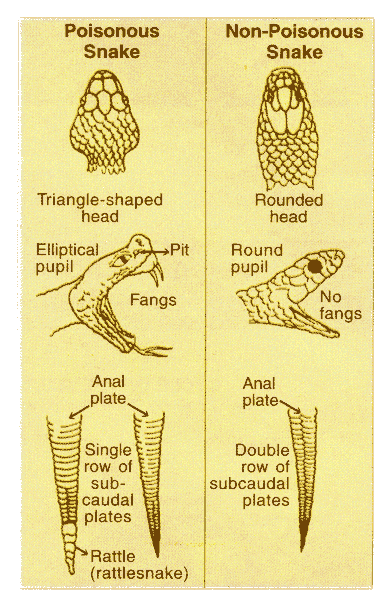
Features of Poisonous & Non-Poisonous snakes

 
Poisonous Snakes

  • Head – Triangle – except Cobra
  • Fangs – Present
  • Pupils – Elliptical pupil
  • Anal Plate – Single row of plates
  • Bite Mark – Fang Mark
Non Poisonous Snakes

  • Head – Rounded
  • Fangs – Not present
  • Pupils – Rounded
  • Anal Plate – Double row of plates
  • Bite Mark – Row of small teeth.

Symptoms due to Snake bite

Cobra or Krait
Mild
 Local symptoms — burning, redness, swelling, superficial necrosis.
Marked Neurotoxic effects.
Earliest symptom – Ptosis – inability to keep Eyes open.
Giddiness, Lethargy, Muscle weakness.
Spreading Paralysis – causing difficulty in speaking and breathing, Salivation, Vomiting. Frothing around mouth.

Viper
Haemotoxic venom is very painful
Severe
 Local symptoms — Intense Pain, Inflammation, Oozing of haemolytic blood.
Marked Vasculotoxic effects.
Bleeding from mucous membrane of the Mouth, Anus, Nose and haemorrhages under the skin.
Because of local damage to circulatory cells, hemotoxic venom spreads more slowly and has a slower action than the neurotoxins.
Vascular Collapse – Cold Skin, Rapid feeble Pulse, Dilated Pupils insensitive to light, Gradual loss of consciousness.

Sea Snakes
No Local symptoms.
Severe Pain while moving Neck, Trunk and Limbs. A few hours later urine turns Brown to Black due to the presence of muscle protein Myoglobin.

Snake Structure
Spitting Snakes
Snakes – Some Facts
How to keep snakes out of my yard?
Protection from Snakes
Snake Bite ~ Management
Poisonous Snakes
Dangerous Snakes in the World
Deadliest Snakes in the World

Dangerous Snakes in the World

Dangerous Snakes in the World
Annually, throughout the world, it is estimated there are a minimum of 1 to 2 million snakebite “incidences.” This number includes bites by non-venomous species. Of that number roughly 50,000 to 60,000 bites result in fatalities. The country that has the largest number of snakebite deaths annually is the tiny island of Sri Lanka.Each year in the United States there are approximately 45,000 snake bite incidences, including non-venomous bites. Only about 8000 of that number are venomous snake bites but a mere 9 to 15 people die.The Most Dangerous Snakes that kill the most people according to the geographical locations are as given below : –In the United States the coral snake has a very toxic venom but has killed few people because it is small, secretive and gentle. The most dangerous are the rattlesnakes like the Eastern and Western Diamondbacks. These rattlesnakes are large, have large venom glands, are relatively common, and are more likely to hold their ground and bite.

In Africa common Egyptian Cobras, Saw-scaled Vipers, and Puff Adders would be the most dangerous.

In Asia the common Cobra and the Russell’s Viper are the snakes that kill the most people.

Although the Asian Cobra and Russell’s Viper probably kill most of the people who die of snake bite annually in the world neither of them are among the most Deadly Snakes. 

The most Deadly Snake, and the most Dangerous Snake are two entirely different concepts. Some of the snakes with the most toxic venom, that is, the most deadly, rarely bite people.

The Most Dangerous Snakes are those that kill the most people.

Asian Cobra and Russell’s Viper probably kill most of the people who die of snake bite annually in the world
Snake Structure
Spitting Snakes
Snakes – Some Facts
How to keep snakes out of my yard?
Protection from Snakes
Snake Bite ~ Management
Poisonous Snakes
Dangerous Snakes in the World
Deadliest Snakes in the World
