Unknown's avatar

About Manbir & Gurpreet

Gurpreet Kaur’s journey in this world .... Gurpreet Kaur was a Musician. She was a singer and a composer of music. Her interest was composing and singing Gurbani Shabads in Indian Classical style. She sang Shabads in All the Raags mentioned in Sri Guru Granth Sahib Ji. She also taught Gurmat Sangeet at Gurmat Gian Missionary College, Jawadi, Ludhiana. Elder child to Pushpinder Kaur and Dr. Brig. Harminder Singh, was born in Amritsar on 13th Jan 1962. She attended various convent schools as a child because her father would get frequent Army postings as a dental surgeon. She graduated with Music Honors from Govt. College for Women, Chandigarh. Music was her hobby and she composed and sang Raag based Gurbani Shabads. Doing Kirtan was part of growing up nurtured by her parents. She learned music from her father Dr. Brigadier Harminder Singh who was a dental surgeon in Indian Army and a very good singer himself. Gurpreet’s Bhua (father’s sister), Ajit Kaur retied as a Head of Department of Music from Govt. College for Women Ludhiana, and was a renounced Punjabi singer of her time. Gurpreet Kaur also learned nuances of Indian Classical Music from Pandita Sharma. She was a mother of three children, and a grandmother. Her daughter Keerat Kaur is a Computer Engineer. Her two sons Gurkeerat Singh and Jaskeerat Singh are doctors in USA. Her daughter Keerat Kaur too was part of her group ~ Gurmat Gian Group. Gurpreet Kaur left this world at the age of 54yrs on 12th Sept 2016 in Baltimore USA. She had recorded around 25 cds of Gurbani Keertan. 'Raag Ratan' Album (6 CDs) is a Compilation of Shabads in All the 31 Sudh Raags of Sri Guru Granth Sahib Ji. 'Gauri Sagar' Album (3 CDs) is a Compilation of All forms of Raag Gauri in Sri Guru Granth Sahib Ji. 'Nanak Ki Malhaar' ~ ((3 CDs) is an album of Raag Malhar Shabads in various forms of Malhar. 'Gur Parsaad Basant Bana' ~ (3 CDs) is an album of Shabads in Raag Basant sung in various forms of Raag Basant. Har Ki Vadeyai Sarni Aayea Sewa Priya Kee Preet Piyaree Mohan Ghar Aavho Karo Jodariya Mo Kao Taar Le Raama Taar Le Tere Kavan Kavan Gun Keh Keh Gawan Mera Baid Guru Govinda Saajanrraa Mera Saajanrraa

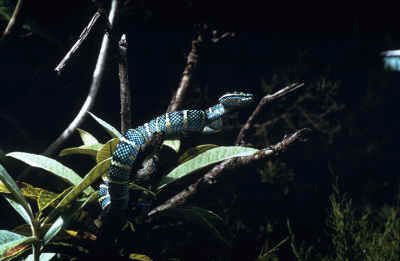
Viper Snakes

 Viper Snake
  VIPER: Characterized by a pair of long, hollow fangs, usually with reserve fangs beside them, in the front of the upper jaw. The fangs fold back against the palate when not in use and quickly swing forward to strike, injecting a deadly venom that attacks blood and tissues. The viper’s broad, triangular head is generally covered with scales, and the eye has a vertical pupil.
They are distributed worldwide, with most found in Africa.
Pit vipers : have deep pits containing heat receptors on each side of the head between the eye and the nostril that enable the snakes to detect warm-blooded prey in the dark.There are more than 120 species.
Important ones are rattlesnake, moccasin, copperhead, fer-de-lance, and bushmaster. Most inhabit the western hemisphere; a few are native to Asia.
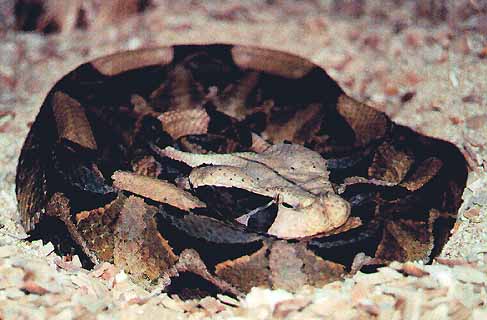
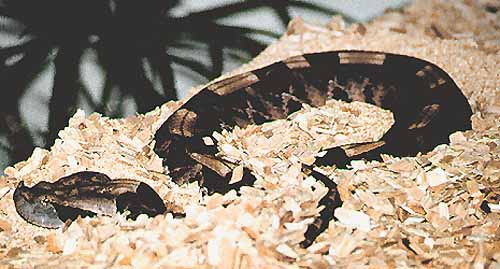
  East African Gaboon Viper: Natural habitat of the Gibbon Viper is spread along the equatorial belt of Africa. Because of their colour patern they are difficult to spot. They give a sluggish appearance but are capable of attaching their prey with speed and swiftness which one may not expect from their placid nature.
   West African Gaboon Viper
 Snake Bite

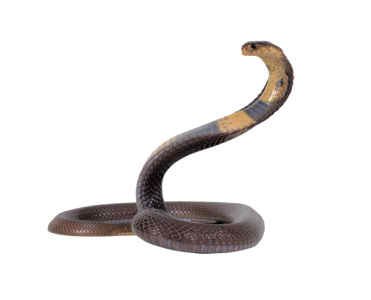
King Cobra

 King Cobra                                         Ophiophagus hannah
Cobras are recognized by the hoods that flare when they are angry or disturbed.These reptiles are found found throughout southeast Asia, from India to southern China to Malaysia, from Indonesia to the Philippines.The king cobra is the world’s longest poisonous snake. It averages 3.7 m (12 ft) in length but is known to grow to 5.5 m (18 ft). It is a thin snake, olive or brown in colour, with bronze eyes.Spitting cobra: This snake can spray its venom from a distance of about 2.4 m (about 8 ft) into the eyes of its victims, blinding them temporarily and causing great pain.The venom of cobras, called a neurotoxin, acts powerfully on the nervous system. With effective serum available, however, the death rate from cobra bites in some areas of Asia has decreased. Cobra venom has been used for years in medical research because it has an enzyme, lecithinase, that dissolves cell walls and membranes surrounding viruses.  
 King Cobra

Venom – Neurotoxin

It is a highly poisonous snake. It is is considered to be the most intelligent of all snakes. King cobras are generally found in dense or open rainforests, as well as swamps, bamboo thickets, and even around human settlements. They are excellent swimmers, often being found near streams, and are avid tree climbers. They are often found in mountainous regions of India, up to altitudes of 6500 ft above sea level.

Their head is small and rounded, with large scales edged in black. The body is slender, and the tail is long and tapering. Coloration ranges from yellow-olive to brownish black. The snake can raise its head to a third of its length and may even move forward while upright. It has a loud, intimidating hiss resembling a dog’s growl. It sometimes assumes an upright posture to see farther. The king cobra is an active hunter. It preys almost exclusively on other snakes. It is not normally aggressive to humans, but it is hostile and dangerous during the breeding season or when cornered or startled. Its paralyzing venom is so copious and powerful that elephants have died within three hours of a bite.

The king cobra can live up to 20 years. It lives longer in captivity than in the wild. It can deliver up to 12 oz of venom in one bite. It is capable of eating a 3 year old cow. King cobras shed their skin 4-6 times per year for adults and every month for juveniles. They have good eyesight, being able to see 330 ft (100 m) away. They lack external ears, but can still hear due to sound travelling through their skin to the jaw bone and to the bone near the ear and from there to the inner eardrum.

When the king cobra becomes scared or agitated, ribs in the neck flatten out, expanding the folds of skin and creating a long, narrow hood.

Mating times vary with region. King cobras reach sexual maturity at 5-6 years of age. The breeding season begins in January. When male and female find each other, the male entwines its body around the female, and they may stay in that position for several hours. The male’s sperm eventually fertilizes eggs, and the female becomes gravid i.e. pregnant. Mated pairs remain together for the season and the female builds a nest in which she lays 20 to 50 eggs. She coils above or near the eggs for about two months and fiercely defends the breeding ground. It is said that the male remains nearby and guards the area. It takes 3 months for the eggs to hatch. After they hatch they stay 2 weeks with their mom then the king cobra can go live on its own. Hatchlings are about 18 to 22 inches (45 to 55 centimetres) long and are black with yellow or white stripes.

The venom is a neurotoxin, and in humans can cause pain, swelling, hypertension, nausea, abdominal pain, drowsiness, limb paralysis, unconsciousness, and finally death. The symptoms begin to show 15-30 minutes after the attack.

Snake Bite

Snake Structure

Snake Structure
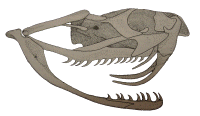
Snakes have a long slender body. It has some 100 vertebrae and in some cases more than 300 vertebrae. Snakes have a light skeleton and are made in such a way so as to enable it to have free movement. Each vertebra is connected to a pair of ribs on both sides. The first two vertebrae are connected to the head and not to the ribs. The skull of the snake is built loosely so as to permit it to swallow a large pray. Both jawshave a large number of sharp, needle like teeth, all curved toward the rear of the mouth.Venomous snakes have two hollow, hypodermics like teeth, known as fangs, in the front of the upper jaw. In a large group of snakes that includes the vipers, the fang-bearing bone is attached to the skull in such a way that the fangs can be moved back up against the roof of the mouth when not in use. The cobras and coral snakes represent another large group of snakes, in which the fangs are not movable but are constantly erect. The fangs are connected by the venom duct to the two venom glands, which are modified salivary glands situated on each side of the head behind the eye.The snakes must bite to inject their venom. They can bite from any position including under water. Three species of snake can spit or eject the venom in a fine spray, which is aimed at the eyes of an enemy. They can spit for distances up to 8 ft. If the venom gets into the eyes, it may cause blindness. The spitting is used only in defence and never to obtain food.Vision is well developed in most snakes. Many burrowing snakes are virtually blind. Snakes have a strong sense of smell, which they use to a large extent for hunting food. They also have an extra chemical sense that is widely used during most activities. The tongue flicks out, picking up odours and carrying them to the roof of the mouth into contact with a sensory receptor called Jacobson’s organ.Snakes are deaf to airborne sounds. Thus a rattlesnake does not hear the sound of another snake’s rattle, nor does the cobra hear the snake charmer’s flute. They can, however, feel vibrations through the ground or whatever they are resting on.The pit vipers, as well as some boas and pythons, have another kind of sense organ, a heat receptor that can detect small differences in temperature. By means of these receptors the snakes can locate and capture warm-blooded prey at night.Snakes move slower than an adult human can run; the fastest recorded speed achieved by any snake is about 13 km/hr.
Snakes have a well developed nervous system. Their intelligence level is between fish and mammals. They are nervous and excitable when caught but adapt to gentle care. Some snakes, such as the hognose when disturbed, go through elaborate bluffing performances; harmless snakes can even appear more dangerous than venomous ones. Many snakes vibrate their tails back and forth when excited, and if they happen to be in dry grass or leaves, a whirring noise may be heard. The rattling sound is a warning to enemies.Urogenital system – The urogenital system in snakes is not very distinctive from that of other vertebrates. The testes and ovaries tend to be staggered as a consequence of the elongation of the body, with the right usually lying anterior to the left. Snakes do not have a urinary bladder, and kidney wastes are excreted in a solid state as uric acid. The male snake has two separate organs, the hemipenes. This structure is not homologous with the penis of mammals but seems to represent a completely different solution to the problem of internal fertilization. It is a saclike structure that must be turned inside out to be inserted in the cloaca of the female and can be removed only by turning it back to inside in, because to draw it out directly would damage the female considerably. The hemipenis is extremely variable in its overall appearance and structure; the cloaca of the female is often similarly constructed, thus preventing cross-fertilization by males of related species.All snakes are carnivorous, eating a variety of animal life, from insects, spiders, and snails to frogs, mice, and rats. A number of snakes eat only other kinds of snakes.Snakes reproduce both by laying eggs and by producing living ones hatched inside their body. The young ones are usually abandoned. Parental care is entirely absent as far as the young are concerned, but a few species guard the eggs during incubation, and the female python actually broods them.The greatest age known for any snake is just under 30 years, attained by both the anaconda and the black-lipped cobra.
Snakes are found in all the warmer parts of the world, except Ireland, New Zealand.
Snake Structure
Spitting Snakes
Snakes – Some Facts
How to keep snakes out of my yard?
Protection from Snakes
Snake Bite ~ Management
Poisonous Snakes
Dangerous Snakes in the World
Deadliest Snakes in the World

Spitting Snakes

Spitting Snakes

Three species of snake can spit or eject the venom in a fine spray, which is aimed at the eyes of an enemy and projected for distances up to 2.4 m (8 ft). If the venom gets into the eyes, it may cause blindness. The spitting is used only in defense and never to obtain food.Some cobras can spray their venom for a distance of up to 2.5 meters . This action is called spitting , but it does not evolve puckering the lips and blowing the venom outward . Spitting is a defensive behaviour that has nothing to do with killing prey. Spitting cobras bite and envenomate their prey just as do other venomous snakes.Two of the spitting-cobra groups are African: –

One group is the African ringhal cobra (Hemachatus haemachatus) , and the second includes the black-necked cobra (Naja nigricollis), the Mozambique spitting cobra (N . mossambica) , the Mozambique red spitting cobra (N . pallida) , and the west African spitting cobra (N . katiensis).

The third group is from eastern Asia and includes the golden spitting cobra (Naja sumatrana) of the Malay Peninsula and Sumatra, the Indonesian spitting cobra (N . sputatrix) of southern Indonesia, the common spiting cobra (N . philippinensis) and Samar spitting cobra (N . samarensis) of the Philippines, the Chinese and Indochinese populations of the Asian black cobra (N . atra), and some populations of the widespread Asian monocled cobra (N . kaouthia). These snakes live in areas inhabited by large herbivores that might trample them or large carnivores that might eat them, and thus use their venom defensively.

At close quarters, the spitting cobras have very accurate aim. If the neurotoxic venom reaches the eyes, it is quickly absorbed by the capillaries of the conjunctiva. The venom may cause temporary blindness by irritating the cornea, extensive damage of the cornea can lead to permanent blindness . The venom should be rinsed out of the eye as soon as possible.

Snake Structure
Spitting Snakes
Snakes – Some Facts
How to keep snakes out of my yard?
Protection from Snakes
Snake Bite ~ Management
Poisonous Snakes
Dangerous Snakes in the World
Deadliest Snakes in the World

Snakes – Some Facts

Snakes – Some Facts

Here are some facts on Snakes:

  • The largest snakes in the world are members of the family Boidae, which includes the boa and the python. Some members of this family never attain a length of more than 0.6 m (2 ft), but the largest may grow to more than 9 m (30 ft).
  • Sea snakes have no gills and must rise to the surface for air, but they can remain underwater for several hours, obtaining dissolved oxygen from water that they swallow and eject.
  • Approximately 2500 different species of snakes are known. Approximately 20 % of the total number of the snake species are poisonous.
  • The skin and outer covering of the horny scales are shed periodically and usually in one piece, including the hard, transparent covering of the eye known as the spectacle (snakes lack movable eyelids, and the spectacle protects the constantly open eyes). The frequency of shedding varies with different species , according to the size and age of the individual. Young, rapidly growing snakes shed their skins more frequently than the slow-growing adults. In some species the skin is shed about every 20 days; in others, only once a year.
  • The big pythons can eat animals that weigh up to about 68 kg (150 lb), but swallowing such a meal is a difficult process.
  • The snake must bite to inject its venom; no snake has a stinger in its tail.
  • Three species of snake can spit or eject the venom in a fine spray, which is aimed at the eyes of an enemy and projected for distances up to 2.4 m (8 ft). If the venom gets into the eyes, it may cause blindness. The spitting is used only in defense and never to obtain food.
  • Vision is well developed in most snakes, but many burrowing snakes are virtually blind.
  • Snakes have a strong sense of smell, which is relied on to a large extent in hunting food. Snakes find their prey by sight and scent, and sometimes temperature. Except for burrowing species, snakes have excellent short-range vision. Their sense of smell is extraordinary, thanks to a harmless, constantly flicking forked tongue that carries scent particles to a specialized sensory organ (‘Jacobson’s organ’) on the roof of the mouth.
  • Snakes are deaf to airborne sounds. The Cobra does not hear, as it is believed, the snake-charmer’s flute. They can, however, feel vibrations through the ground or whatever they are resting on.
  • Snakes move slower than an adult human can run; the fastest recorded speed achieved by any snake is about 13 km/hr (8 mph), but few can go that fast.
  • Depending on the species, snakes may be egg-layers or give birth to live young. They generally mate in the spring, shortly after leaving whatever hollow, burrow or rock crevice has sheltered them through winter hibernation. Egg-layers usually deposit groups of eggs in dirt, beneath stones or logs, or in piles of decaying wood or vegetation during late spring or early summer. Most snakes hatch or are born in late summer. Whether deposited as eggs or dropped as fully formed miniature adults, snakes are on their own from the start. Snakes do not take any responsibility for the care and protection of their young. Most snakes mature at one or two years of age, and individuals may live up to twenty years in the wild.
  • The greatest age known for any snake is just under 30 years, attained by both the anaconda and the black-lipped cobra.
  • Effects of the bites of Black and Green Mamba –
    Black and green mambas both produce neurotoxins, which is why they kill so fast. Black mamba is more venomous. Neurotoxin inhibitors and antivenin are generally made from the venom of the same snake, but it is likely that antivenin from one would be at least partially effective against the other. Because these are two different snakes  their venom has to be different and thus the antivenin from one may not act for the other.
  • Snakes do not leap or jump into the air. Instead, those that do strike out coil themselves enough to get a push or strong outward movement designed to snatch prey or inject venom. Most snakes can only strike about one half their total body length. They do not actually leave the ground. They are capable of striking upward or outward at approximate one half length level.
Snake Structure
Spitting Snakes
Snakes – Some Facts
How to keep snakes out of my yard?
Protection from Snakes
Snake Bite ~ Management
Poisonous Snakes
Dangerous Snakes in the World
Deadliest Snakes in the World