Gurpreet Kaur’s journey in this world ....
Gurpreet Kaur was a Musician. She was a singer and a composer of music. Her interest was composing and singing Gurbani Shabads in Indian Classical style. She sang Shabads in All the Raags mentioned in Sri Guru Granth Sahib Ji. She also taught Gurmat Sangeet at Gurmat Gian Missionary College, Jawadi, Ludhiana.
Elder child to Pushpinder Kaur and Dr. Brig. Harminder Singh, was born in Amritsar on 13th Jan 1962. She attended various convent schools as a child because her father would get frequent Army postings as a dental surgeon. She graduated with Music Honors from Govt. College for Women, Chandigarh.
Music was her hobby and she composed and sang Raag based Gurbani Shabads. Doing Kirtan was part of growing up nurtured by her parents. She learned music from her father Dr. Brigadier Harminder Singh who was a dental surgeon in Indian Army and a very good singer himself. Gurpreet’s Bhua (father’s sister), Ajit Kaur retied as a Head of Department of Music from Govt. College for Women Ludhiana, and was a renounced Punjabi singer of her time. Gurpreet Kaur also learned nuances of Indian Classical Music from Pandita Sharma.
She was a mother of three children, and a grandmother. Her daughter Keerat Kaur is a Computer Engineer. Her two sons Gurkeerat Singh and Jaskeerat Singh are doctors in USA. Her daughter Keerat Kaur too was part of her group ~ Gurmat Gian Group.
Gurpreet Kaur left this world at the age of 54yrs on 12th Sept 2016 in Baltimore USA.
She had recorded around 25 cds of Gurbani Keertan.
'Raag Ratan' Album (6 CDs) is a Compilation of Shabads in All the 31 Sudh Raags of Sri Guru Granth Sahib Ji.
'Gauri Sagar' Album (3 CDs) is a Compilation of All forms of Raag Gauri in Sri Guru Granth Sahib Ji.
'Nanak Ki Malhaar' ~ ((3 CDs) is an album of Raag Malhar Shabads in various forms of Malhar.
'Gur Parsaad Basant Bana' ~ (3 CDs) is an album of Shabads in Raag Basant sung in various forms of Raag Basant.
Har Ki Vadeyai
Sarni Aayea
Sewa
Priya Kee Preet Piyaree
Mohan Ghar Aavho Karo Jodariya
Mo Kao Taar Le Raama Taar Le
Tere Kavan Kavan Gun Keh Keh Gawan
Mera Baid Guru Govinda
Saajanrraa Mera Saajanrraa
Scientists are in a search for a gene that may be a deciding factor for a long life at least in some. In this pursuit Harvard scientist Tom Perls feel that they have found such a gene, a discovery they hope could ultimately be used to make a pill to lengthen life.
The scientists feel that they have strong evidence that an important longevity gene may be located in a small stretch of chromosome 4. The function of the gene is unknown and its possible that more than one gene may be involved. It is thought that the gene may be somehow conferring resistance to disease. That is why many centenarians remain remarkably healthy.
Conventional wisdom that diet, exercise, avoidance of smoking and other good habits prolong life is certainly true for most of us but there may be something like a ‘genetic booster rocket’ that propels a very small percentage of humanity from 80 years-old stage to centenarian status.
There is much evidence contrary to the postulations in favour of the longevity gene. A large body of scientific research suggests that environment counts for more. In 1993, a study of 600 Danish twins found that gene account for only 30 % of the reason that some people live to the ripe old age. But that may not be the last word.
But many researchers were surprised to find that many of the centenarians were not particularly free of vices. Many eat fatty foods regularly, and some were couch potatoes. French women Jeanne Calment, the oldest person in documented history when she died at an age of 122, were a smoker.
Four families in New England were found to have unusual cluster of centenarians. In one family, eight of the ten siblings lived to be at least 90 years old. The odds of that happening by chance are too remote. Similar clusters of centenarians were found in many families. Part of the clustering may be explained by the fact that the siblings share similar upbringing and habits. But some of the families included centenarians who lived far apart. In some families the spouses sharing many habits did not live particularly long.
A technique by which an ovum is fertilized with sperm in a laboratory dish and subsequently implanted in a uterus for gestation is known as in vitro fertilization..In the late 1970s the widely publicized use of in vitro fertilization (IVF) gave new hope to many women with defective Fallopian tubes; in IVF, an ovum taken from the woman’s body is fertilized by the man’s sperm in the laboratory and then returned to the woman’s uterus. Use of this method has been growing rapidly.Women have also been implanted with the ovum of another woman after it was fertilized by IVF or regular artificial insemination techniques. In the 1990s, IVF was used to enable women well past menopause to become pregnant, with an egg donated by a younger woman; through this method a 63-year old woman in the U.S. gave birth in 1996.In the practice known as surrogate mothering a second woman is inseminated with the sperm of a man whose wife is infertile, to bear a child for the couple.
Patrick Christopher. 1913–1988. British physician with physiologist Robert Edwards perfected in vitro fertilization of the human egg, resulting in the birth (July 25, 1978) of world’s first “test-tube baby.” Later credited with over a thousand such births.
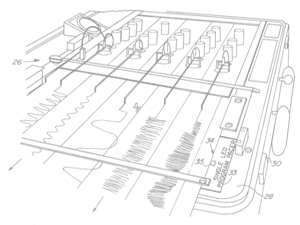
The first modern “lie detector” – Polygraph test was developed by John A. Larson, a medical student at the University of California in the USA, in collaboration with a police officer. It is called a polygraph because it is capable of recording blood pressure, pulse and respiration continuously and simultaneously.The police first used the polygraph as an interrogation device in 1924.
It is considered that physiological phenomenon such as blood pressure, pulse and respiration are affected by a person’s emotional condition. These phenomenon are not generally under voluntary control.
A pneumograph tube is fastened around the subject’s chest. A blood pressure cuff is strapped around his arm. The operator puts questions to the the subject, changes in the physiological phenomenon are recorded on a moving graph paper as in an ECG machine. A long questionnaire is prepared in which loaded questions are mingled with a large number of innocuous questions.
Experts then analyze the data and correlate the subject’s response to specific questions. Then the experts decide on which questions the subject had lied and where he was truthful.
Though in use for almost for 80 years, the polygraph test’s reliability is not accepted universally. The results are not always judicially acceptable.
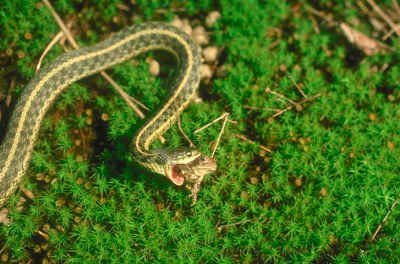
Garter SnakeA group of harmless snakes, the most common snakes in the U.S. Twelve species are widely distributed in the U.S.; garter snakes are also common in Canada and most of Mexico.Garter snake may attain a length of 1 m (3 ft) and a diameter of 2.5 cm (1 in).
The best-known garter snakes in the U.S. are the common garter snake and the ribbon snake.
The ribbon snake differs from other garter snakes in several ways. Its coloration is more intense; it is extremely slender, less than 1.2 cm (0.5 in) in diameter; it is always found near water; and it rarely produces more than 12 young in a litter.
They can be found in developed areas in parks, vacant lots, or backyards. Garter snakes have coarse, ridged scales and are named for the garter like pattern on the skin: Three stripes run the length of the dark brown or black body, one on either side and one along the back. They bear their young alive, averaging 20 in a litter.
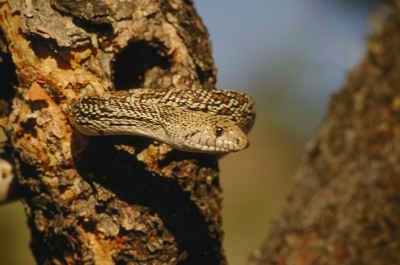
Bull Snake is a harmless snake and is named for its distinctive hiss, which sounds like a bull grunting.They are found in agricultural areas of the U.S., where they prey on rodents that destroy crops. They are whitish to pale brown with dark blotches and from 1.5 to 2.4 m (5 to 8 ft) long.
Three types of bull snakes are the common bull snake of the central U.S., the western bull snakeof the West Coast, and the pine snake of the East and Gulf coasts.
Bull snakes are also sometimes called Gopher snake.


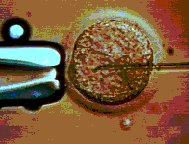 Women have also been implanted with the ovum of another woman after it was fertilized by IVF or regular artificial insemination techniques. In the 1990s, IVF was used to enable women well past menopause to become pregnant, with an egg donated by a younger woman; through this method a 63-year old woman in the U.S. gave birth in 1996.In the practice known as surrogate mothering a second woman is inseminated with the sperm of a man whose wife is infertile, to bear a child for the couple.
 Manbir Online ~ for Health & Fitness