Some Facts on Cancer  |
|
Cancer Fighting Food
Some Facts about Soy Food
Nutritional value of Soyabean
Phytochemicals


| Some Facts on Cancer |
|
Cancer Fighting Food Some Facts about Soy Food Nutritional value of Soyabean Phytochemicals
| Urticaria | |
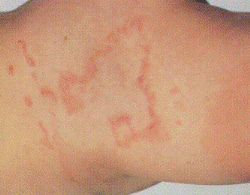
| Chronic Urticaria is common and extremely difficult condition.Chronic urticaria presents in a variety of presentation.About 5 % are shown to be Reactive to the food allergens.5% may have urticarial vasculitis.
Physical urticaria is seen in about 35%-40 %, aprox. 50 % have so called Idiopathic Urticaria. |
Epidemiological data available is scare. In UK about 1% of the population will suffer from urticaria during their lifetime. Out of this appox. 25 % of the patients would be of chronic urticaria.
|
| Physical Urticaria: In this most striking is dermographism. A useful procedure in confirming the diagnosis of dermographism is challenge test with a calibrated dermographometer, which measures the pressure being applied to the skin.Other common physical urticarias are cold urticaria, cholinergic urticaria and solar urticaria. Cold urticaria can be tested by applying ice to the skin, cholinergic urticaria can be seen by exercising the patient or bathing in warm water and solar urticaria can be tested by solar simulator lamp. | 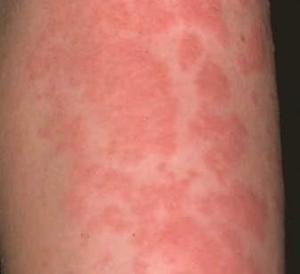 |
| Cold urticaria can be tested by applying ice to the skin | 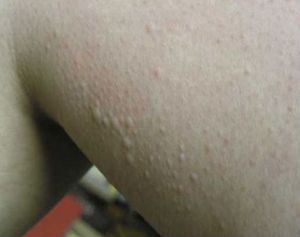 |
| Solar urticaria can be tested by solar simulator lamp.Patients with physical urticaria need no firther investigations. The patients shold be informed of the condition for which the average time course of 2-3 years, and during this time the main therapeutic approach is to cover the patient with H1 antihistamine. Very little is known about the pathogenesis of the physical urticaria. | 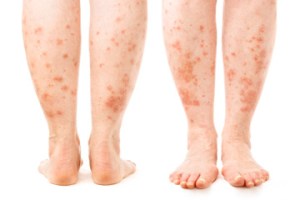 |
| Urticarial Vasculitis:In this the duration of the wheals is important. If the wheals last longer than the 24 hrs, the patient almost certainly has urticarial vasculitis. Staining of the the skin after fading of the wheals is another clue. Itching is not a major problem with this type of urticaria. The lesions are more likely to be tender and painful. The diagnosis of this type of urticaria is confirmed with skin biopsy. Another very important point to remember in this is that urticarial vasculitis may be a marker for serious systemic diseases involving kidneys, lung or cardiovascular system. It may be associated with hepatitis B or C. It may be first sign of autoimmune connective tissue diseases such as Sjogren’s syndrome, Systemic Lupus or Rheumatoid Arthritis. This condition is difficult to treat. Among the drugs useful are Dapsone, Colchicine, Indomethacin, Phentoxiphylline, Azathioprine, Corticosteroids.Food Allergens:A small proportion of the patients of chronic urticaria are allergic to food additives such as preservatives like Tartrazine and Sodium Benzoate, coloring agents and various antioxidants.
Parasitic infestations: May also produce urticaria especially in under developed countries. Chronic Idiopathic Urticaria: Autoimmune phenomenon appears to play part in in about 30-50% of the patients of Chronic idiopathic urticaria. Such patients have functional autoantibodies reacting with IgE receptor on the mast cells. |
|
|
Management Aggravating factors such as alcohol consumption, intercurrent infection, vigrous exercise and psychological stress should be kept in mind to understand why urticaria is at times worse. Antihistamine Treatment – Antihistamines such as Fexofenadine, Loratadine and Certizine. In patients uncontrolled with antihistamines, a short course oral steroids may have to be given. In some patients Cyclosporin for a period of 3 months may have to be given. |
|
| Skin Diseases | |
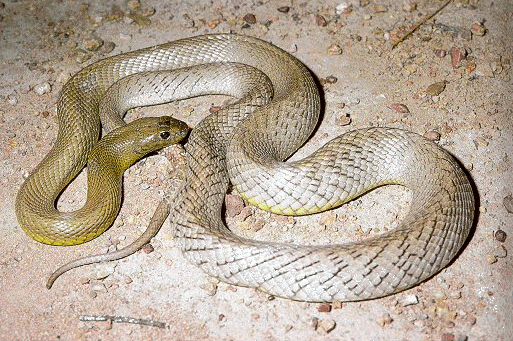
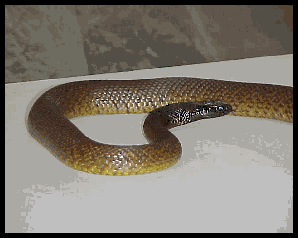
Inland Taipan Oxyuranus microlepidotus |
|
| Inland Taipan is the most toxic land snake in the world, with a lethal dose estimated to be fifty times that of the Indian cobra.Inland Taipan has most toxic venom. Maximum yield recorded (for one bite) is 110mg. That would probably be enough to kill over 100 people or 250,000 mice.Although the Inland Taipan has the most potent venom of any land snake on earth. It is usually quite shy in nature. Taipan venom is overwhelmingly Neurotoxic and thus nervous system is severely affected. Symptoms include vomiting, flaccid paralysis, and eventual respiratory paralysis.The back, sides and tail may be buff-grey to greyish brown, buff-brown, brown or reddish dark brown. The round-Snouted head and neck are usually darker than the body (glossy black in winter, dark brown in summer). The eye is of average size with a blackish brown iris.The Inland Taipan shelters in rat burrows (probably having eaten the original owners), in deep soil cracks and sink holes, and sometimes in rock crevices and deep fissures. It feeds on small to medium-sized mammals. The extremely potent venom acts so quickly that the snake can hold the prey until it succumbs without itself suffering injury. In times of plenty, the Inland Taipan can become quite fat; during prolonged drought, it can starve and become remarkably thin.It is usually most active on the surface in the early half of the morning when it basks. In cooler weather, it is also active in the afternoon; in hot weather it becomes nocturnal. |
 |
 |
|
| There are about 140 species of snakes in Australia. The most poisonous land snake is the inland tiapan found in south-western Queensland and north-eastern South Australia. Tiger snakes, death adders, copperheads, brown snakes, and red-bellied black snakes are all also highly venomous. | |
Eastern Green Mamba Snake |
|||
This is a long slender green snake with long narrow shaped head and long thin tail. It has rounded eyes. There colour is bright green with hint of yellow. It is not an aggressive snake and prefers to hide from danger. They prefer to escape when faced with danger. |
|
||
Eastern Green Mamba Snake |
|||
Eastern Green Mamba Snake |
|||
Diamondback Rattle snake |
|
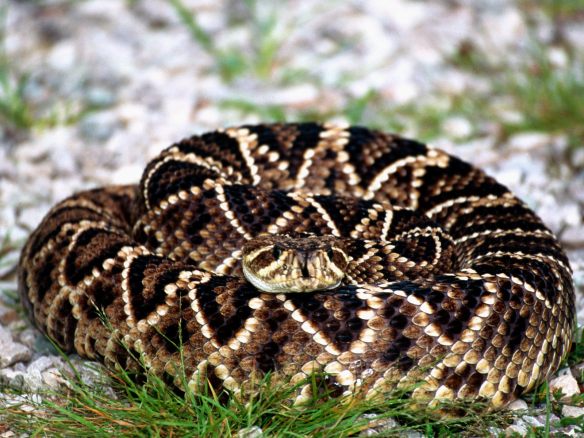
| Size upto 6 feet.It has characteristic loud buzzing rattler sound.Their venom contains at least two poisonous, protein-based substances. One, a neurotoxin, depresses the action of the heart and lungs; the other, a hemotoxin, damages blood vessels and other tissue.Rattlesnakes feed on small mammals and reptiles. Like most pit vipers, they give birth from eggs hatched inside the mother.It has forked tongue. The snake uses this to “taste” the air and find its prey. Pit vipers, like the diamondback, also use heat sensitive areas in “pits” on the front of their heads to locate their victims even in total darkness.Rattle snakes are recognized by a loose, horny rattle at the end of the tail, which is shaken vigorously to warn off intruders. The rattle is formed when the snake’s skin is shed, the end section of the rattle and an attached ring of the old skin are retained on molting. A new ring is added each time the snake molts, which may be as often as four times a year. The last ring on the rattle often becomes worn and breaks off, so that the number of rattles is not, as popularly believed, an accurate indication of age of the snake.Western diamondback rattlesnake are found along the Mexican border from Texas to California |
Eastern Diamondback Rattlesnake |
Western Diamondback Rattlesnake 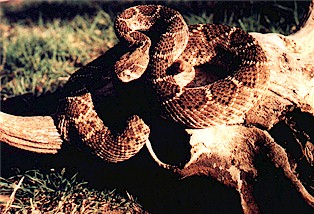 |
|
Western Diamondback Rattlesnake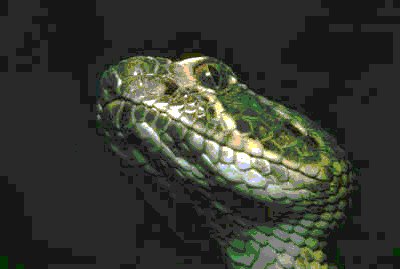 |
|
Eastern Diamondback Rattlesnake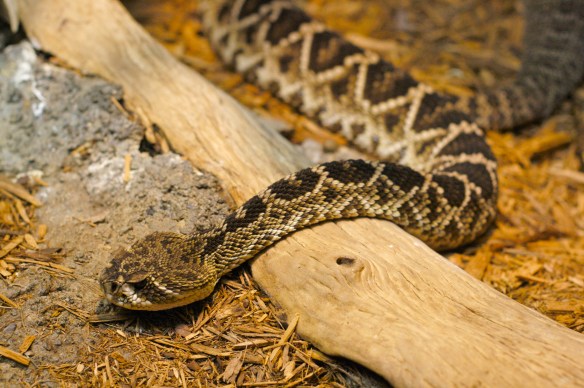 |
|
 Manbir Online ~ for Health & Fitness